

Local reviews are no longer a “nice-to-have” marketing asset. For Delaware businesses, local reviews are a core growth channel that influences visibility, trust, and conversion—often before a customer ever clicks your website.
Whether you run a restaurant in Wilmington, a home services company in Newark, a boutique in Rehoboth Beach, or a professional practice in Dover, local reviews shape how people discover you, evaluate you, and decide to buy from you.
This guide explains why local reviews matter for Delaware businesses and how to get them the right way—without risking your reputation or violating platform rules.
You’ll learn what local reviews do for local SEO, how to build a review generation system, and how to respond to reviews in ways that win customers. You’ll also find practical scripts, timing strategies, and future predictions so your approach stays effective as search and AI continue to evolve.
Why Local Reviews Matter for Delaware Businesses

Local reviews matter because they reduce uncertainty. Customers searching for a nearby business are usually comparing several options. At that moment, local reviews are the most trusted “proof” that your business delivers.
Ratings, recent feedback, and thoughtful responses act like a digital word-of-mouth network—especially powerful in a smaller state where communities are connected and referrals move quickly.
Local reviews also impact local search visibility. When people search “near me” or “best” services in Delaware, platforms like Google Business Profile and other map-based results often highlight businesses with strong local reviews.
Review volume, rating quality, recency, and response activity signal relevance and reliability. That means local reviews can increase your exposure on maps and local packs, even if you’re not spending heavily on ads.
Delaware businesses often serve repeat customers and seasonal traffic. Coastal locations like Lewes and Bethany Beach may see peaks, while inland communities may rely more on repeat relationships. Local reviews matter in both cases.
In peak season, local reviews help you stand out quickly. In steady months, local reviews support consistent lead flow and help you maintain pricing power because customers perceive your business as safer and more established.
Finally, local reviews matter because they shape your brand narrative. Your website says what you want to be. Local reviews show what customers experienced. When you earn consistent local reviews that mention specific services, neighborhoods, and outcomes, you build credibility that is difficult for competitors to copy.
How Local Reviews Influence Local SEO in Delaware
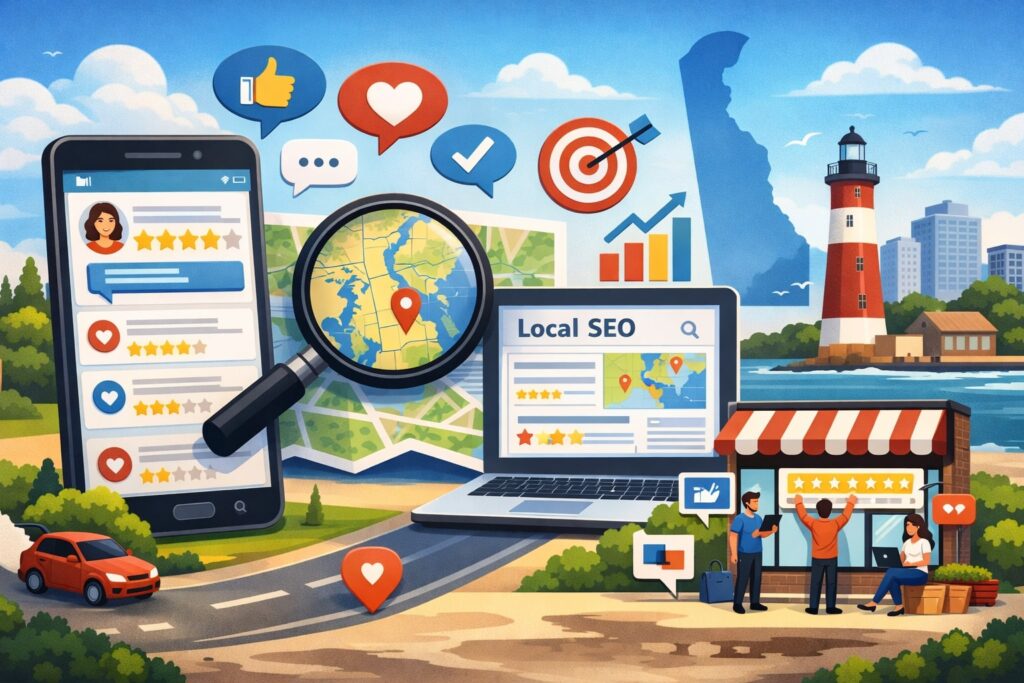
Local reviews influence local SEO through relevance, prominence, and trust signals. Search platforms attempt to rank results that match intent and minimize risk for the user. Local reviews help with both.
When customers mention service keywords like “HVAC repair,” “roofing,” “haircut,” “CPA,” or “orthodontist,” that language strengthens topical relevance. When customers mention cities or landmarks—Wilmington, Dover, Newark, Middletown, Rehoboth Beach, Christiana Mall, Riverfront, or nearby routes—those references can reinforce geographic relevance.
Prominence is another key factor. Prominence is how “known” your business appears. Local reviews contribute to prominence by increasing engagement around your listing. More local reviews typically mean more clicks, calls, and direction requests. These interactions can strengthen your overall local presence.
Delaware is a unique market because many customers cross borders for work and shopping. Your listing may be compared against nearby options across state lines, especially in northern areas.
That means local reviews can become your differentiator. A business with consistent local reviews and strong responses can win clicks even if another listing is physically closer.
Local reviews also affect conversion rate directly. When a customer sees 4.7 stars with recent, specific comments, they’re more likely to call. If your reviews are old, generic, or inconsistent, customers may hesitate. That hesitation is expensive because local traffic is high-intent. People searching locally often want to act now.
To maximize local SEO impact, focus on review recency and content richness. The goal isn’t just to collect local reviews; it’s to earn local reviews that describe what you do, where you do it, and how well you did it—without forcing customers to use unnatural wording.
The Real Business Impact of Local Reviews on Revenue and Leads

Local reviews affect revenue by influencing three critical moments: discovery, decision, and repeat business. At the discovery stage, strong local reviews improve click-through from maps and directories. More clicks means more opportunities to convert. At the decision stage, local reviews reduce friction.
Customers feel more confident paying your rates, booking sooner, and choosing you over “cheaper” competitors. At the repeat stage, local reviews reinforce loyalty because customers see your consistent reputation confirmed by others.
For service-based Delaware businesses, local reviews can also shorten the sales cycle. When customers have already read local reviews describing fast response times, clean workmanship, or friendly staff, your team spends less time convincing them. That can lower customer acquisition cost and help you scale without adding heavy marketing overhead.
Local reviews also help your operations. When you read local reviews carefully, you find patterns. Customers may praise same-day scheduling, but complain about unclear estimates. Those insights are valuable because they come directly from your market.
Delaware customer preferences can vary by region and season. Local reviews are a real-time feedback stream that helps you adjust faster than competitors.
Another revenue impact is pricing confidence. Businesses with strong local reviews can often charge slightly higher rates. Customers don’t only buy the cheapest; they buy the safest option. Local reviews signal safety. If your reviews mention reliability, transparency, and quality, price becomes less of a barrier.
Finally, local reviews strengthen referral loops. A customer who leaves a review is more likely to refer friends later. When you build a system that earns local reviews ethically, you’re also building a referral engine that compounds over time.
Delaware Customer Behavior: What People Look for in Local Reviews

Delaware customers often search with specific intent. They want quick confirmation that your business is legitimate, responsive, and worth the visit or appointment. In local reviews, they typically look for three things: consistency, specificity, and recency. A handful of glowing reviews from years ago won’t compete with steady local reviews posted in the last 30–90 days.
Specificity matters because it feels real. Delaware customers respond well to local reviews that mention details like “scheduled within 24 hours,” “explained the process,” “kept the storefront clean,” “handled my insurance paperwork,” or “recommended the right product.”
For restaurants and retail, they look for recent mentions of service, cleanliness, and value. For home services, they want proof of professionalism—arriving on time, clear estimates, and good communication.
Local context also matters. Customers may look for mentions of neighborhoods, coastal travel, parking, seasonal crowds, and appointment availability. A salon in Rehoboth Beach may benefit from local reviews that mention booking ahead in summer. A contractor in Middletown may benefit from local reviews that mention clean job sites and respect for property.
Delaware is also relationship-driven. Customers notice how you handle problems. A business with a few negative reviews can still win if the responses are calm, respectful, and solution-focused. In fact, the way you respond can be more persuasive than the review itself.
To match Delaware customer behavior, focus on building a steady stream of local reviews, encourage authentic detail, and respond consistently so customers see you as attentive and accountable.
What Makes a High-Quality Local Review
A high-quality local review is believable, recent, and informative. It doesn’t have to be long, but it should communicate real experience. The best local reviews usually include at least one of these elements: the service or product purchased, a specific outcome, a detail about the team, and a mention of timing or location.
For example, a strong local review might say, “Booked a same-week appointment in Newark, the staff explained everything, and the repair was done faster than expected.” Another might say, “Stopped by after work near the Riverfront—great customer service and clean store.” These details help future customers imagine themselves choosing you.
Quality also comes from balance. Not every local review needs to be perfect. A natural mix of 4-star and 5-star local reviews often feels more genuine than a wall of “perfect” ratings. What matters is the overall trend and how you respond.
High-quality local reviews also avoid red flags. Overly promotional language, repeated phrases, and sudden spikes can look suspicious to platforms and customers. The goal is not to “manufacture” local reviews. The goal is to earn them through great service, consistent follow-up, and simple asking.
To increase review quality, your business must deliver review-worthy moments. That might mean better appointment confirmations, cleaner handoffs, clearer estimates, and proactive updates. When service feels smooth, customers are more likely to leave local reviews that describe the experience clearly.
Where Delaware Businesses Should Collect Local Reviews
To maximize impact, Delaware businesses should focus on the platforms customers use to make decisions. For many local searches, Google Business Profile is the primary review destination because it appears directly in map results. If you only choose one platform, prioritize local reviews on Google because the visibility is immediate and the intent is high.
However, depending on your industry, you may need additional platforms. Restaurants and hospitality often benefit from local reviews on Yelp or TripAdvisor, especially in tourist areas. Home services may see value from Angi, Thumbtack, or Nextdoor.
Healthcare and professional services may benefit from industry-specific directories. Retail may benefit from Facebook recommendations because customers share local experiences socially.
The best approach is “primary + secondary.” Choose one primary platform where you want most local reviews, then choose one or two secondary platforms that matter to your audience. Don’t spread your requests across too many destinations because it weakens momentum and confuses customers.
For Delaware businesses with multiple locations, each location should build local reviews on its own listing. Customers searching in Dover should see Dover-focused local reviews, not reviews from Wilmington. Keep your profiles accurate and location-specific so your local reviews strengthen the right listing.
Also remember that your website can showcase local reviews. Embedding review widgets or highlighting testimonial snippets can support conversions. The key is to build a consistent system that earns local reviews where customers already search.
How to Set Up Your Google Business Profile to Earn More Local Reviews
Your Google Business Profile is often the “front door” to your local reputation. A strong profile makes it easier for customers to trust you and leave local reviews. Start by ensuring your business name, address, phone number, and hours are accurate. Even small inconsistencies can reduce trust and hurt conversions.
Next, select the most accurate categories and add your services or products. When your listing matches what people search, you appear more often in relevant searches.
Add photos regularly. Delaware customers want to see what to expect—interior, exterior, staff, completed projects, menu items, or product displays. Fresh photos also encourage engagement, which can support local visibility.
Then make leaving local reviews simple. Use your direct review link. Add it to your invoice emails, text messages, and thank-you pages. Train your team to share the link when customers express satisfaction. The easier it is, the more local reviews you’ll earn.
Messaging and Q&A also matter. If your profile allows messaging, respond quickly. Customers may judge responsiveness before they ever book. In Q&A, add helpful questions and answers that reduce uncertainty, such as parking options, service area, appointment policies, and seasonal scheduling.
Finally, commit to responding to local reviews. A profile with active responses looks alive and trustworthy. It also encourages more local reviews because customers see you pay attention. Over time, this creates a feedback loop: better profile experience → more actions → more local reviews → better visibility.
Ethical Review Generation: What to Do and What to Avoid
Ethical review generation means asking customers for honest feedback without manipulating outcomes. This matters because platforms have strict policies, and customers can spot dishonesty quickly.
The safest approach is to ask all customers consistently, not only the happiest ones. That builds a natural review profile and reduces risk.
You should avoid incentives for reviews. Offering discounts, gift cards, or freebies in exchange for local reviews can violate platform rules and damage trust. You should also avoid asking employees, friends, or family to leave fake local reviews. Even if they mean well, these reviews can look unnatural and lead to removal or suspension.
Avoid “review gating,” where you filter customers and only send review links to those who say they’re happy. This can also violate policies and creates an unrealistic public picture that eventually backfires.
Instead, focus on ethical systems. Ask at the right moment, make it easy, and follow up once. If a customer had a poor experience, offer support privately and invite them to share feedback through your internal channels. You’re not blocking local reviews—you’re improving service and giving the customer a direct path to resolution.
Ethical review generation also protects your team. When the process is transparent, employees feel better asking. Customers feel respected. Your local reviews become a true reflection of your business, which makes them more persuasive and sustainable over time.
The Best Times to Ask for Local Reviews
Timing determines whether your request feels natural or annoying. The best time to ask for local reviews is right after a positive moment—when the customer is satisfied and the experience is still fresh.
For service businesses, that might be immediately after the job is completed and the customer confirms everything looks good. For retail, it might be after a successful purchase or a helpful interaction. For restaurants, it might be shortly after the visit, while the customer still remembers details.
In Delaware, timing can be influenced by seasonality. In beach towns, customers may be moving quickly, so requests should be simple and immediate. In professional services, customers may need time to see results, so asking after the first “win” can be better than asking right after onboarding.
A practical approach is a two-step timing system. Step one: ask verbally when the customer is happy. Step two: send a link by text or email within a few hours. If you wait too long, customers forget. If you ask too early, they may not feel ready.
Also consider the customer’s mindset. If the experience involved stress—like an urgent repair—customers may need a short cooling-off period. Ask once they feel relief and stability, not during peak frustration.
The goal is to make leaving local reviews feel like a natural closing step, not a marketing push. When done well, customers see it as helping neighbors choose a good local business.
Scripts Delaware Businesses Can Use to Request Local Reviews
The best scripts are short, polite, and specific. Customers don’t want pressure. They want a clear request and an easy action. A strong script also reinforces the community aspect—local reviews help other people nearby make good decisions.
Here are effective script styles you can adapt:
- In-person script: “Thanks for coming in today. If you have a minute, would you mind leaving a quick local review? It really helps people in the area find us.”
- Phone script: “I’m glad we could help. If you feel we did a good job, could you leave a local review when you get a chance? I can text you the link.”
- Email script: “Thank you for choosing us. Your feedback helps us improve and helps others nearby. If you can, please leave a local review using this link.”
- Text script: “Thanks again! If you have 30 seconds, here’s the link to leave a local review: [link]. We appreciate it.”
To improve results, add a gentle detail prompt without telling them what to say. For example:
“If you mention what we helped you with, it really helps others.”
That small line can increase the quality of local reviews because customers provide context. Keep the message short. Avoid exclamation overload. Avoid guilt. The goal is friendly and simple.
Also train your staff to recognize “review moments.” When a customer says, “This was easy,” or “You saved me,” that is the time to ask for local reviews. The script should feel like a continuation of a positive conversation.
How to Build a Simple Review Funnel That Works
A review funnel is a repeatable system that turns completed transactions into local reviews. The best review funnel is simple enough to run consistently. Complexity kills execution. Start with three stages: trigger, request, follow-up.
The trigger is the moment the service is completed or the purchase is confirmed. That trigger should automatically send a request via email or text, depending on what your customers prefer. For many Delaware businesses, text works well because it feels immediate and easy.
The request should include a direct review link and one sentence explaining why local reviews matter. Don’t include multiple links to multiple platforms in the same message. Choose your primary destination.
The follow-up should be a single reminder. Keep it polite. Something like: “Just checking in—if you have a moment, we’d appreciate your local review. Here’s the link again.” Then stop. Repeated messages can annoy customers.
To support the funnel, create a “review short link” that’s easy to share in person. Add it to QR codes on receipts, menus, or business cards. Train your team to share it naturally.
Finally, track your funnel. Monitor how many customers you ask, how many local reviews you receive, and what the common themes are. When you see patterns, refine your service and your messaging. Over time, your funnel becomes a reliable engine for local reviews that supports both reputation and local SEO.
Handling Negative Local Reviews Without Damaging Your Reputation
Negative local reviews can feel personal, but they’re also an opportunity. Customers judge your business by how you respond, not just what the reviewer said. A calm, professional response can increase trust even when the review is harsh.
Start by acknowledging the customer’s experience. Avoid arguing in public. If details are unclear, invite them to contact you directly so you can resolve it. This shows accountability without escalating conflict. Keep responses short and respectful.
For Delaware businesses, local perception spreads quickly. A defensive response can create a ripple effect. A respectful response can do the opposite—it can reassure future customers that you handle issues with maturity.
If the review contains a genuine issue, fix it internally. Use negative local reviews as feedback. If multiple reviews mention the same problem—communication delays, unclear pricing, long waits—treat it like a process issue, not a “bad customer” problem.
If a review seems fake or violates platform rules, you can report it through the platform’s process. Still, respond calmly in case it stays visible. Your response is for future customers as much as for the reviewer.
Negative local reviews are also a reason to earn more reviews. When you consistently generate local reviews, a single negative post has less impact on your overall rating and reputation. The best defense is a steady stream of authentic local reviews that reflect your typical service.
How to Respond to Local Reviews in a Way That Boosts Trust
Responding to local reviews is not just good manners—it’s conversion optimization. When customers see that you reply, they assume you’re responsive in real life. That matters in Delaware markets where customers value reliability and community connection.
For positive local reviews, thank the customer and mention a specific detail if possible. This signals authenticity. Keep it short. For example: “Thanks for visiting us in Dover—glad we could help you quickly. We appreciate your local review.”
For neutral or mixed local reviews, acknowledge the positives and address the concern respectfully. If the customer mentions a delay, you can say you’re improving scheduling. This shows progress.
For negative local reviews, avoid legal threats, sarcasm, or blame. Offer a path to resolution. Something like: “We’re sorry to hear this. We’d like to make it right—please contact us at [phone/email] so we can review what happened.” If appropriate, add a brief explanation without exposing private details.
Consistency matters. Respond regularly so your listing looks active. Even a few responses each week can change perception.
Also, your responses can reinforce your brand. If you emphasize transparency and professionalism, reflect that in every reply. Over time, your review section becomes a public record of how you treat customers, which can be a strong advantage over competitors who ignore local reviews.
Using Local Reviews in Marketing Without Looking Pushy
Local reviews are valuable marketing assets when used thoughtfully. The key is to present them as customer stories, not advertisements. Delaware customers are especially sensitive to forced marketing language. They want real proof.
Start by featuring local reviews on your website where they reduce friction—service pages, booking pages, and contact pages. If you can, include review snippets that mention specific services and locations. Keep it clean and readable.
Use local reviews in social posts, but avoid posting only reviews. Mix them into your content schedule. For example, share a review alongside a behind-the-scenes photo, a staff spotlight, or a community event update. That makes your brand feel local and real.
For email marketing, include one local review in a monthly newsletter. Pair it with a practical tip related to your service. This keeps the focus on value, not promotion.
For paid ads, local reviews can improve performance. Even simple messaging like “4.8-star rated by local customers” can increase trust. Just ensure your claims are accurate and current.
Also consider training and hiring. Local reviews can attract good employees because they show a healthy workplace culture and customer respect.
The goal is not to “show off.” The goal is to use local reviews to reduce uncertainty and help customers feel confident choosing you.
Measuring Results: What to Track When You Focus on Local Reviews
To know whether your local reviews strategy is working, track both review metrics and business outcomes. Review metrics include volume (how many local reviews per month), rating (average score), recency (how often new reviews arrive), and response rate (how often you reply).
Business outcomes include calls, direction requests, website clicks from your listing, booked appointments, and walk-ins. These metrics show whether local reviews are improving conversion, not just visibility.
A practical tracking routine is weekly and monthly. Weekly, check new local reviews and respond. Monthly review trends: Are local reviews increasing? Are customers mentioning specific services? Are certain locations performing better?
Also track the “review request rate.” How many customers are you asking? If you ask 100 customers and get 10 local reviews, that’s a 10% conversion rate. If you improve timing, messaging, and ease, you can often increase that rate without changing your service.
Pay attention to keyword patterns in local reviews. If customers naturally mention “quick appointment,” “same-day service,” or “transparent pricing,” those are market advantages. Reinforce them in your website copy and staff training.
Tracking helps you improve. Local reviews aren’t just reputation—they’re actionable data that can strengthen every part of your marketing and operations.
Future Predictions: Where Local Reviews Are Headed Next
Local reviews are becoming more influential because search is becoming more conversational and AI-driven. Instead of scanning ten links, people increasingly ask questions like “Who is the most reliable electrician near me?” or “Which salon has the best customer service?”
In these answers, local reviews are a major data source. Platforms can summarize sentiment, pull recurring themes, and highlight businesses with strong trust signals.
This shift means quality and detail will matter even more. A large number of short “Great service” local reviews may not perform as well as fewer, more descriptive local reviews that mention outcomes, timing, and service types. Businesses that encourage authentic detail—without scripting—may benefit.
Recency is also likely to become more important. As customer expectations shift quickly, platforms want fresh signals. Delaware businesses that earn consistent local reviews year-round will have an advantage over businesses that only collect reviews during busy periods.
Video and photo reviews may rise. Customers may increasingly share quick visuals as proof. Businesses that capture permission-based photos of completed work or storefront experiences can align with this trend.
Finally, review authenticity checks will likely strengthen. That means ethical processes will win long-term. The future of local reviews rewards consistency, transparency, and real customer experience—not shortcuts.
FAQs
Q.1: What is the fastest way to get more local reviews without breaking rules?
Answer: The fastest ethical method is to ask every satisfied customer at the right moment and send a direct link immediately afterward. Consistency matters more than creativity. Train staff to ask naturally when customers express satisfaction, then follow with a single text or email.
This method works because it removes friction and catches customers while the experience is fresh. Avoid incentives and avoid “filtering” customers, because those approaches can backfire and risk removals.
The real speed comes from making review requests part of your normal workflow, not an occasional marketing push. When you build a simple system and run it weekly, local reviews grow steadily and your reputation becomes stronger over time.
Q.2: How many local reviews does a Delaware business need to compete?
Answer: There isn’t one perfect number because competition varies by city, category, and search intent. In many cases, consistent local reviews each month can beat a competitor with a higher total count but no recent activity.
A business with 10 new local reviews in the last 90 days may appear more trustworthy than a business with 200 total reviews but nothing recent. Focus on building a stable review pace that matches your customer volume.
If you’re in a highly competitive category, you’ll likely need more consistent local reviews and stronger response habits. The goal is to look active, reliable, and current—not just “big.”
Q.3: Should I ask customers to mention Delaware or the city in their local reviews?
Answer: You shouldn’t tell customers exactly what to write, but you can gently encourage helpful detail. A good prompt is: “If you mention what we helped you with, it helps others.” Customers will often naturally mention their city or neighborhood when describing the experience.
This creates local context without forcing unnatural language. Forced wording can look fake and reduce trust. The best local reviews sound like real people describing real service. If your business consistently serves certain areas, those locations will show up naturally in local reviews over time.
Q.4: What should I do if I get a fake negative local review?
Answer: First, respond calmly and professionally so future customers see your maturity. Then report the review through the platform’s process if it violates guidelines. Avoid public accusations unless you’re confident and can keep it factual.
Keep your response focused on resolution: “We can’t find a record of this experience, but we’d like to help—please contact us directly.” Also, strengthen your defense by earning more authentic local reviews. A steady flow of real reviews reduces the impact of one suspicious post and improves your overall rating stability.
Q.5: Do local reviews matter if my business relies on referrals?
Answer: Yes, because local reviews are often the new referral check. Even when someone is referred, they still search your business name and read local reviews to confirm they’re making a safe choice.
Strong local reviews protect your referral pipeline by ensuring the first impression matches the recommendation. They also increase conversion from referrals because customers feel more confident booking quickly. Referrals plus local reviews is a powerful combination: word-of-mouth creates interest, and local reviews remove doubt.
Conclusion
Local reviews matter for Delaware businesses because they influence how customers discover you, how they choose you, and how confidently they commit.
Local reviews improve visibility in map results, strengthen local SEO signals, and increase conversion by providing trust at the exact moment customers are deciding. In a smaller, community-driven market, local reviews also shape long-term reputation in ways that compound—good or bad.
The best way to win with local reviews is simple: deliver review-worthy service, ask consistently, make it easy, and respond professionally. Avoid shortcuts like incentives, fake reviews, or aggressive tactics.
Build a repeatable review funnel that your team can run every week. Over time, your local reviews become a competitive moat that improves marketing performance, strengthens customer loyalty, and supports sustainable growth.