

Opening a restaurant is exciting—until the compliance checklist hits. Delaware food safety requirements for new restaurants are detailed, practical, and very enforceable, because they’re designed to prevent foodborne illness before it reaches customers.
If you treat food safety as something you “handle later,” you’ll usually pay for it in rework, delays, failed inspections, or costly menu/equipment changes.
The good news is that Delaware’s approach is also predictable. The state publishes the State of Delaware Food Code (the core rulebook for retail food safety), runs permitting and inspections through the Division of Public Health (DPH), and supports operators through the Office of Food Protection and Milk Safety.
This guide walks you through Delaware food safety requirements in the order most new restaurants experience them: planning, licensing, facility buildout, training, daily operations, inspections, and future-proofing. It’s written for real-world owners, chefs, managers, and builders who need clarity—not legalese.
Delaware food safety requirements and who enforces them
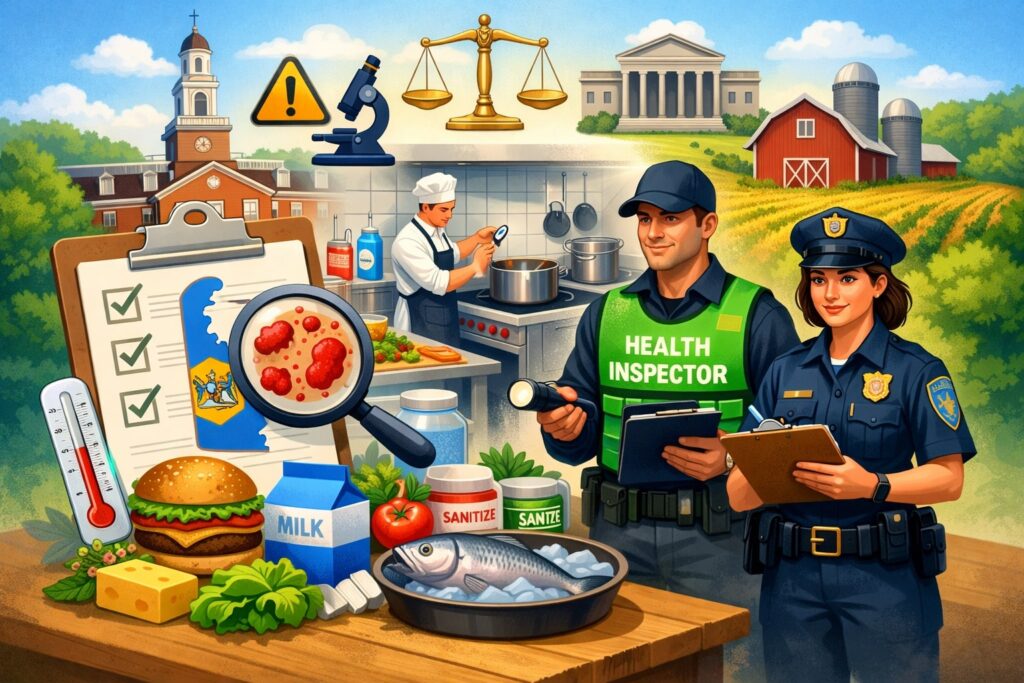
When people say “the health department,” in Delaware your main food safety authority is the Division of Public Health (DPH), specifically the Office of Food Protection and Milk Safety working with Community Environmental Health Services (CEHS) staff.
These teams set standards, review plans, issue permits, inspect restaurants, respond to complaints, and investigate outbreaks.
The backbone of compliance is the State of Delaware Food Code, which establishes the rules for safe sourcing, storage, preparation, cooking, cooling, holding, labeling, employee practices, cleaning, and enforcement. The Food Code isn’t just “best practice”—it’s the basis for inspections and corrective actions.
A key mindset shift for new operators: Delaware food safety requirements for new restaurants are system-based. Inspectors look for proof that you can control risk every day—not just “pass” on opening week.
That means your kitchen layout, your menu process flow, your employee training, your temperature logs, your sanitizer controls, and your management oversight all connect.
If you build the right system early, you’ll usually find that inspections become routine rather than stressful—and your food quality improves along the way.
The legal foundation: the State of Delaware Food Code

The State of Delaware Food Code exists to safeguard public health, reduce foodborne illness risk, and ensure food is safe and honestly presented. It also defines the state’s authority to regulate food production, handling, and service, plus permitting, inspections, and enforcement for food establishments.
For new restaurants, this matters because the Food Code sets “non-negotiables” you must design around:
- Approved sources for food and ingredients
- Time/temperature control for safety foods (often called TCS foods)
- Minimum cooking and reheating temperatures and safe cooling methods
- Cross-contamination prevention (raw vs ready-to-eat, allergens, equipment separation)
- Handwashing and employee health controls
- Cleaning and sanitizing standards, including sanitizer concentration and test methods
- Facility requirements that support sanitation (hand sinks, dish areas, smooth/cleanable surfaces, ventilation, plumbing)
Delaware also has processes for exceptions—but they’re formal. If you want to do specialized processing that increases risk (like certain reduced-oxygen packaging or acidification methods), you may need a variance and typically a documented safety plan. Delaware even provides variance-related guidance templates that reference Food Code sections.
Pre-opening steps: the licensing and inspection roadmap for new restaurants
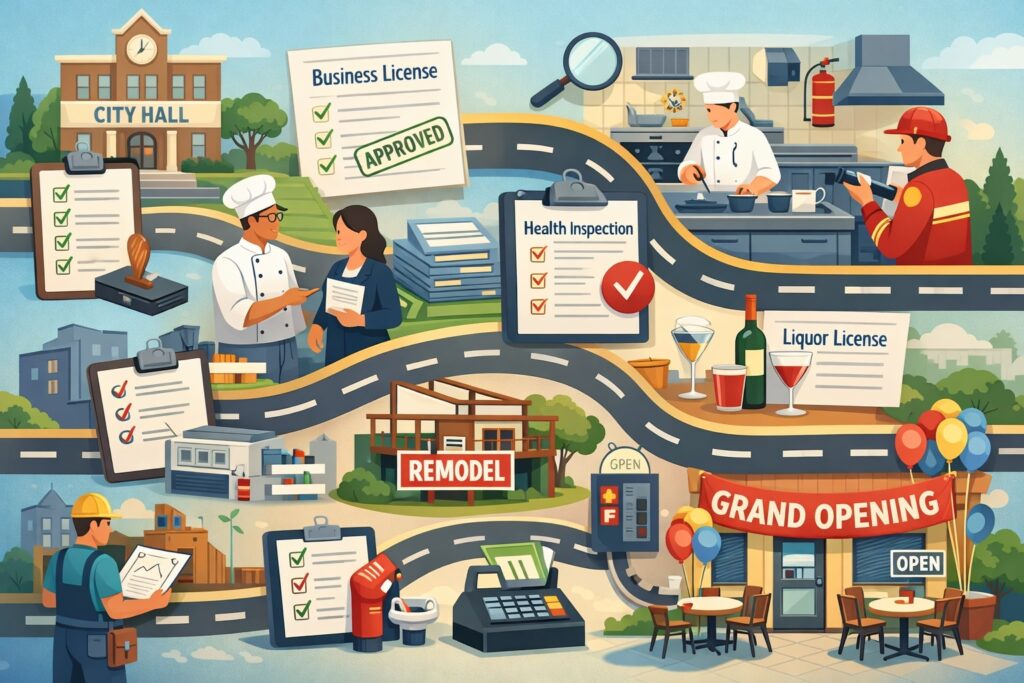
Most delays happen because owners sign a lease, start construction, or finalize equipment—before understanding Delaware food safety requirements for new restaurants. Delaware explicitly encourages operators to contact the Office of Food Protection early to understand the licensing procedure.
A realistic roadmap looks like this:
- Early call and concept alignment: Start with DPH/Office of Food Protection to confirm your concept type (restaurant, takeout, bakery, bar with food, catering, commissary, etc.) and risk profile. Delaware emphasizes calling early—before purchasing or constructing—so you don’t design yourself into a corner.
- Plan review (when required) before construction/remodel: Delaware requires a properly prepared plan submission (with any required fees) before new construction, converting a structure into a food establishment, remodeling/renovating, or changing operation type.
- Permit issuance: Your food establishment permit is tied to your operation and conditions. Delaware plan-review documents also explain that permits are valid for one year and can become invalid due to closure, permit actions, or changes in control/ownership.
- Opening inspection and ongoing inspections: You should expect your operation to be evaluated against your approved plans and the Food Code.
Also note: if you’re taking over an existing restaurant, permits generally aren’t treated like something you “inherit.” Delaware’s own restaurant-opening FAQs state that permits are not transferable and that taking over a restaurant still requires the proper process.
Plan review: what Delaware expects in your drawings, equipment list, and menu flow
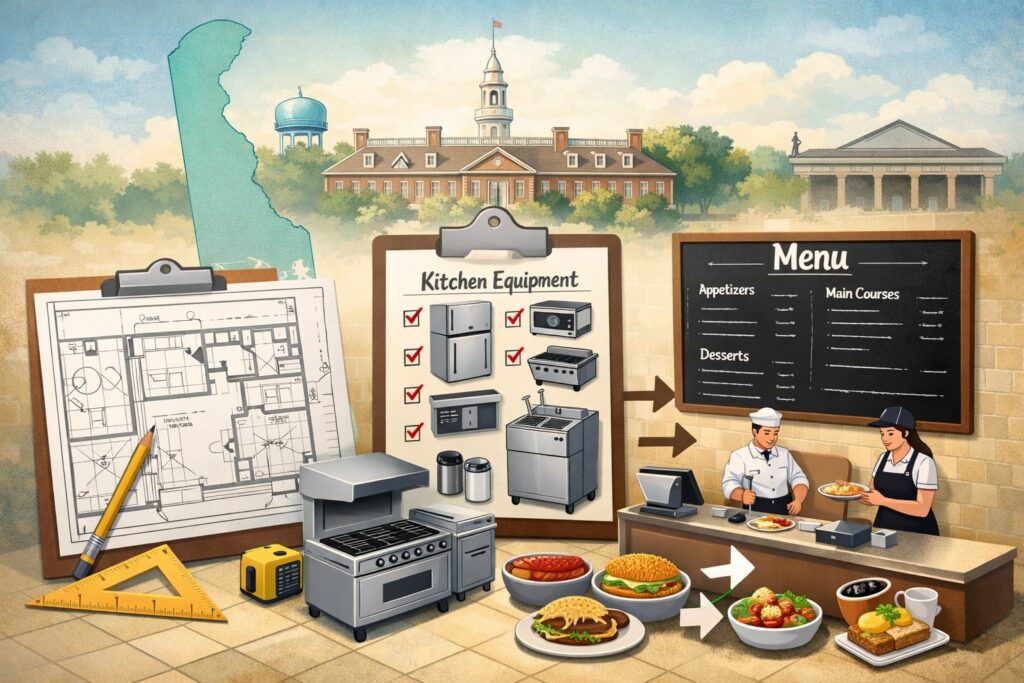
Plan review is where you win (or lose) time and money. Delaware’s plan review requirements make it clear that submission and approval are required in common scenarios, including new builds, conversions, remodeling, and operational changes.
What does that mean in practice for Delaware food safety requirements for new restaurants?
Your plan set must show how the facility supports sanitation and safe workflow. Inspectors and reviewers want to see that your design prevents cross-contamination and allows proper cleaning. Even if your contractor can build anything, you need a build that matches food safety reality.
Plan review typically focuses on:
- Menu and process flow (how food moves from receiving → storage → prep → cook → cool/hold → service)
- Equipment specifications (refrigeration capacity, hot holding, dishwashing, prep sinks, hand sinks)
- Sink count and placement (especially handwashing access where work happens)
- Storage capacity (dry storage, cold storage, chemical storage separation)
- Plumbing and wastewater considerations
- Ventilation and hood design for grease-producing equipment
- Finish materials that are smooth, durable, and cleanable
If you want a shortcut: treat plan review like a “food safety engineering” exercise. The goal isn’t to impress with style—it’s to prove you can maintain clean, safe, controlled conditions every hour you’re open.
Food establishment permits: renewal, changes, and why “ownership” matters
In Delaware, your permit is the legal permission to operate a food establishment—and it comes with conditions. Delaware plan-review materials explain that a permit is valid for one year from issuance, and can become invalid if the establishment permanently closes, if a new owner/management firm/lessee takes possession, or if DPH takes permit action for violations.
That has practical implications for new restaurants:
- Budget and calendar your annual renewal like rent or insurance.
- Treat management changes seriously. If you change who controls the operation, you may trigger a need for a new permit path.
- Don’t assume you can “buy a restaurant” and keep operating under the old permit. Delaware’s restaurant-opening FAQ emphasizes that permits aren’t transferable.
Also, Delaware makes inspection information accessible to the public. The state posts Food Establishment Inspection Reports covering the past two years on its public portal, and provides a contact number for questions about specific reports.
From a business standpoint, this means your compliance record can affect customer trust, partnerships, and reputation. Under Delaware food safety requirements, “we’ll fix it later” is not just a regulatory risk—it can become a marketing problem.
Certified Food Protection Manager and the Person in Charge requirement
One of the most important Delaware food safety requirements for new restaurants is management-level food safety competency.
Delaware publishes a specific FAQ explaining that the Food Code requires that at least one employee—the Person in Charge at the time of inspection—must be a Certified Food Protection Manager (CFPM) who passed an accredited exam program. The FAQ further states this applies broadly to food establishments unless a variance is approved.
This requirement changes how you should staff:
- You need coverage when inspectors arrive, not just “someone certified on payroll.”
- You need a schedule where a qualified Person in Charge (PIC) can demonstrate knowledge and active managerial control.
- You should build your daily procedures so the PIC can show consistent control: temperature logs, sanitizer checks, cooling practices, allergen controls, and employee health policies.
If your certified manager quits or is consistently absent, you’re exposed. A smart approach is to certify more than one leader—GM and kitchen lead, for example—so your compliance doesn’t hinge on one person’s availability.
Under Delaware food safety requirements, the CFPM/PIC role is not ceremonial. It’s meant to ensure a competent adult is actively preventing hazards in real time.
Employee health, handwashing, and hygiene systems that inspectors actually look for
Most critical foodborne illness events are linked to human behavior: sick employees, poor handwashing, bare-hand contact with ready-to-eat foods, and cross-contamination during rush periods. Delaware food safety requirements push restaurants toward systems that reduce reliance on “good intentions.”
A strong Delaware-ready hygiene program includes:
- Employee illness reporting and exclusion rules (clear “do not work” symptoms and diagnoses)
- Handwashing accessibility (hand sinks located where work happens, kept clear, stocked, and used)
- Glove and utensil policies for ready-to-eat foods
- No-eating/no-drinking rules in prep areas (except controlled employee beverage rules)
- Training new hires before their first shift touches food
Even though your restaurant’s vibe may be casual, your health controls must be disciplined. The simplest way to stay aligned with Delaware food safety requirements is to implement a written policy and train on it during onboarding—then retrain after any violation, staff turnover spike, or menu/process change.
This is also where culture matters. If managers ignore handwashing during rush periods, staff will too. Inspectors can usually tell within minutes whether hygiene rules are real—or just posters on the wall.
Time and temperature control: the core of Delaware food safety requirements
If you only master one technical area, master this one. Time/temperature control for safety (TCS) is the center of retail food safety because dangerous bacteria grow rapidly when food sits in the “danger zone.”
Delaware’s Food Code framework aligns with widely adopted Food Code temperature concepts such as:
- Cold holding around 41°F for TCS foods
- Hot holding around 135°F for TCS foods
- Reheating to 165°F for 15 seconds for foods cooked, cooled, and reheated for hot holding
These values appear in FDA Food Code materials that many states use as the model standard for retail food safety.
Cooling is a major inspection focus because it’s frequently done wrong. FDA guidance emphasizes that improper cooling of TCS foods is a top contributor to illness and highlights following Food Code cooling guidance to prevent it.
To operationalize this under Delaware food safety requirements for new restaurants:
- Buy probe thermometers and calibrate them.
- Train cooks on cook temps, but also train on cooling method (shallow pans, uncovered cooling, ice baths, blast chillers if needed).
- Use time as a control only when allowed and documented.
- Log temps during critical steps (receiving, cooling, reheating, hot holding).
And if you want to use a specialized preservation method (like acidifying rice), Delaware references variance processes tied to Food Code sections and HACCP-style controls.
Cross-contamination prevention: storage, prep separation, and workflow
Cross-contamination is one of the easiest ways to fail an inspection because it can be visible and immediate: raw chicken dripping over ready-to-eat foods, dirty utensils used on cooked items, or allergen residue on shared surfaces.
To align with Delaware food safety requirements, build cross-contamination control into your physical layout and daily habits:
- Storage order in coolers: ready-to-eat foods above raw animal products
- Dedicated prep zones: raw protein prep separate from salad/sandwich plating
- Color-coded cutting boards and tools to reinforce separation
- Dishwashing verification: correct sanitizer or final rinse parameters and air-dry procedures
- Utensil storage: clean and protected from splash, dust, and handling
Plan review matters here: if your layout forces raw and ready-to-eat work onto the same small table, your team will eventually cut corners. Delaware food safety requirements for new restaurants are easier to sustain when workflow is realistic.
A strong “rush proof” design includes extra landing space near the grill line, a dedicated salad/ready-to-eat counter, and enough refrigeration so food isn’t stacked in risky ways.
Allergen management and consumer protection expectations
Allergens are both a safety issue and a business survival issue. While food codes primarily emphasize contamination and illness prevention, modern expectations—and litigation trends—mean restaurants must treat allergen control as core risk management.
Under Delaware food safety requirements for new restaurants, your allergen program should include:
- Ingredient awareness: know what’s in sauces, spice blends, marinades, fry batters, and desserts
- Menu disclosure practices: clear identifiers and staff guidance for common allergens
- Cross-contact controls: dedicated utensils, cleaned surfaces, separate fryer policies when needed
- Staff scripting: servers must know how to handle allergy questions (no guessing)
- Manager escalation: when in doubt, involve the PIC/CFPM
Even if your concept is “simple,” suppliers change formulations. That’s why a smart practice is to store allergen information with receiving records and re-check it when switching brands.
Good allergen control also improves operational consistency: fewer remakes, fewer disputes, and better customer trust—especially for families and repeat guests.
Cleaning and sanitizing: building a Delaware-ready sanitation program
Cleaning removes soil; sanitizing reduces microorganisms to safe levels. Inspectors often find problems where restaurants do one but not the other—or they sanitize with the wrong concentration and don’t verify it.
A Delaware-ready program includes:
- Written cleaning schedules (daily, weekly, monthly) tied to stations
- Correct chemical storage away from food and single-service items
- Sanitizer test strips used daily (and recorded)
- Three-compartment sink procedures (wash/rinse/sanitize and air-dry)
- Dish machine verification (if applicable): temperature or chemical parameters
Sanitation is also linked to pest control. Grease buildup, food debris under equipment, and unsealed penetrations make pests inevitable. The fix is boring but effective: deep cleaning, sealing, and disciplined waste handling.
Delaware food safety requirements for new restaurants reward consistency. A clean kitchen on Monday that collapses by Saturday will eventually show up on an inspection report.
Inspections, enforcement, and public inspection reports in Delaware
Inspections are the accountability mechanism behind Delaware food safety requirements. Delaware notes that DPH issues permits to thousands of retail food establishments and conducts inspection services across the state.
A major operational reality: inspection visibility is public. Delaware provides an online portal with food establishment inspection reports from the past two years and encourages contacting the Office of Food Protection for questions.
To prepare for inspections:
- Keep your PIC/CFPM coverage reliable (inspectors often assess the Person in Charge).
- Maintain logs and proof: cooling logs, sanitizer checks, pest service records, temperature calibration notes
- Train staff on “inspection behavior”: answer honestly, show procedures, demonstrate handwashing and temp checks on request
- Treat minor issues as signals: a weak sanitizer bucket today can become a major violation pattern later
A useful strategy is running internal “mini-inspections” weekly using your own checklist. When you do this consistently, your staff becomes calm and competent during real inspections—because nothing feels unfamiliar.
Mobile units, temporary events, catering, and other special restaurant models
Not every “new restaurant” is a traditional dining room. Delaware has separate guidance pathways for alternative models.
If you’re operating a mobile food unit, Delaware provides plan review and approval documentation that mirrors the core plan review concept: submit properly prepared plans/specs for approval before construction, conversion, remodeling, or changing operation type.
If you’re considering selling certain foods from a home kitchen while you build your restaurant brand, Delaware also operates a Cottage Food Establishment Program, designed to set basic food safety requirements for limited foods made in residential kitchens.
For catering, commissaries, satellite kitchens, and shared prep operations, the key compliance question is: what facility is permitted, and where is food prepared and stored?
Delaware’s plan review materials define “food establishment” broadly and describe how operations can include mobile, stationary, temporary, or permanent facilities, and even central preparation facilities supplying other locations (depending on the permitting structure).
If your business model is non-traditional, your safest move is to align early with the Office of Food Protection so your permitting structure matches your real workflow.
Recordkeeping, traceability, and recall readiness
Many restaurant owners underestimate recordkeeping because they associate it with manufacturers. But traceability expectations are rising across the food system, and restaurants benefit from being organized—especially during supplier recalls.
At the federal level, FDA’s Food Traceability Rule (FSMA Section 204) sets enhanced traceability recordkeeping for certain foods.
FDA states the original compliance date was January 20, 2026, and the agency has proposed extending it (a proposal published in the Federal Register) to July 20, 2028 if finalized.
Even if your restaurant isn’t directly covered in the same way as large supply-chain entities, the downstream effects are real:
- Distributors may require better receiving documentation.
- Suppliers may provide more lot-level data.
- During an outbreak investigation, “what lot did you use?” becomes a real question.
FDA’s New Era of Smarter Food Safety Blueprint also signals the direction of travel: tech-enabled traceability, smarter prevention tools, retail modernization, and stronger food safety culture.
To future-proof under Delaware food safety requirements for new restaurants:
- Keep receiving records (supplier, date, product identifiers)
- Maintain menu ingredient mapping for high-risk items
- Create a basic recall SOP: who checks alerts, how you isolate product, how you document disposal
- Store critical documents digitally so you can respond fast
Future prediction: where Delaware restaurant food safety is headed next
Food safety isn’t standing still. Delaware food safety requirements are grounded in today’s Food Code enforcement, but the broader system is moving toward more data, faster response, and more transparency.
Here are the most realistic trends new restaurants should plan for:
- More digital traceability expectations: With FDA pushing tech-enabled traceability and FSMA 204 timelines evolving, supply chains will increasingly transmit structured data that restaurants may be asked to retain or use.
- Digital temperature monitoring and verification: Retail food protection organizations and regulators increasingly discuss digital temperature monitoring equipment (DTME) as an efficiency and accuracy upgrade for cold holding and hot holding control. Expect “show me your temperature control system” to become more common.
- More public visibility and consumer awareness: Delaware already publishes inspection reports. Over time, more consumers use inspection portals as part of choosing where to eat, increasing reputational pressure.
- Smarter inspection targeting: Food safety systems are moving toward smarter outbreak response and data-driven prevention. The direction is clear even when local practices vary: higher-risk operations and repeat patterns get more attention.
The best “future-proofing” move is not a fancy app—it’s operational discipline: strong PIC coverage, consistent temperature control, verified sanitizing, clean prep flow, and documented routines.
FAQs
Q.1: Do I have to complete a plan review before I build or remodel?
Answer: In many common scenarios, yes. Delaware states that a permit applicant or holder must submit properly prepared plans/specs for review and approval (with required fees) before construction, converting a structure into a food establishment, remodeling/renovation, or changing the type of operation.
If you build first and submit later, you risk redesign costs, delays, and equipment that doesn’t meet requirements.
Q.2: Are restaurant permits transferable if I buy an existing location?
Answer: No—Delaware’s restaurant-opening FAQ states that permits for food establishments are not transferable, and taking over a restaurant still requires the proper process.
This is a common surprise for buyers, so factor it into acquisition timelines.
Q.3: Do I need a Certified Food Protection Manager (CFPM)?
Delaware’s CFPM FAQ explains that the Food Code requires at least one employee—the Person in Charge at the time of inspection—to be a CFPM through an accredited program, unless a variance is approved.
For smooth operations, certify more than one leader so you’re never uncovered.
Q.4: Where can customers see my inspection history?
Answer: Delaware publishes food establishment inspection reports for the past two years on a public portal and provides a contact number for questions.
This is another reason to treat compliance as brand protection, not just regulation.
Q.5: What if I want to do “special processing” like acidifying rice or other preservation methods?
Delaware references variance processes tied to Food Code requirements, and provides variance request procedure information. These processes typically require demonstrating safe controls (often HACCP-style documentation) before approval.
If your menu depends on specialized processing, raise it during plan review—not after opening.
Conclusion
Delaware food safety requirements for new restaurants are not meant to block your dream—they’re meant to ensure your dream doesn’t become someone’s illness.
When you understand how Delaware enforces the Food Code—through plan review, permits, CFPM/PIC expectations, inspections, and public reporting—you can build a restaurant that’s both compliant and operationally efficient.
The highest-performing new restaurants treat compliance as a system:
- Design a kitchen that supports clean flow and easy sanitation
- Staff and schedule reliable Person in Charge coverage
- Control time and temperature with training and verification
- Prevent cross-contamination and manage allergens deliberately
- Document the basics so inspections are calm and predictable
- Stay aware of modernization trends like traceability and digital monitoring
If you do this, you don’t just “meet Delaware food safety requirements.” You build a restaurant customers trust, staff are proud of, and inspectors can verify—again and again.