If you run (or plan to open) a retail business in Delaware, you’ll quickly notice the conversation around Delaware sales tax laws sounds different than in many other states. That’s because the “headline” rule is simple: there is no general statewide or local sales tax collected at the register on most retail transactions.
Instead, Delaware relies heavily on a gross receipts tax (paid by the business, not separately listed on a customer’s receipt) plus a handful of industry-specific taxes and license requirements that can still impact pricing, compliance, and profit margins.
This guide explains what “Delaware sales tax” really means in day-to-day retail operations: what you do (and don’t) charge customers, what you owe the state, how you register properly, how audits typically happen, and how to plan for future changes.
You’ll also find practical examples, common mistakes, and an FAQ section designed for store owners, ecommerce operators with Delaware activity, and multi-location retailers.
What “Delaware Sales Tax” Really Means (And Why It Confuses Retailers)
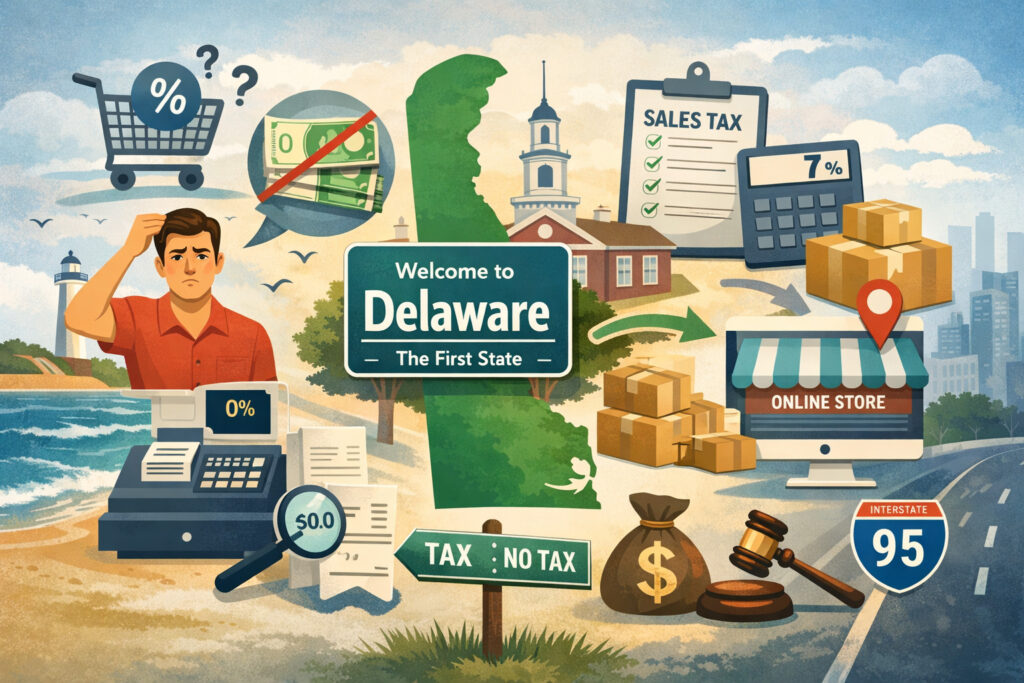
People often search for Delaware sales tax laws expecting a rate chart like “6% state + local.” In Delaware, the story is different.
The practical reality is that the checkout total generally does not include a separate statewide or local sales tax line on most consumer purchases, because Delaware does not impose a general sales tax in the same way many states do.
However, “no Delaware sales tax” does not mean “no transaction-related tax obligations.” Delaware funds public services through other methods, especially the gross receipts tax (GRT)—a tax imposed on businesses based on revenue from goods sold and services rendered in Delaware.
This is an important shift in mindset: instead of collecting a tax from customers and remitting it, many retailers must calculate and pay GRT out of their own receipts.
That difference affects pricing strategy and margins. In sales-tax states, your advertised price can stay “clean,” and the sales tax is added at the end. Under Delaware sales tax laws, many retailers build the cost of GRT into pricing, because customers usually expect the shelf price to match what they pay.
This also affects discounting: a “10% off” promotion reduces gross receipts, which can reduce GRT exposure, but it also shrinks your margin—so you want to understand how your tax base moves with your promotions.
Core Rule: Delaware Has No General Sales Tax (What Retailers Must Do at the Register)
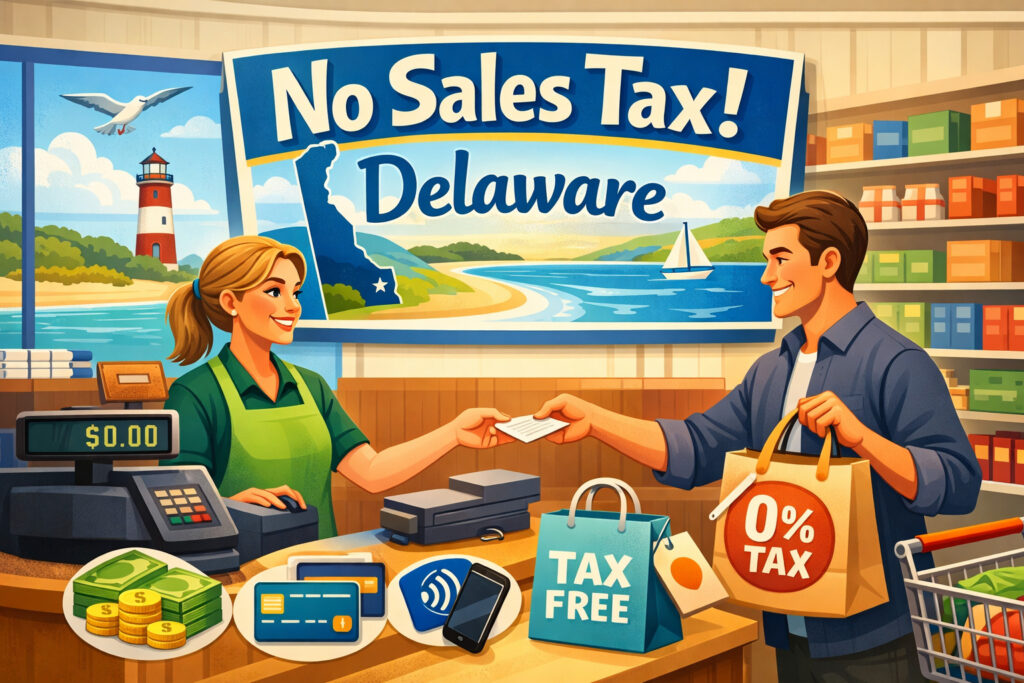
For most retail businesses, the day-to-day application of Delaware sales tax laws at the point of sale is refreshingly straightforward: you typically do not add a statewide or local sales tax percentage to taxable goods at checkout. This means your POS system usually won’t need a standard “sales tax rate” for Delaware transactions the way it would in nearby states.
That said, retailers still need to configure systems correctly. The most common operational mistake is importing multi-state settings that accidentally apply another state’s tax rate to Delaware store sales.
This can create customer complaints, refund headaches, and accounting cleanup. Another mistake is assuming that “no Delaware sales tax” means you can ignore tax setup entirely. Even when you don’t collect sales tax, your POS and bookkeeping should still track:
- Gross receipts by product line
- Returns and allowances
- Delivery vs. pickup
- Taxable vs. excluded receipts for GRT purposes (where applicable)
Why? Because Delaware’s main retail-facing tax obligation is often not sales tax—it’s gross receipts tax reporting and payment. The more clearly you track receipts, the easier compliance becomes.
Also, certain industries can involve taxes that feel “sales-tax-like” to consumers (because they affect the total paid), such as lodging occupancy taxes in hospitality contexts.
If you sell products connected to taxed categories (like tobacco products through properly licensed channels), you need to understand how those taxes flow through the supply chain and pricing, even if they aren’t labeled “Delaware sales tax.”
The Real Compliance Centerpiece: Delaware Gross Receipts Tax for Retailers
If you’re serious about understanding Delaware sales tax laws, you must understand gross receipts tax (GRT). Delaware’s GRT is imposed on the seller (the business), generally based on gross receipts from goods sold and services rendered in Delaware. It’s not a profit tax and does not allow standard expense deductions like rent, payroll, or cost of goods sold.
How retail GRT typically works
For “general retailers” selling tangible personal property, Delaware publishes guidance indicating a retail gross receipts tax rate and an exemption threshold for receipts before tax applies.
In the general retailer guidance, Delaware describes a rate of 0.7543% on taxable gross receipts and notes that the first $100,000 of gross receipts per month (or $300,000 quarterly) can be exempt (depending on filing status and how the state sets your filing frequency).
That exemption is meaningful for smaller retailers, pop-up stores, and seasonal businesses. But once your receipts rise, the tax becomes a recurring cost that needs to be priced in.
Why GRT changes the pricing conversation
In states with sales tax, you might charge $100 + tax. Under Delaware sales tax laws, customers often see a flat $100. If you owe GRT on that $100, your margin effectively shrinks unless your pricing accounts for it. Many retailers handle this by:
- Building GRT into markup
- Reviewing margins by category
- Using promotions strategically
- Tracking receipts at a granular level to support exclusions (where allowed)
Industry classification matters
Delaware’s published rate schedules vary widely by industry, and the “right” category matters for compliance and audit risk. Delaware provides detailed lists of business licenses and tax rates by activity classification.
A practical approach is to treat your Delaware classification like a compliance “root setting.” If you classify incorrectly, you can underpay (penalties) or overpay (lost cash). Either way, it’s worth getting right early.
Business Licensing in Delaware: The Often-Missed Requirement Tied to Tax Duties
Another critical piece of Delaware sales tax laws for retailers is that Delaware generally requires businesses operating in the state to obtain a Delaware business license and maintain proper registration through the state’s systems.
Delaware’s Division of Revenue describes licensing and registration pathways and points businesses to its One Stop registration environment for licensing and ongoing compliance.
Licensing isn’t just a “paperwork step.” It connects directly to your tax account setup, including gross receipts tax filing expectations.
Many new retailers (especially small store owners moving from online selling to a physical presence) assume that forming an LLC is the key compliance milestone. In reality, licensing and tax registration are often what triggers the state’s ability to:
- Assign filing frequency
- Expect returns (even in low-activity periods)
- Match reported receipts to other data sources
- Contact you for missing filings
Delaware also publishes “doing business” guidance explaining that sales of tangible property involve licensing and gross receipts tax obligations, and that these taxes are imposed on the seller and remitted on a schedule depending on activity.
A practical compliance habit: treat licensing as an annual calendar item (renewal timing matters), keep copies of confirmations, and make sure your legal business name, trade name (DBA), and location details are consistent across your bank, POS, invoicing, and state registration. Inconsistent records are a common cause of misapplied payments and confusing notices.
If you operate multiple locations, multi-location licensing rules and fee structures can apply depending on business type. Delaware’s published tax tips and license guidance for various activities frequently reference location-based licensing requirements.
Filing & Payment Rules: Due Dates, Monthly vs Quarterly Filers, and Online Filing Requirements
Even with “no Delaware sales tax” at checkout, retailers can still face penalties if they miss state filing obligations tied to gross receipts tax.
Delaware’s Division of Revenue explains that gross receipts tax returns and payments are due either monthly or quarterly, depending on your gross receipts, and that the state uses a look-back period to determine whether you are a monthly or quarterly filer.
Key due date patterns (common structure)
- Monthly filers: due on or before the 20th day of the following month for the prior month’s receipts.
- Quarterly filers: due on or before the last day of the first month following the close of the quarter.
This matters for cash flow planning. If you have a big holiday season, your gross receipts tax payment timing may hit right as you’re restocking inventory or paying seasonal payroll.
Online filing expectations and penalties
Delaware also discusses penalties and interest for late filings and late payments. The state’s FAQ indicates that late-filed returns can face a 5% per month penalty plus interest of 0.5% per month, and there can be additional penalties for failure to pay the tax due.
Delaware further notes that online filing requirements apply for gross receipts taxes (the FAQ references mandatory online filing beginning in 2021).
Practical compliance habits for retailers
To make Delaware sales tax laws (and GRT compliance) painless:
- Close your books on a consistent schedule (weekly is ideal)
- Reconcile POS totals to deposits (card + cash)
- Track returns separately (with documentation)
- Set reminders for filing dates and renewal dates
- Keep classification and location records up to date
Retailers who do this rarely struggle with Delaware’s system. Most compliance pain comes from messy records, missed returns, or incorrect business classification.
Exclusions, Thresholds, and Documentation: How Retailers Reduce Delaware Tax Friction
Retailers often hear “Delaware is tax-free,” then get surprised by how documentation-driven compliance can be. Under Delaware sales tax laws, your main exposure is often gross receipts tax—so any exclusions, thresholds, and proper recordkeeping can meaningfully reduce risk and cost.
A prominent example is Delaware’s general retailer guidance noting that the first $100,000 per month (or $300,000 quarterly) of receipts may be exempt for general retailers, and that the tax applies above that threshold.
Documentation becomes crucial when the taxability of a receipt depends on facts like delivery location, business activity classification, or the nature of the transaction.
Delaware’s gross receipts FAQ also discusses exemption documentation concepts—such as using specific forms for certain exempt situations and maintaining records to support exemptions.
What retailers should document consistently
To stay aligned with Delaware sales tax laws as a retailer, build these habits:
- Keep clean daily POS close reports
- Store invoices and receipts by month
- Save return/refund records with references to original sale
- Track shipping vs pickup (especially if your operations cross state lines)
- Maintain your Delaware license confirmations and renewals
- Keep evidence for any claimed exclusions (don’t rely on memory)
Why this matters in real life
In an audit or a notice review, “we think this is excluded” doesn’t carry weight without records. But “here are the invoices, delivery confirmations, and reconciliation reports” typically does. Strong documentation also prevents accidental overpayment—because you can more confidently categorize receipts and apply thresholds correctly.
If your retail model includes services (repairs, customization, installation), or bundles goods + service, your classification and reporting approach should be consistent and defensible, since Delaware’s rate structures vary by activity category.
Special Transaction Taxes Retailers Should Know (Lodging, Tobacco, and Other Categories)
While Delaware has no general statewide sales tax, some transactions are subject to specific excise or occupancy taxes that retailers may encounter depending on what they sell or whether they operate “retail-adjacent” services.
Lodging / accommodations (if your business touches hospitality)
Delaware imposes an 8% tax on rents received from occupancy of rooms in hotels, motels, and tourist homes, imposed on the occupant and collected/remitted by the operator. Delaware’s published guidance references Title 30 provisions for this lodging tax and explains the operator’s monthly remittance obligation.
If your retail business includes short-term rentals (for example, a boutique with rooms, or a retailer that also operates a small tourist home concept), this is an area where Delaware sales tax laws can feel “sales-tax-like” because it changes what the customer pays.
Tobacco-related products (if you sell regulated products)
Delaware administers cigarette and tobacco taxes through the Division of Revenue, and tobacco sellers typically need correct licensing and compliance with product-tax rules. Delaware’s FAQ materials address tobacco tax administration topics and retailer-facing questions.
Why this matters even for “normal” retailers
Even if you don’t run a hotel or sell tobacco, understanding these carve-outs helps you avoid misinformation. Customers from nearby states often assume Delaware has “no taxes at all,” and staff sometimes repeat that casually.
It’s safer to communicate accurately: Delaware has no general sales tax, but it does have business taxes and certain industry-specific taxes that can affect pricing and compliance.
Ecommerce and Multi-State Selling: What Delaware Sales Tax Laws Mean for Online Retailers
Online retail often creates confusion because “sales tax compliance” usually means collecting tax based on the customer’s delivery state.
Under Delaware sales tax laws, the Delaware side of the equation is still generally simple: Delaware does not impose a general sales tax on most purchases, but businesses operating in Delaware may owe gross receipts tax and must meet licensing requirements.
If you have Delaware operations
If your ecommerce business has Delaware operations—like an office, employees, inventory, or a store—your Delaware obligations may include:
- Maintaining a Delaware business license
- Filing gross receipts tax returns on the schedule assigned
- Tracking receipts attributable to Delaware activity correctly
Delaware’s “doing business” guidance emphasizes that sales of tangible property and business activities are connected to licensing and gross receipts tax remittance requirements.
If you sell into other states from Delaware
Here’s where many ecommerce retailers get tripped up: Delaware sales tax laws do not remove your responsibilities elsewhere. If you ship to customers in states with sales tax, you may still need to collect and remit that destination state’s sales tax if you meet its nexus rules. Delaware being “no sales tax” does not protect you from other states’ rules.
Marketplace platforms
If you sell on large marketplaces, many states apply “marketplace facilitator” collection rules. Delaware’s system is unusual because it lacks a general sales tax, so “marketplace collection” works differently than in sales-tax states. In practice, you still focus on:
- Delaware licensing and gross receipts tax if you operate in Delaware
- The tax rules of customer states if you have nexus there
- Clear reporting from your marketplace statements for reconciliation
For online retailers, the best practice is to treat Delaware as “simple at checkout, serious behind the scenes”: you might not collect Delaware sales tax, but you still need strong books and consistent state reporting.
Audits, Notices, and Common Mistakes Under Delaware Sales Tax Laws
Retail audits in Delaware tend to focus less on “did you collect sales tax correctly?” and more on “did you file correctly and classify receipts properly?” Because gross receipts tax is based on receipts, errors in reporting can arise from routine retail realities: returns, discounts, cash handling, gift cards, and multi-channel sales.
Common mistakes Delaware retailers make
- Assuming no filings are needed because there’s no Delaware sales tax: Many retailers still have gross receipts tax returns due monthly or quarterly.
- Missing filing deadlines: Delaware describes penalty and interest structures for late filing/payment.
- Incorrect business activity classification: Rates vary by classification; Delaware publishes rate schedules and activity lists.
- Poor reconciliation between POS, bank deposits, and books: This can lead to underreported receipts or inconsistent records that are hard to defend.
- Not renewing or maintaining licensing details: Licensing ties directly to registration and compliance expectations.
How to make audits less stressful
A retailer with clean documentation usually has a straightforward outcome. The “audit-proof” approach is boring but powerful:
- Keep monthly folders (digital or physical)
- Save POS close reports and merchant processing statements
- Document unusual transactions (bulk sales, special orders, big refunds)
- Keep copies of filed returns and confirmation numbers
Under Delaware sales tax laws, clean records are your best defense—and your fastest path to resolving notices.
Retail Pricing Strategy in a “No Sales Tax” State: Competitive Advantage Without Compliance Surprises
Delaware’s “no general sales tax” reputation creates a real marketing advantage for retailers. Shoppers often cross borders expecting a better deal, and Delaware retailers can price goods with the confidence that the checkout total will match the shelf price in most cases.
This simplicity can increase conversion rates, reduce cart abandonment (for ecommerce with Delaware pickup), and make promotions feel more transparent.
But the pricing advantage only stays profitable if you account for the tax costs that do exist. Under Delaware sales tax laws, the gross receipts tax is a cost of doing business that effectively behaves like a small percentage “off the top” once you exceed thresholds.
Delaware’s general retailer guidance highlights the retail gross receipts tax rate and exemption threshold structure, which is exactly the type of rule you need to model in your margins.
Practical pricing moves Delaware retailers use
- Margin-first pricing: calculate target gross margin, then back into price after estimating GRT exposure.
- Category-based pricing: higher margin categories absorb GRT more comfortably than low-margin staples.
- Promotion controls: ensure “storewide discounts” don’t push you below profitability when combined with GRT.
- Bundling strategy: bundle goods with services carefully so classification and reporting stay consistent.
Customer messaging (simple but accurate)
Train staff to say something like:
“Delaware doesn’t charge a general sales tax at checkout, so the price you see is usually the price you pay.” That keeps the benefit clear without accidentally suggesting Delaware has “no taxes at all.”
When done well, Delaware sales tax laws give retailers a shopper-friendly checkout experience while still requiring disciplined back-office compliance.
2026 Outlook and Future Predictions: Where Delaware Transaction Tax Policy Could Head
Predicting tax policy is never guaranteed, but retailers can still watch the signals that typically influence change: budget pressures, cross-border shopping dynamics, and how other states treat consumption taxes.
Delaware has maintained its “no general sales tax” position for a long time, and the state’s current structure continues to emphasize licensing and gross receipts tax as key revenue mechanisms for business activity.
Likely “steady-state” trajectory
For most retailers, the most realistic expectation is continued reliance on gross receipts tax + targeted excise taxes, rather than a sudden shift to a broad consumer sales tax.
Delaware publishes extensive rate schedules by business activity, suggesting the system is designed to fine-tune revenue through classification rather than a single sales-tax rate.
Areas retailers should monitor
- Rate updates or classification changes: Even small GRT rate adjustments can affect margins.
- Filing modernization: Online filing expectations can expand, and enforcement often improves when systems modernize.
- Industry carve-outs: Specific taxes (like lodging occupancy) can be modified more easily than implementing a broad sales tax.
- Cross-border competitive pressures: Delaware’s “no sales tax” brand is economically valuable; changes would be politically and commercially significant.
Strategic preparation (without overreacting)
The best hedge is operational excellence: clean books, correct classification, timely filing, and pricing models that can absorb small tax shifts. If Delaware ever adjusted its approach, the retailers with strong data and flexible POS/accounting setups would adapt fastest.
FAQs
Q1) What is the Delaware sales tax rate for retail purchases?
Answer: For most retail purchases, Delaware does not impose a general statewide or local sales tax rate at checkout, so shoppers typically don’t pay an added Delaware sales tax line item.
Q2) If there’s no Delaware sales tax, why do I still owe taxes as a retailer?
Answer: Because Delaware relies heavily on gross receipts tax, which is paid by the business based on gross receipts from goods sold and services rendered in Delaware, along with business licensing requirements.
Q3) What is the gross receipts tax rate for general retailers?
Answer: Delaware’s guidance for general retailers states a gross receipts tax rate of 0.7543% on taxable gross receipts from selling tangible personal property, with an exemption threshold described for the first portion of receipts (often cited as the first $100,000 per month or $300,000 quarterly, depending on filing status).
Q4) Do I file gross receipts tax monthly or quarterly?
Answer: It depends on your gross receipts and the state’s look-back determination. Delaware explains that returns and payments are due either monthly or quarterly based on your business receipts, with monthly filers commonly due by the 20th of the following month.
Q5) What happens if I file late?
Answer: Delaware describes penalties and interest for late filing and late payment, including monthly penalties and interest accrual from the original due date.
Q6) Do I need a Delaware business license if I run a retail store?
Answer: Generally, businesses operating in Delaware must be licensed through the Division of Revenue and registered appropriately, with licensing tied to ongoing compliance.
Q7) Are there any “sales-tax-like” taxes in Delaware that affect what customers pay?
Answer: Yes, certain categories such as lodging occupancy have an 8% tax collected from the occupant and remitted by the operator, and regulated product categories like tobacco involve specialized tax rules and licensing.
Q8) If I sell online from Delaware to other states, do Delaware sales tax laws protect me?
Answer: No. Delaware sales tax laws mainly describe Delaware’s system. If you ship to customers in other states, you may have sales tax obligations in those states depending on their nexus rules.
Conclusion
For retail businesses, Delaware sales tax laws deliver a major consumer-facing advantage: most customers won’t see a general sales tax added at checkout. But for the retailer, the compliance burden doesn’t disappear—it shifts.
Delaware’s system centers on business licensing and gross receipts tax, with specific taxes applying in certain industries like lodging and regulated product categories.
To succeed in Delaware long-term, retailers should focus on three things. First, get registration and licensing right from the start, because those accounts drive filing expectations and how the state tracks your activity.
Second, treat gross receipts tracking like a core operational metric—because your tax exposure is often tied to revenue, not profit. Delaware’s published rules on filing frequency, deadlines, and penalties make it clear that timely filing and clean records matter.
Third, build the cost of compliance into pricing and planning. Even a small gross receipts tax rate can meaningfully affect thin-margin retailers, especially during heavy discounting seasons.
Retailers who reconcile POS data, document exceptions, and model taxes into margin strategy can enjoy Delaware’s shopper-friendly reputation without getting blindsided by back-office obligations.