
Building in Delaware is popular for a reason: predictable business courts, mature corporate statutes, and a familiar playbook for investors. But that doesn’t mean compliance is “set it and forget it.”
The Regulatory Requirements for Startups in Delaware span entity formation, taxes, annual filings, licenses, employer rules, and—depending on your product—industry regulations and privacy/security obligations.
This guide walks through the Regulatory Requirements for Startups in Delaware in a practical, founder-friendly way. You’ll see what to do first, what to calendar, what can wait, and where startups commonly get surprised.
You’ll also get a forward-looking view of where Delaware compliance is heading so you can build a company that stays in good standing while scaling.
Understanding the Regulatory Requirements for Startups in Delaware: What “Compliance” Really Means
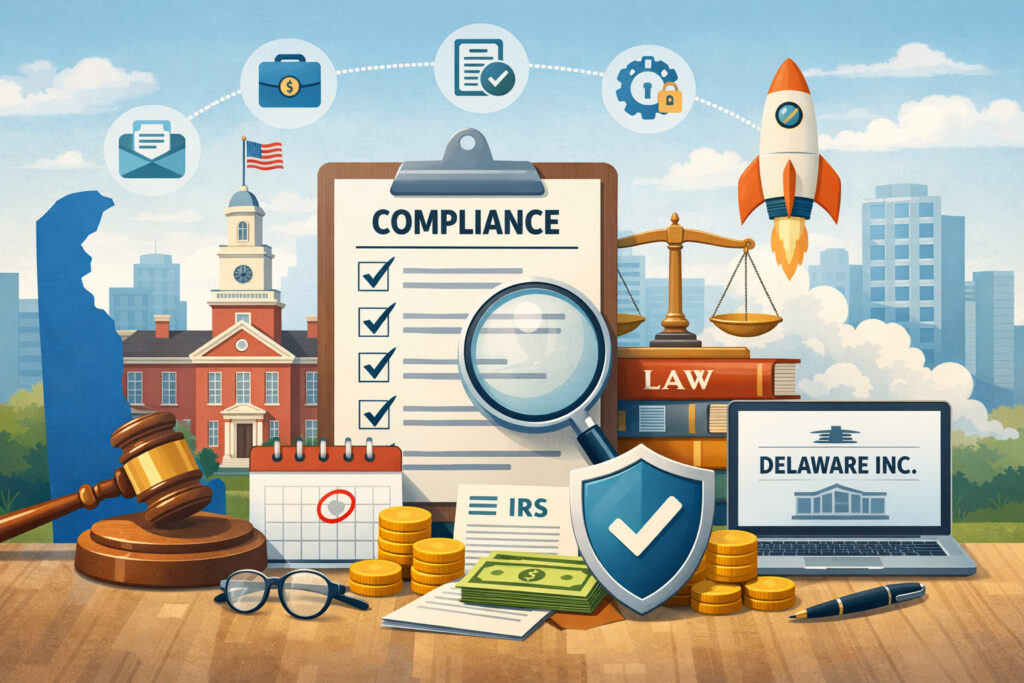
When founders hear “compliance,” they often think only about forming a company and filing an annual report. In reality, the Regulatory Requirements for Startups in Delaware operate in layers.
There are entity-level rules (how your company legally exists), tax rules (what you owe and when), operational rules (licenses, labor, contracts), and product or sector rules (payments, healthcare, cannabis-adjacent, fintech, marketplaces, and more).
If you miss one layer, the impact can range from small late fees to losing good standing, triggering investor concerns, or blocking a fundraising round.
At the state level, Delaware focuses heavily on keeping the “entity registry” accurate and paid up: franchise taxes, annual reports for corporations, and alternative entity taxes for LLCs/LPs/GPs. Delaware’s Division of Corporations and Division of Revenue are the major touchpoints for these core items.
For example, Delaware corporate annual reports and franchise taxes are due by March 1 each year, and failure can trigger penalties and interest. For many LLCs, the state’s compliance center of gravity is the flat $300 annual tax due by June 1 (with no annual report required).
But the Regulatory Requirements for Startups in Delaware don’t stop at the Delaware border. Startups must also manage federal obligations (like EIN/IRS filings and ownership reporting requirements that have changed materially in the last year), plus “foreign qualification” and taxes in every state where they actually operate.
This is the most important mindset shift: incorporating in Delaware doesn’t mean you only comply with Delaware rules. It means Delaware is your legal home—while your real-world footprint drives additional requirements elsewhere.
Finally, compliance is not just “avoid penalties.” It’s also about being investable and bankable. Investors and banks routinely ask for certificates of good standing, cap table clarity, and proof that you’ve met the Regulatory Requirements for Startups in Delaware. Treat compliance like infrastructure—boring, essential, and easiest when built early.
Choosing the Right Entity Structure: How It Shapes Regulatory Requirements for Startups in Delaware
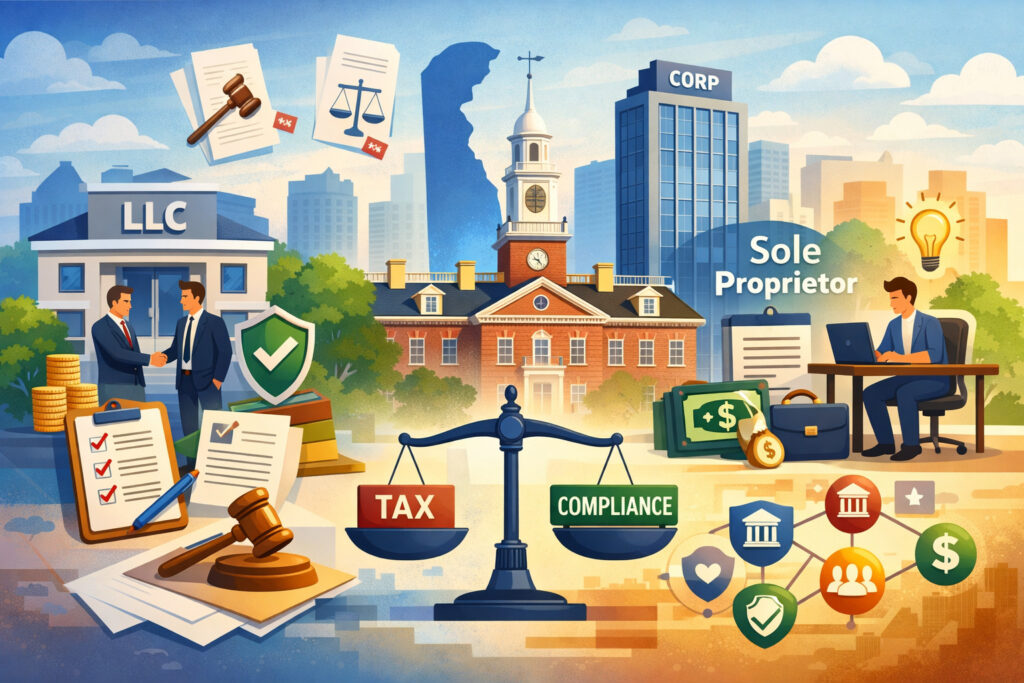
Your entity type determines a huge portion of the Regulatory Requirements for Startups in Delaware—including what you file, what you pay, how you govern, and what investors expect to see.
The two dominant choices for startups are the Delaware C-Corporation and the Delaware LLC. Each can work, but they create different compliance burdens and different financing paths.
A Delaware C-Corporation is common for venture-backed startups. Corporate law in Delaware is well-developed, and many investors prefer C-Corps because equity issuance, option plans, and preferred stock financings are standardized.
That said, corporations face recurring Delaware obligations: annual report filings and franchise tax payments are due each year by March 1, and late filings can result in penalties and monthly interest.
Corporate governance also has formalities: appointing a board, keeping minutes or written consents, issuing shares properly, and respecting fiduciary duties.
These governance steps are part of the broader Regulatory Requirements for Startups in Delaware because they’re what prove your company is run as a separate legal entity (which matters for liability protection and diligence).
A Delaware LLC can be simpler early on, especially for bootstrapped startups, consulting-heavy businesses, or companies planning pass-through taxation. Delaware LLCs typically enjoy flexible governance through an operating agreement.
However, LLCs still have a clear compliance “must-do”: the annual tax payment to Delaware (commonly referred to as a flat $300 tax), due by June 1, and Delaware notes that LLCs/LPs/GPs generally do not file annual reports with the Division of Corporations.
LLCs may be less standardized for VC financings, and converting later can add cost and complexity—so the “simpler now” choice can become “harder later.”
To make this decision well, treat it like product strategy: think about your future capital plans, ownership structure, and how you’ll compensate talent. Then map those goals back to the Regulatory Requirements for Startups in Delaware you’re willing to maintain.
If venture financing is likely, a Delaware C-Corp often reduces downstream friction even if it increases early governance formality.
Formation Essentials: Incorporation, Registered Agents, and Startup Paperwork That Protects You

The first mile of the Regulatory Requirements for Startups in Delaware is creating the entity correctly and setting up a compliance foundation you won’t regret.
Formation is not just filing a document; it’s also building the legal skeleton for fundraising, taxes, banking, and hiring. The goal is to become “real” in the eyes of the state, the IRS, your bank, and future investors.
Delaware formation typically begins with filing a Certificate of Incorporation (for a corporation) or a Certificate of Formation (for an LLC). Founders also need a Delaware registered agent—an in-state contact that can accept legal documents.
A registered agent is not a “nice to have.” It’s core to staying compliant and reachable. If you lose your registered agent, you can fall out of good standing and miss legal notices—both of which are avoidable but damaging.
Next comes internal documentation. For corporations, that includes bylaws, initial board consents, stock issuances, and an equity incentive plan if you’ll grant options. For LLCs, the operating agreement matters because it defines who owns what, who can sign, and how profits/losses work.
Even if Delaware doesn’t require you to file these internal documents publicly, they’re still part of practical Regulatory Requirements for Startups in Delaware because they are routinely requested in diligence.
You’ll also typically obtain an EIN to open bank accounts and file taxes. This is where “Delaware entity” meets “federal obligations.” Your EIN is not a Delaware number—it’s an IRS identifier—and it is a gateway requirement for payroll, benefits, and many vendor relationships.
Finally, don’t treat formation as “done” once the state accepts your filing. A founder’s real compliance win is a clean startup record: properly issued equity, signed invention assignment agreements, clear officer roles, and a secure place to store your governance records. These steps are the difference between a smooth financing and a painful (and expensive) cleanup.
Delaware Franchise Tax and Annual Filings: The Core Regulatory Requirements for Startups in Delaware
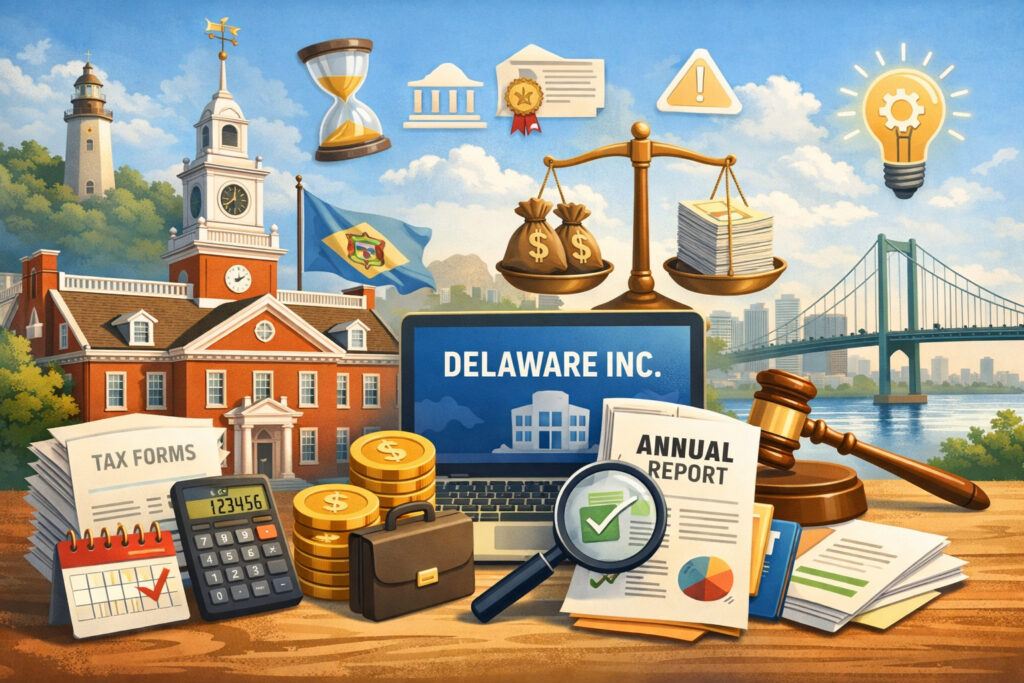
If you only remember one section of the Regulatory Requirements for Startups in Delaware, make it this one: Delaware cares a lot about annual payments and filings, and it enforces them with penalties that add up quickly. Staying in good standing is largely about meeting these recurring obligations on time, every year.
For Delaware corporations, the annual report and franchise tax for the prior year are due on or before March 1 and are filed online. Delaware also states that failure to file and pay triggers a $200 penalty plus 1.5% interest per month on tax and penalty. This matters even if your startup is pre-revenue.
Many early-stage companies assume “no revenue means no filings.” Delaware franchise tax rules do not work that way for corporations—your obligation is tied to corporate status and capitalization structure, not just revenue.
For Delaware LLCs, LPs, and GPs, the compliance mechanics are different: Delaware’s guidance emphasizes that these entities typically are not required to file annual franchise tax reports, but they must pay a $300 yearly tax due on or before June 1.
Again, this applies even if you are small, inactive, or pre-revenue. If you formed the entity and haven’t dissolved it, you need to pay and stay current.
This annual cycle is why a compliance calendar is part of smart operations. Put March 1 (corporations) and June 1 (LLCs/LPs/GPs) on a recurring company calendar with internal reminders. Also note that Delaware often routes notices through your registered agent, so ensure your registered agent contact information is always correct.
One more nuance inside the Regulatory Requirements for Startups in Delaware: being “in good standing” can affect financing timelines. Investors, acquirers, and even some banks may request a good standing certificate.
Missing franchise tax can block that certificate. The operational consequence is bigger than the late fee—the real cost is deal friction at the worst possible time.
Delaware Business Taxes Beyond Franchise Tax: Gross Receipts Tax and Other State-Level Obligations
Many founders associate Delaware with “no sales tax,” which is often true in common conversation, but the Regulatory Requirements for Startups in Delaware still include meaningful business tax compliance.
One key concept is Delaware’s gross receipts tax, which functions differently than a traditional sales tax and can surprise founders who price tightly or operate on thin margins.
Delaware’s Division of Revenue explains that gross receipts tax returns and payments are due monthly or quarterly, depending on total gross receipts. If you’re set as a monthly filer, the tax is due on or before the 20th of each month for the prior month.
If you’re set as a quarterly filer, it’s due on or before the last day of the first month following the close of the quarter. This is not a “profit tax.” It’s about receipts, and that distinction matters for startups that reinvest heavily or run at a loss.
Not every startup will owe gross receipts tax in the same way—liability depends on business activity and sourcing rules. But founders should still treat it as part of the baseline Regulatory Requirements for Startups in Delaware: determine early whether you’re engaged in taxable activity in Delaware, register appropriately, and build reporting into your accounting process.
If you run a marketplace, provide services, operate a retail location, or maintain meaningful in-state operations, it’s worth evaluating quickly rather than discovering it later.
Also remember that Delaware entity status doesn’t automatically mean Delaware is your only tax exposure. If your team, office, or customers are in other states, you may owe taxes and filings there too.
This is where founders often get caught: they are incorporated in Delaware but never “foreign qualified” and never filed where they actually operate. That’s not just a paperwork issue—it can create back taxes and penalties.
A clean approach is to set up a “tax footprint” review every quarter. Update where employees live, where you have offices, where inventory is stored, and where revenue is sourced. This ongoing discipline keeps the Regulatory Requirements for Startups in Delaware from turning into multi-state chaos.
Business Licenses, Local Permits, and “Doing Business” Rules: Compliance That Depends on What You Actually Do
A major reason founders struggle with the Regulatory Requirements for Startups in Delaware is that not all compliance is statewide and not all compliance is purely corporate.
A startup can be perfectly formed and current on Delaware franchise tax and still be out of compliance if it lacks required business licenses, local permits, or regulatory registrations tied to its actual operations.
This category is highly fact-specific. A software-only startup working remotely may have minimal Delaware local licensing needs—especially if it has no physical presence. But a startup with an office, storefront, warehouse, lab, or staff working in Delaware may need local permits, zoning compliance, signage approvals, fire inspections, and industry permits.
Professional services can also trigger licensing: certain regulated professions require state-issued licenses, and operating without one can create enforcement issues and contract problems.
This is also where “foreign qualification” becomes part of the practical Regulatory Requirements for Startups in Delaware. If you incorporate in Delaware but have your headquarters elsewhere, you typically must register as a “foreign” entity in that other state. “Foreign” doesn’t mean international—it means “formed in another state.”
The compliance burden includes filings, fees, and often annual reporting in each additional state. If you skip this, you can face penalties and limits on your ability to sue in that state’s courts.
The cleanest founder workflow is to build an operational compliance checklist tied to reality, not paperwork assumptions. Ask: Where are people working? Where is money collected? Where is inventory stored? Where is the product delivered?
Then map those answers to licensing and registration requirements. This reduces the risk that your startup is accidentally noncompliant while believing it met the Regulatory Requirements for Startups in Delaware.
Hiring and Employment Compliance: Payroll Taxes, Worker Classification, and Workplace Rules
Once you hire, the Regulatory Requirements for Startups in Delaware expand fast. Employment compliance isn’t just an HR topic—it’s a legal and tax topic. The moment you pay someone for work, you create obligations related to payroll taxes, worker classification, wage rules, recordkeeping, and sometimes insurance.
Startups often misclassify workers as contractors to move fast. But classification depends on the nature of control, the relationship, and the work performed. Misclassification can lead to tax liabilities, wage claims, and penalties that arrive years later—often triggered by a worker dispute or an audit.
The risk is highest when a “contractor” works full-time, uses company tools, follows company schedules, and performs core business functions. In that case, your compliance posture under the Regulatory Requirements for Startups in Delaware is fragile.
Payroll is another area where founders underestimate complexity. You must withhold and remit payroll taxes and comply with reporting requirements.
If employees work in multiple states, you’ll likely need payroll registrations and withholding in each state where employees live or work. For Delaware-based employees, you may also face state-level unemployment insurance and other employer registrations.
Workplace rules also scale with headcount. Anti-discrimination rules, accommodation obligations, wage and hour requirements, and leave rules can apply early—sometimes from your first hire.
Even if you don’t have a formal HR department, your startup needs a lightweight system: offer letters, I-9 verification, policy acknowledgments, timekeeping rules (for non-exempt staff), and a process for handling complaints.
Treat employment compliance like you treat security: minimal viable controls now, stronger controls as you scale. That mindset turns the Regulatory Requirements for Startups in Delaware into manageable routines rather than urgent emergencies.
Federal Reporting and Ownership Transparency: The Shifting Landscape Founders Must Watch
Some of the most important Regulatory Requirements for Startups in Delaware come from outside Delaware—especially when it comes to ownership transparency and federal reporting rules.
In the last year, beneficial ownership information (BOI) reporting has been unusually fluid, with changes in deadlines and enforcement posture that founders need to track carefully.
FinCEN’s BOI page has stated that reporting requirements were back in effect with a deadline of March 21, 2025, while it assessed options for further modifying deadlines.
At the same time, FinCEN has also issued an interim final rule removing the BOI reporting requirement for certain groups (described publicly as removing requirements for domestic companies and persons), reflecting major policy movement.
Additionally, FinCEN’s own small-entity compliance materials and fact sheets have reflected exemptions in ways that differ from earlier expectations. Public reporting has also described ongoing legal and policy uncertainty around enforcement.
What should a founder do with that? First, recognize that “federal compliance” is part of the real-world Regulatory Requirements for Startups in Delaware, even if Delaware doesn’t administer it.
Second, avoid operating on old blog posts or outdated checklists. Third, document your ownership structure cleanly—because even when reporting rules change, banks, payment providers, and investors still require ownership transparency as part of KYC/AML and diligence.
A practical approach is to maintain an “ownership factsheet” internally: legal entity name, EIN, formation date, registered agent, officers, directors/managers, cap table summary, and any parent/subsidiary structure. Then monitor FinCEN updates during fundraising or banking events, when these topics resurface.
Fundraising, Equity, and Securities Compliance: How to Raise Money Without Creating Regulatory Debt
Raising capital is not only a finance milestone—it’s a compliance event. A startup can meet the Delaware filing Regulatory Requirements for Startups in Delaware and still create serious problems by mishandling securities rules, equity issuance, or investor disclosures.
These issues often don’t “explode” immediately; they surface during later rounds, acquisitions, or audits, when cleanup becomes expensive.
At the Delaware entity level, you must issue shares (or membership interests) properly and keep records that match what you promised. For corporations, board approvals (or written consents) should authorize issuances, set purchase price, approve option grants, and adopt option plans.
Founders should also use invention assignment agreements and IP transfer documents early, because investors expect the company—not the founders—to own the IP.
At the securities level, most startups raise money using exemptions from registration (rather than registering securities). That typically involves specific notice filings, investor qualification checks, and disclosure practices.
If you use crowdfunding or online platforms, you may trigger additional rules and reporting obligations. The underlying principle is simple: selling equity is regulated, even for startups, even for friends-and-family rounds. That’s a key part of the overall Regulatory Requirements for Startups in Delaware.
Another common issue is valuation and tax compliance around equity compensation. Option grants, restricted stock, and advisor equity can create tax reporting requirements.
Poorly documented grants can create disputes and tax surprises for both the company and the recipient. Even if you’re keeping things informal, treat equity like a regulated product: documented approvals, signed agreements, clear vesting, and accurate cap table tracking.
Data Privacy, Cybersecurity, and Consumer Protection: Modern Compliance for Modern Startups
In 2026, privacy and security are no longer “only for big companies.” They are a core part of the Regulatory Requirements for Startups in Delaware in practice because customers, enterprise buyers, insurers, and regulators increasingly expect baseline controls—especially if you handle personal data, payments, healthcare information, or children’s data.
Even before you look at any specific statute, consumer protection principles matter: be honest in marketing, disclose key terms, handle refunds appropriately, and avoid deceptive patterns. If you collect user data, publish a privacy policy that matches reality.
If you use cookies or tracking tools, understand what disclosures and consents may be expected depending on where users live.
For many startups, the biggest risk isn’t a surprise enforcement action—it’s that a customer or partner asks, “What data do you collect, where do you store it, and how do you secure it?” and you don’t have a credible answer.
Cybersecurity also connects to vendor contracts and insurance. Enterprise contracts may require security addenda, incident notification timelines, and minimum standards such as access controls, encryption, and regular vulnerability management.
If you process payments, you may need to align with card network security expectations. If you operate in regulated sectors, security requirements can be stricter.
From a “Delaware startup” standpoint, the smart move is to create a security baseline that scales: use MFA, least-privilege access, secure backups, patching, logging, and an incident response plan.
This operational discipline becomes part of your compliance story and helps you satisfy the broader Regulatory Requirements for Startups in Delaware that appear during diligence—because investors increasingly ask about data risk and cyber exposure.
Industry-Specific Regulations: When Your Startup Crosses Into Heavily Regulated Territory
Some founders can follow a relatively standard checklist for the Regulatory Requirements for Startups in Delaware. Others can’t—because their product is regulated. The moment you touch money movement, lending, insurance, healthcare, education, employment screening, or controlled goods, your regulatory surface area increases dramatically.
For example, fintech and payments startups may face layered requirements: money transmission considerations, partner bank oversight, AML/KYC expectations, and consumer disclosure rules.
Healthcare startups can trigger privacy rules and security obligations tied to protected health information. Marketplaces can face tax and consumer protection complexity. Even “simple” products can become regulated if they make claims about health outcomes, credit improvement, or guaranteed earnings.
The key is to define your regulatory category early. Don’t wait until you scale to ask, “Are we regulated?” If the answer is “maybe,” treat that “maybe” as a yes until proven otherwise.
Build a short compliance memo: what you do, what you don’t do, how money flows, what data you collect, who your customers are, and what claims you make. That memo helps counsel, partners, and investors evaluate your exposure.
This is also where Delaware compliance meets multi-state reality again. Even if your entity is Delaware, sector rules may be state-by-state. A startup might be compliant under the Regulatory Requirements for Startups in Delaware and still face licensing requirements elsewhere based on customers or operations.
Ongoing Compliance Systems: Building a Founder-Friendly Calendar for the Regulatory Requirements for Startups in Delaware
Startups fail at compliance not because founders can’t understand rules, but because they don’t build a system. The easiest way to manage the Regulatory Requirements for Startups in Delaware is to make them routine and visible, like product sprints.
Start with a single compliance calendar that includes: Delaware annual deadlines, registered agent renewal, tax filing cycles, payroll filing dates, and any license renewals.
For Delaware core items, the big recurring dates are clear: corporations file annual reports and pay franchise tax by March 1 and many LLCs pay the annual $300 tax by June 1.
If your business owes Delaware gross receipts tax, your cadence could be monthly (by the 20th) or quarterly (by the end of the first month after quarter close), depending on your filer status. Put these on the calendar the day you form the company—not “after we launch.”
Next, assign ownership. Compliance fails when it belongs to “everyone.” A founder, finance lead, or ops lead should own the list. If you outsource accounting or legal work, you still need an internal owner who ensures tasks get completed and records get stored.
Then build a document vault. Keep formation docs, consents, cap table exports, tax confirmations, good standing certificates, and major contracts in one secure place. During fundraising, you’ll be asked for these quickly. Having them ready makes you look mature—and reduces stress.
Finally, add a quarterly “compliance check-in.” Review entity status, confirm registered agent info, update your state footprint, and verify tax registrations. This transforms the Regulatory Requirements for Startups in Delaware from an anxiety cloud into a manageable operating cadence.
Future Predictions: Where Regulatory Requirements for Startups in Delaware Are Headed
Compliance is not static, and founders benefit from planning one step ahead. The Regulatory Requirements for Startups in Delaware will likely remain stable in their core mechanics (franchise tax, annual reports, entity registry maintenance). Delaware’s value proposition is predictability, and it has strong incentives to keep entity administration clear and consistent.
Where change is more likely is in the “outer ring” of compliance: federal transparency rules, privacy and AI governance, cybersecurity expectations, and multi-state enforcement. The BOI reporting story is a good example of why founders must keep an eye on policy movement.
FinCEN has publicly posted shifting deadlines and policy decisions regarding BOI requirements, including a deadline announcement and later changes reflecting exemptions and rule updates. Even when a rule changes, the market expectation for ownership clarity doesn’t disappear—banks and partners still require it.
Another likely trend is stronger compliance expectations from vendors and customers. More startups will face security questionnaires, privacy addenda, and audit rights earlier—especially if selling to mid-market or enterprise.
This effectively turns “best practices” into de facto Regulatory Requirements for Startups in Delaware for any company that wants distribution through major channels.
Finally, multi-state compliance will continue to grow in importance. Remote work and distributed teams mean startups can accidentally create nexus and employment obligations across many states. Expect more enforcement and better state data-matching over time, which makes “we didn’t know” a weaker defense.
The best founder strategy is to build a compliance posture that is adaptable: clean records, clear ownership data, basic security hygiene, and a calendar-driven system. That’s how you stay ahead of the future version of the Regulatory Requirements for Startups in Delaware.
FAQs
Q.1: What are the most important annual deadlines for the Regulatory Requirements for Startups in Delaware?
Answer: For many startups, the biggest recurring obligations are Delaware annual payments and filings. Delaware corporations generally must file an annual report and pay franchise tax by March 1, and late filing can trigger penalties and monthly interest.
Delaware LLCs/LPs/GPs generally pay a flat annual tax (often $300) by June 1 and typically do not file an annual report with the Division of Corporations. If your business is subject to Delaware gross receipts tax, your filing and payment schedule may be monthly or quarterly depending on your filer status.
The practical answer is to treat these as non-negotiable calendar events. Put them on a recurring company compliance calendar and assign an owner. The most common early-stage mistake is assuming you can “catch up later.”
Catch-up often costs more than doing it right the first time, and it can delay fundraising when you need proof you’re in good standing under the Regulatory Requirements for Startups in Delaware.
Q.2: Do I only need to follow the Regulatory Requirements for Startups in Delaware if I incorporated there but operate elsewhere?
Answer: No. Incorporating in Delaware makes Delaware your legal home, but you still must comply where you actually operate. If your team is located in another state, or you have an office there, you will often need to register your Delaware entity there as a “foreign” entity and comply with that state’s reporting and tax rules.
This is one of the most misunderstood parts of the Regulatory Requirements for Startups in Delaware: Delaware compliance is necessary, but it’s rarely sufficient for a growing startup.
A useful way to think about it: Delaware is your “entity layer,” while your operational footprint drives additional layers. Every quarter, reassess where employees live, where customers are served, where inventory is stored, and where contracts are performed.
This is how you avoid multi-state compliance surprises while still meeting the Delaware-specific Regulatory Requirements for Startups in Delaware.
Q.3: How do I know if Delaware gross receipts tax applies to my startup?
Answer: Delaware’s gross receipts tax is triggered by business activity and receipts in ways that differ from a traditional sales tax.
Delaware’s Division of Revenue explains that gross receipts tax returns and payments are due either monthly or quarterly depending on total gross receipts, with monthly payments due by the 20th and quarterly payments due by the end of the first month after quarter close.
That tells you the cadence, but not whether you owe—because applicability depends on your specific business model, revenue sourcing, and in-state activity.
A strong founder move is to do an early “taxability review” with an accountant familiar with Delaware. Even a short review can determine whether you must register and file.
If you wait until you have meaningful revenue, you may discover back filings under the Regulatory Requirements for Startups in Delaware, which can create avoidable penalties and accounting cleanup.
Q.4: Is beneficial ownership reporting part of the Regulatory Requirements for Startups in Delaware?
Answer: Not directly through Delaware, but it can be part of your overall compliance obligations because it’s administered at the federal level.
In the last year, public guidance and policy actions around BOI reporting have shifted, including announced deadlines and later rule changes that removed requirements for certain groups, plus ongoing public uncertainty about enforcement.
The founder-safe approach is to keep ownership records clean and watch official FinCEN updates when forming entities, opening financial accounts, or fundraising.
Even if reporting requirements change again, banks and partners will still ask you for beneficial ownership information as part of compliance onboarding. That operational reality effectively links BOI readiness to the broader Regulatory Requirements for Startups in Delaware.
Q.5: What’s the fastest way to stay compliant without over-lawyering everything?
Answer: Think “systems, not heroics.” The most efficient way to manage the Regulatory Requirements for Startups in Delaware is:
- Choose the right entity type for your funding plan
- File correctly and keep governance records clean
- Calendar the Delaware deadlines (March 1 for corporations; June 1 for many LLCs)
- Build a lightweight document vault and cap table discipline
- Reassess your state footprint quarterly
This approach prevents last-minute scrambles. It also reduces legal spend because you’re not paying professionals to fix preventable mistakes. The goal isn’t perfection—it’s a steady, auditable posture that meets the Regulatory Requirements for Startups in Delaware and keeps you investable.
Conclusion
The Regulatory Requirements for Startups in Delaware aren’t “hard,” but they are persistent. Delaware wants your entity information current and your annual obligations paid on time.
For corporations, the annual report and franchise tax deadline (and associated penalties) make March 1 a date you never miss. For LLCs, the annual tax due by June 1 is the recurring anchor. And depending on your activity, Delaware gross receipts tax can add a monthly or quarterly reporting cadence.
Beyond those core items, the real compliance story is about operations: where you hire, where you do business, what you sell, what data you handle, and whether your fundraising and equity practices are disciplined.
Add in shifting federal ownership transparency rules and growing privacy/security expectations, and the modern founder’s job is to build compliance into operations—not treat it as a legal afterthought.