If you want to file a Doing Business As name in Delaware, you’re in the right place. A DBA—called a trade name in Delaware—lets you legally operate, market, invoice, and accept payments under a name that’s different from your personal name (sole proprietor) or your company’s legal name (LLC/corporation).
Delaware recently modernized how trade names work. Beginning February 2, 2026, Delaware’s Division of Revenue manages a statewide Trade Name (DBA) registry through Delaware One Stop. That means most entrepreneurs will register a trade name in Delaware online (instead of filing at the county court level like in the past).
This guide walks you through Delaware DBA filing requirements, step-by-step, with practical tips for freelancers, sole proprietors, LLC owners, and small business operators—so you can confidently handle Registering a business name in the First State.
Not legal advice: This article provides general, practical guidance. For the most accurate, current rules, confirm details with Delaware One Stop and the Delaware Division of Revenue before you submit.
What a DBA is in Delaware (and who needs one)
A Doing Business As (DBA) in Delaware is generally the same thing as a trade name: it’s the public-facing name your business uses when it’s different from the business’s legal name. Delaware One Stop describes a trade name as a name a business operates under that differs from its legal registered name.
A DBA is especially useful when:
- You’re a freelancer or sole proprietor who wants a brand name that isn’t your personal name.
- Your LLC or corporation wants to run a product line, storefront, or website under a different name.
- You want customers to see a simpler, more marketable name on invoices, receipts, and card statements.
- You need your banking and payment tools to align with your branding (while keeping the legal entity unchanged).
Delaware’s current system focuses on a statewide registry and ties trade names to business licensing. Delaware One Stop explains that to register a trade name, your business must be licensed with the Delaware Division of Revenue—either via a standard Delaware business license (if you operate in Delaware) or a Trade Name–Only License (if you don’t operate in Delaware but still need the trade name).
Who typically needs to file a DBA name in Delaware?
- Sole proprietors: If you’re not using your exact personal legal name for the business, a trade name is often the cleanest way to operate under your brand.
- Partnerships: If the partnership is using a brand name that differs from the partners’ names or the partnership’s legal name.
- LLCs/corporations: If you’ll advertise, contract, invoice, or accept payments under a different name than the legal entity name.
Pro Tip: If you’re planning to open a business bank account, onboard a payment processor, or sign contracts under the brand name, registering the trade name early can reduce back-and-forth later—because many providers want documentation showing the business’s right to use that name.
DBA vs. LLC/Corporation name in Delaware (and when you still need a DBA)
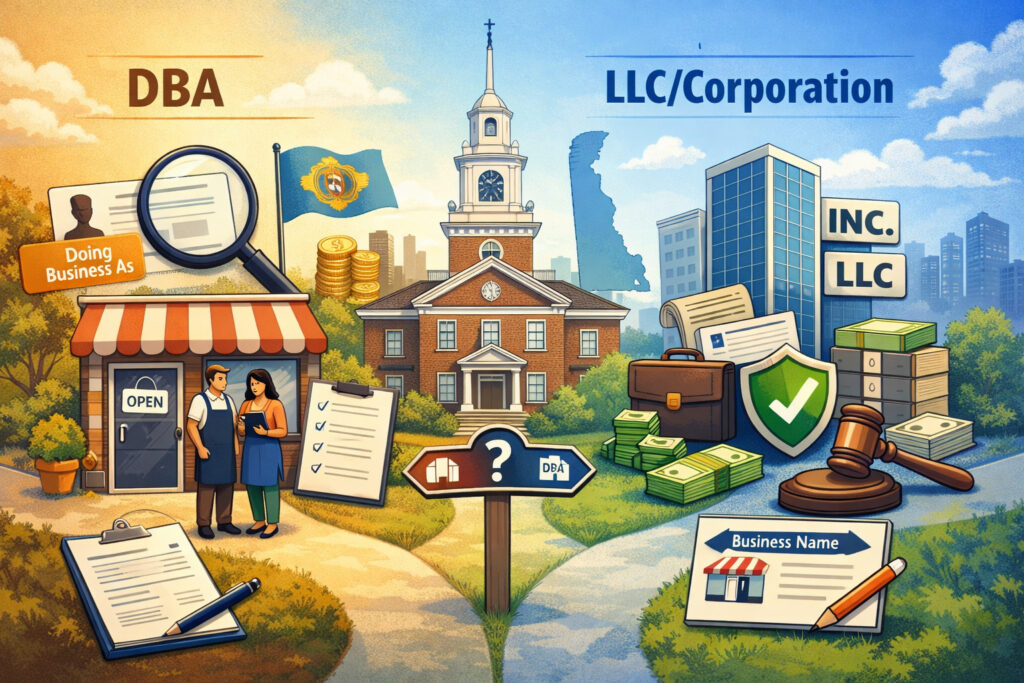
It’s easy to assume that forming an LLC automatically covers every name you want to use. But your LLC/corporation name and your trade name (DBA) serve different purposes.
Your legal entity name (LLC/corp name):
- Is the official name on your formation documents.
- Appears in the Delaware Division of Corporations entity record.
- Often includes required endings like “LLC” or “Inc.” depending on entity type.
Your DBA/trade name:
- Is the brand name you present to the public.
- Lets you operate under a name different from the entity name without forming a new entity.
- It is registered through Delaware’s trade name process (via One Stop starting February 2, 2026).
When an LLC might still need a DBA
You may still need to file a DBA name in Delaware if your LLC’s legal name is not the same as the name customers will see. Common examples:
- Your LLC is “First State Ventures LLC,” but your storefront is “Coastal Candle Co.”
- You run multiple brands under one company (e.g., “Bay Nutrition” and “Bay Fitness Studio”).
- Your domain/branding drops the legal suffix (“LLC”) or uses a different wording entirely.
Delaware’s One Stop guidance also ties trade names to licensing: a trade name registration is not just marketing—it’s part of how you show the name is legitimately associated with a licensed business.
DBA vs. trademark (quick reality check)
A trade name/DBA is not the same as a trademark. A DBA generally helps you operate under a name in Delaware’s system, while trademark protection is a separate process (state or federal), with different standards and enforcement.
Pro Tip: If your brand name is central to your long-term business value, consider researching trademarks and domain availability early—even if you’re “just” starting with a DBA.
Before you file: choosing a compliant trade name (quick naming rules)
Before you register a trade name in Delaware, do a little upfront homework. You’ll save time and reduce the chance of delays.
Practical name rules to keep you out of trouble
Delaware’s trade name process is designed to prevent confusion and keep records clean. While specific “restricted word” rules vary depending on context (industry, licensing, regulated terms), these practical guidelines usually help:
- Avoid names that imply a regulated activity you aren’t licensed for (for example, words suggesting you’re a bank, insurer, or government agency).
- Avoid names that look like another brand already operating in your market.
- Use a name you can consistently use everywhere (website, invoices, merchant account descriptor, signage).
- Think about searchability: a unique name is easier to verify, register, and market.
Delaware One Stop notes that the system will check availability automatically during registration and that a registry search is part of the “determine availability” step.
Quick checklist: trade name readiness
- The name is spelled exactly how you want it on receipts and invoices
- You’ve checked Delaware’s trade name search tools
- You’ve checked entity names (LLCs/corps) in Delaware
- You’ve checked domain/social handles (at least the basics)
- You’re ready to keep your Delaware business license active (or obtain a Trade Name–Only License if needed)
Delaware business name search: what to check (and where)
To reduce conflicts, it’s smart to check both:
- Trade name records, and
- Legal entity names (LLCs/corporations)
For trade names, Delaware’s Division of Revenue provides a Trade, Business and Fictitious Names Search and notes that historic data from the Delaware Courts’ former database remains viewable.
For legal entity names, Delaware’s Division of Corporations provides an online entity name search tool for retrieving information on Delaware entities.
Pro Tip: Delaware’s trade name search page notes there can be up to a 72-hour data lag between One Stop registration and the trade names database—and recommends One Stop for real-time availability. If your name choice is time-sensitive, do the final check right before you submit.
Step-by-step: how to file/register a trade name in Delaware
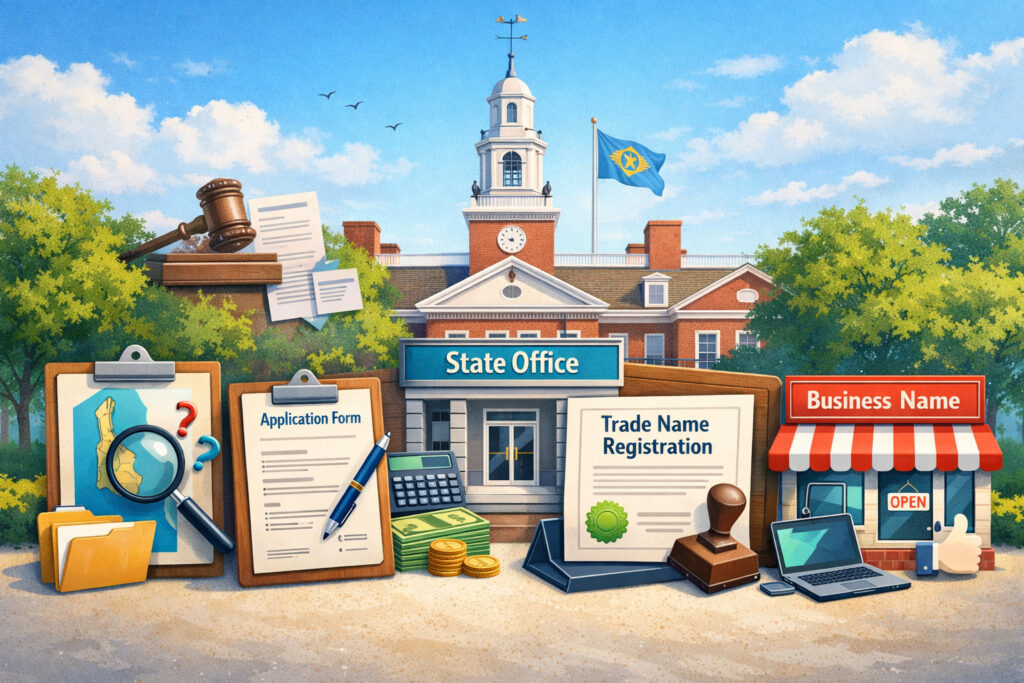
This is the core “how-to” section for anyone trying to file a Doing Business As name in Delaware under today’s rules.
Step 1: Confirm where to file (state vs. county—what applies now)
Historically, Delaware trade names were handled at the county court level (Prothonotary offices). Delaware courts now clearly state that effective February 2, 2026, all trade name registrations will be filed with the Division of Revenue.
Delaware One Stop repeats this shift and explains that the Division of Revenue will manage a statewide Trade Name (DBA) registry through One Stop beginning February 2, 2026.
So, where do you file today?
- For new trade names after February 2, 2026: You’ll typically file through Delaware One Stop (state-level).
- For older court-registered trade names: They remain recognized, and Delaware provides an optional “re-register into the DOR registry” path if you want the name to appear in the new registry and obtain a DOR Tradename Certificate.
Pro Tip: If you previously registered through the courts and now need to update ownership, address, or other key details, Delaware’s Division of Revenue FAQs indicate updates are managed through the One Stop system by adding/re-registering the DBA into the Revenue registry.
Step 2: Make sure you have the right business license first
Delaware’s current process ties trade names to licensing. Delaware One Stop says every trade name must be associated with a valid Delaware Business License issued by the Division of Revenue.
You generally meet this requirement in one of two ways:
- You operate in Delaware: Use a standard Delaware business license issued by the Division of Revenue.
- You don’t operate in Delaware but still need a trade name: Obtain a Trade Name–Only License, which One Stop describes as a special license for out-of-state businesses. It costs $25/year, must be renewed annually to keep the trade name active, and one license can cover multiple trade names.
The Division of Revenue’s Trade Names FAQs also mention that a Trade Name–Only license requires a Certificate of Good Standing from the Delaware Division of Corporations.
Checklist: license prep
- I have a standard Delaware business license or I qualify for a Trade Name–Only License
- If I need a Trade Name–Only License, I can obtain a Delaware Certificate of Good Standing (as required)
- I know which Taxpayer ID (TPID) I’ll use (often FEIN for entities; SSN/ITIN for individuals)
Step 3: Create/sign in to Delaware One Stop and start the trade name workflow
Once you have licensing lined up, you’ll use Delaware One Stop to register your trade name. Delaware One Stop provides a dedicated “Register or Modify Trade Names” area and allows you to register, update, or terminate a trade name.
What you’ll do in One Stop (high level):
- Create an account or sign in.
- Choose the “Register a trade name” option.
- Enter the required information (next step).
- Pay the filing fee and submit.
Delaware One Stop also notes it will check for availability automatically during registration, and a registry search tool is part of the availability step.
Pro Tip: If the trade name search database shows a name available but you still get blocked in One Stop, the 72-hour lag mentioned on the state trade name search page could be a factor—treat One Stop as your “real-time” confirmation point.
Step 4: Gather the info Delaware asks for (so you don’t stall mid-application)
Delaware One Stop lists the information you’ll need for the trade name forms, including:
- The trade name you want to register
- A valid Division of Revenue business license
- The legal name of your business entity
- Names of all owners, members, or partners
- Your business formation date
- A brief description of your business activity
You’ll also see “TPID” referenced. Delaware One Stop notes that a Taxpayer ID (TPID) is typically a Federal Employer Identification Number (FEIN) for entities or an SSN/ITIN for individuals.
Practical preparation tip:
Write your “business activity description” as a plain-English sentence that matches what you actually do (and what your business license covers). Overly broad descriptions can create confusion later when banks, processors, or agencies review your records.
Fast pre-fill worksheet (copy/paste into your notes)
- Trade name:
- Legal entity name (or personal legal name if sole proprietor):
- Business license number / details:
- TPID (FEIN or SSN/ITIN as applicable):
- Formation/start date:
- Owners/members/partners list:
- Business activity description (1–2 sentences):
Step 5: Pay fees, submit, and track timing (what to expect)
Delaware One Stop states the trade name registration filing fee is a one-time $25 charge per trade name.
If you are optionally re-registering an existing Superior Court trade name into the new Division of Revenue registry (and provide your Superior Court filing number), One Stop says that optional re-registration can be available at no cost.
Typical timelines (ranges, not guarantees):
- Many online registrations can be processed quickly, but allow time for verification and system updates.
- Delaware’s trade name search page notes up to a 72-hour data lag between One Stop registration and the trade names database.
- If you need proof for banking or compliance, plan ahead and avoid submitting right before a deadline.
Pro Tip: If you need the trade name for a bank account or merchant services onboarding, save your confirmation and any certificate/record available from the system immediately after submission. Different providers ask for different proof, and having it handy keeps onboarding moving.
After filing: what to do next (licenses, banking, payments, and public-facing updates)

Registering the name is only step one. What you do next determines whether your DBA actually “works” in real life—on invoices, deposits, websites, and payment tools.
Business license considerations (keep the foundation active)
Delaware One Stop’s guidance makes the licensing connection clear: every trade name must be associated with a valid Delaware business license, and trade names don’t operate in a vacuum.
It also explains something many owners miss: trade names themselves do not expire or renew, but your underlying Delaware business license (or Trade Name–Only License) must remain active to keep your trade name in good standing.
If you renew your Delaware business licenses through One Stop, Delaware notes licenses are issued by calendar year and renewal can be for one or three years.
Checklist: staying compliant after registration
- My underlying business license stays current (or my Trade Name–Only License renews annually if applicable)
- My business activity details remain accurate for renewals and updates
- I keep copies of confirmations/certificates for banks, vendors, and processors
Banking, invoicing, and payment processing (where DBAs matter most)
Most entrepreneurs register a DBA because they want the brand name to show up professionally:
- On customer invoices and estimates
- On checks customers write
- In bank deposits and statements
- On card statements or payment receipts
A common misconception is that you need a separate business entity to open a bank account under your brand. Often, a DBA/trade name plus your entity documents is enough for banks—but requirements vary by institution.
Practical banking steps:
- Ask your bank what they require to open an account under the trade name (often: entity docs + DBA/trade name proof + EIN/SSN depending on entity type).
- Keep your TPID/EIN alignment consistent. Delaware One Stop notes TPID is typically FEIN for entities or SSN/ITIN for individuals.
- Update your invoice templates and payment links so the business name customers see matches the name you’ve registered.
Updating your processor/payment accounts to match the DBA
If you accept cards or ACH, your processor may allow:
- The DBA as the customer-facing business name, and
- The legal entity as the underlying owner
That’s normal, but processors usually want documentation showing that the DBA is legitimately connected to the business. Having your trade name registration details ready can prevent funding holds and reduce underwriting questions.
Pro Tip: Keep your “name stack” consistent: Legal name (entity) → DBA (public brand) → Website/domain → Bank account name. Inconsistent names are one of the most common causes of payment onboarding delays.
Contracts, websites, signage, and branding updates
Once you register the DBA, use it consistently:
- Update your website footer and terms (example format: “Brand Name is a trade name of Legal Entity Name”).
- Update customer contracts and proposals to show both the DBA and legal entity name when appropriate.
- Align storefront signage, receipts, and estimates to the registered spelling.
If you use multiple DBAs (brands), create a simple internal policy for:
- Which brand is used for which line of business
- Which bank deposit accounts map to which brand
- Which websites and payment links correspond to each DBA
Common mistakes that cause delays or rejections (and how to avoid them)
Even with a streamlined system, trade name registrations can get stuck if details don’t match or if you skip key prerequisites.
Mistake 1: Trying to register the trade name before the business license is active
Delaware One Stop is explicit: to register a trade name, the business must be licensed with the Division of Revenue, and every trade name must be associated with a valid Delaware business license.
Avoid it:
Secure the correct license first (standard Delaware business license or Trade Name–Only License).
Mistake 2: Using inconsistent legal names, owners, or dates
Delaware One Stop lists required form information like legal name, owners/members/partners, formation date, and business activity. If you enter a legal name that doesn’t match your entity record or you list owners differently than your entity documents, you can create review issues—especially when third parties verify the name.
Avoid it:
Copy/paste the legal entity name exactly as shown in your official records.
Mistake 3: Assuming trade name availability based on one search
Delaware provides trade name search tools and notes historic data is available, but also warns of a data lag up to 72 hours between One Stop registration and the trade names database, and directs users to One Stop for real-time availability.
Avoid it:
Use searches for early screening, but treat the One Stop workflow as your final availability check.
Mistake 4: Forgetting the ongoing license requirement
Trade names don’t renew, but your underlying license must remain active to keep the trade name in good standing.
Avoid it:
Set a recurring reminder to renew your Delaware business license (or Trade Name–Only License annually if applicable).
Pro Tip: Most “DBA problems” are really “license problems.” If something goes sideways later, check whether the underlying license is active before assuming your trade name registration is the issue.
Renewals, changes, and cancellations (how updates work in Delaware)
Trade names aren’t “set it and forget it” if your business evolves. The good news: Delaware’s system supports updates and termination through One Stop.
Do Delaware trade names renew?
Delaware One Stop says trade names themselves do not expire or renew. Instead, your underlying Delaware business license (or Trade Name–Only License) must remain active.
That means your practical “renewal” task is usually:
- Renew the business license on time, and
- Keep the business details accurate.
Delaware One Stop’s license renewal guidance notes licenses are issued by calendar year and can be renewed for one year or three years.
How to amend/update a DBA in Delaware
The Division of Revenue’s Trade Names FAQs state:
- You can update an existing DBA associated with the business after completing registration and obtaining a business license.
- There is no fee to update a DBA—including updates like business addresses or changing key individuals.
Delaware One Stop also indicates you can update trade name details through the portal.
Common updates include:
- Address changes
- Ownership/member/partner updates
- Adjusting the business activity description (when appropriate)
Pro Tip: If you registered a DBA through the courts in the past and now need to update key details, Delaware’s FAQs indicate updates are managed through Revenue’s registry via One Stop—often by adding/re-registering the DBA into the DOR registry first.
How to cancel/terminate a trade name
Delaware’s FAQs say you can cancel a DBA through One Stop using the termination workflow, and there is no fee to cancel.
If you stop using a name, it’s wise to terminate it rather than leaving it hanging—especially if you want clean records for banking, taxes, or future brand changes.
Transfers: moving a trade name to a different owner/entity
Delaware One Stop notes that One Stop does not offer a direct transfer. To move a trade name to a different TPID, you cancel it under the current TPID and re-register it under the new TPID (and the standard registration fee applies).
Special scenarios: sole proprietors, LLCs, multi-location businesses, and multiple DBAs
Different business structures use DBAs for different reasons. Here’s how to think about the most common Delaware cases.
Sole proprietor DBA Delaware: when it’s essential
If you’re a sole proprietor and your business name is anything other than your personal legal name, a DBA/trade name is often the practical way to operate under your brand.
Examples:
- “Jordan Lee” doing design work under “First State Design Studio”
- “Aisha Patel” selling baked goods under “Brandywine Bakes”
As a sole proprietor, you’ll also want to think about:
- How your name will appear on invoices and payment links
- Whether you’ll use an EIN (some sole proprietors do, depending on hiring, banking preferences, and vendor requirements)
- Consistency across your business license, trade name, and bank setup
Delaware’s One Stop guidance ties registration to licensing and references TPID as SSN/ITIN for individuals in many cases.
Pro Tip: If you’re a sole proprietor who wants to keep your SSN off W-9s and invoices, you may prefer using an EIN. That’s a federal tax identity decision, but it can make vendor onboarding smoother.
DBA vs LLC name: how LLC owners should decide
If you already have an LLC, you may or may not need a DBA. The deciding factor is simple: Will the public-facing name differ from the LLC’s exact legal name?
If yes, a DBA/trade name can help you:
- Keep your legal entity stable (contracts, taxes, ownership)
- Use a cleaner brand name for marketing and payments
- Operate multiple product lines without forming new entities
Delaware One Stop’s trade name page frames DBAs as a way to operate under a more marketable name without changing the original legal entity name.
Multi-location businesses: one brand, multiple sites (or multiple brands)
If you run multiple locations, you might:
- Use one trade name across all locations (consistent brand), or
- Use different DBAs for different concepts/locations (common in food, retail, and services)
Your operational complexity increases when:
- Different locations need different bank deposits
- Different brands need different merchant accounts or descriptors
- Different websites route payments differently
Delaware’s system allows multiple trade names under a single business license (helpful for multi-location or multi-brand operators).
Using multiple DBAs under one entity
Delaware explicitly allows multiple DBAs under a single Delaware business license.
This can be a smart strategy when:
- You sell different product categories to different audiences
- You want separate websites/branding but centralized bookkeeping
- You want to test new concepts without forming a new company
Pro Tip: Multiple DBAs are great—but only if your accounting stays organized. Use separate “classes” or “tags” in your bookkeeping system to track revenue by brand, even if everything rolls up to one entity.
FAQs
Q.1: Do I need a DBA in Delaware if I have an LLC?
Answer: Not always. If your LLC’s legal name is exactly the name you use publicly, you may not need a DBA. But if you advertise, invoice, sign contracts, or accept payments under a different name, a DBA (trade name) is a practical tool.
Delaware One Stop explains that a trade name lets a business operate under a more marketable name without changing the original legal entity name.
In real life, many LLCs choose DBAs because their legal name includes wording or an “LLC” suffix they don’t want on storefront signage or customer receipts. If your bank, processor, or vendors see the DBA name, registering it helps you show the name is legitimately connected to the business and reduces verification friction during onboarding.
Q.2: How much does it cost to file a DBA name in Delaware?
Answer: Delaware One Stop states the fee is a one-time $25 charge per trade name. If you don’t operate in Delaware but still need a trade name, Delaware One Stop describes a Trade Name–Only License that costs $25/year and must be renewed annually to keep the trade name active (and one license can cover multiple trade names).
Keep in mind you may also have costs tied to your underlying Delaware business license, banking documentation, or optional certificates (depending on what a bank or vendor asks for). Always verify current fees directly in One Stop before submitting.
Q.3: How long does a Delaware DBA filing take?
Answer: Timelines can vary, but Delaware provides a helpful clue: the trade name search page notes that updates between One Stop registration and the trade name database can vary by up to a 72-hour data lag, and recommends One Stop for real-time availability.
Practically, you should plan for anything from “same day” to several business days depending on system processing, verification, and whether you’re also applying for or renewing a business license.
If your DBA is needed for a time-sensitive activity—like opening a bank account or launching a payment system—submit earlier than you think you need to.
Q.4: Can two businesses use the same trade name in Delaware?
Answer: Delaware’s goal with the new statewide registry is to reduce confusion and keep names unique within the registry. Delaware One Stop also indicates the system checks availability during registration.
That said, “same” can be tricky (punctuation, spacing, or similar names). Also, name availability is different from trademark rights. The safest approach is to:
- Search trade names using Delaware’s search tools
- Check entity names with the Division of Corporations search
- Do broader brand checks (domain/social/trademark screening)
If you’re building a serious brand, consider professional guidance on trademarks.
Q.5: Do I need an EIN to register a trade name in Delaware?
Answer: Not always, but it depends on your structure. Delaware One Stop explains that the Taxpayer ID (TPID) is typically a FEIN for entities and an SSN/ITIN for individuals. If you’re an LLC/corporation, you’ll often use an EIN.
If you’re a sole proprietor, you might use SSN/ITIN—or you may obtain an EIN for privacy and onboarding convenience. Banks and processors often prefer an EIN, but each provider sets its own requirements.
If you’re unsure, confirm what your bank/processor needs before you file so you choose a TPID path that won’t create extra steps later.
Q.6: Can I open a bank account with a DBA in Delaware?
Answer: Often, yes—many banks allow accounts to be opened under the DBA/trade name as long as you can document the connection to the underlying owner (you or your legal entity). Delaware’s trade name registration process helps create that paper trail. Delaware One Stop describes DBAs as trade names under which a business operates that differ from the legal name.
In practice, banks commonly request:
- Entity documents (or personal ID for sole proprietors)
- EIN/SSN verification as applicable
- Proof of trade name registration/record
Because requirements vary by institution, call ahead and ask for their “DBA account opening checklist” so you bring the right documents.
Q.7: Do I need to publish my DBA in a newspaper in Delaware?
Answer: Delaware’s current statewide One Stop trade name guidance focuses on registration through the state system and does not describe a newspaper publication requirement on the trade name registration page or FAQs.
Publication rules vary widely across states, and older online articles may describe processes that no longer apply (especially with Delaware’s 2026 transition). If you see conflicting information, rely on Delaware One Stop and the Division of Revenue’s official FAQs as your primary reference points.
Q.8: Where do I file a DBA in Delaware—state or county?
Answer: For new filings after February 2, 2026, Delaware courts state that all trade name registrations will be filed with the Division of Revenue, and Delaware One Stop explains the Division of Revenue manages the statewide registry through One Stop starting February 2, 2026.
Older resources may mention filing with county Prothonotary offices. That was historically true, but Delaware’s official court page now directs trade name registrations to the Division of Revenue.
If you have an older court-registered trade name, Delaware One Stop explains it remains recognized, and you can optionally re-register it into the DOR registry if you want it to appear there and obtain a DOR Tradename Certificate.
Q.9: How do I change or cancel a DBA in Delaware?
Answer: Delaware’s Division of Revenue FAQs say you can cancel a DBA through the One Stop termination workflow and there is no fee to cancel.
For updates, the FAQs say you can amend/update an existing DBA after completing registration and obtaining a business license, and there is no fee to update (including address changes or changing key individuals).
Delaware One Stop also notes you can update or terminate a trade name directly through One Stop and explains how transfers work (cancel + re-register).
Q.10: Do Delaware trade names expire?
Answer: Delaware One Stop states that trade names themselves do not expire or renew—but your underlying Delaware business license (or Trade Name–Only License) must remain active to keep the trade name in good standing.
So, while the trade name isn’t on a fixed renewal cycle, your ongoing compliance task is to keep licensing current. If you let your underlying license lapse, you may run into problems with banking, payment processing, or proving your right to use the name when a vendor requests documentation.
Q.11: Can I have multiple DBAs under one Delaware business license?
Answer: Yes. Delaware’s Division of Revenue Trade Names FAQs state that Delaware allows businesses to register multiple DBAs under a single Delaware business license. This is helpful if you operate multiple brands, product lines, or concepts under one entity. The key is staying organized:
- Track revenue and expenses by DBA internally
- Ensure each DBA is used consistently on websites, invoices, and customer touchpoints
- Confirm with your bank/processor how they want each DBA documented under your master account structure
Q.12: What if I already registered a trade name through the Delaware courts?
Answer: Delaware One Stop states that existing trade names recorded with the Delaware Superior Court remain recognized, and no new action is required to remain recognized.
However, if you want your trade name to appear in the Division of Revenue registry and to obtain a DOR Tradename Certificate, One Stop describes an optional re-registration process at no cost if you provide your Superior Court filing number (a valid Delaware business license is still required).
Also, if you need to update key details, Delaware’s FAQs indicate updates are managed through Revenue’s registry via One Stop—often by adding/re-registering the DBA into the new system first.
Conclusion
Filing a trade name is one of the simplest ways to operate professionally under your brand—without forming a new entity. Delaware’s modern process means most entrepreneurs can file a DBA name in Delaware through Delaware One Stop, with the Division of Revenue managing the statewide registry.
The biggest success factor is consistency: align your legal name, licensing, DBA, banking, and payments so customers (and financial partners) see one clear, credible identity.