
Starting a business in Delaware is often described as “simple,” but the legal requirements for starting a business in Delaware can feel surprisingly complex once you factor in entity formation rules, licensing, taxes, hiring obligations, and ongoing compliance.
This guide breaks down what entrepreneurs actually need to do—step by step—so you can start strong, stay compliant, and avoid expensive cleanup later.
If you’re starting a business in Delaware as a local operator (storefront, service business, contractor) or as a non-resident founder (raising capital, forming a holding company, or protecting IP), the requirements overlap—but they’re not identical.
Delaware treats “forming an entity” and “operating a business” as two different tracks. That distinction is the heart of many common mistakes.
Also important: this article is educational information, not legal advice. If you’re unsure about the legal requirements for starting a business in Delaware for your specific industry (financial services, healthcare, alcohol, construction, childcare, transportation, etc.), talk to a qualified attorney or accountant.
Choosing the Right Entity Type (LLC, Corporation, Partnership): The Compliance Impact
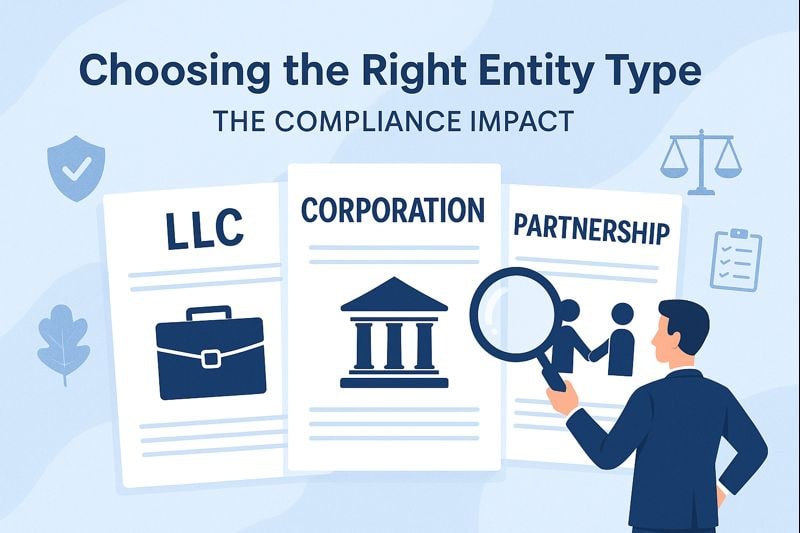
Before you file anything, the most important legal decision when starting a business in Delaware is the entity type. Your structure determines (1) what you file with the state, (2) how you’re taxed, (3) what ongoing reporting you must do, and (4) what records you need to keep to protect limited liability.
Most entrepreneurs starting a business in Delaware choose an LLC for flexibility and simpler governance. A Delaware corporation (especially a C-corp) is common when you expect outside investors, stock options, or venture funding.
Partnerships and LPs may fit real estate, funds, and specialized arrangements. The key legal insight: entity selection isn’t just a tax preference—it changes your annual compliance deadlines, fees, and required documents.
For example, Delaware corporations must file an annual report and pay franchise tax as part of remaining in good standing. The Division of Corporations is clear that Delaware corporations are required to file an annual report and pay franchise tax.
By contrast, Delaware LLCs don’t file a state annual report in the same way; instead, they pay a flat annual tax (often called the LLC franchise tax) by a set date.
If you’re starting a business in Delaware primarily to operate elsewhere, you also need to consider foreign qualifications in the “home” state where you’re doing business—because forming in Delaware doesn’t replace local registration.
Getting entity choice right upfront is one of the biggest “cost savers” in the legal requirements for starting a business in Delaware.
Name Rules, DBA (Trade Name) Strategy, and Brand-Safety Checks
A business name is more than a brand decision—it’s a compliance requirement when starting a business in Delaware. You typically have three layers to consider:
- Legal entity name (the name on your formation document filed with the Division of Corporations)
- DBA / trade name (“doing business as”) used for storefronts, websites, or product lines
- Trademark risk (brand conflicts that can trigger cease-and-desist letters)
When you’re starting a business in Delaware, the legal entity name must meet the state’s naming rules for your entity type and must be distinguishable from other registered entities. Many founders reserve a name early to avoid rework, then align the legal name and public-facing name later using a DBA if needed.
A DBA can be useful if you want a clean consumer brand without renaming the entity (for example, “Blue Oak Ventures LLC” operating publicly as “Blue Oak Design Studio”).
This is also helpful when you’re starting a business in Delaware with multiple product lines under one entity. However, using a DBA doesn’t eliminate trademark risk: you still want to do a basic clearance search to avoid choosing a name that’s already protected in your market.
Practical compliance tip: keep the spelling consistent across your formation filing, licensing profile, bank account, contracts, and invoices. Inconsistent naming is a common reason vendors, payment processors, and banks request extra documentation, which can delay launch.
Registered Agent Requirement: What It Is and Why It Matters
One of the non-negotiable legal requirements for starting a business in Delaware is maintaining a registered agent and registered office in the state. Delaware law requires corporations to have and maintain a registered office in Delaware, and a registered agent in Delaware to accept service of process and official notices.
This isn’t a formality. The registered agent is the legal “door” where lawsuits, subpoenas, and state compliance notices are delivered. If you miss those notices, the consequences can include default judgments, penalties, and loss of good standing—often without you realizing it until a bank or customer flags the issue.
When starting a business in Delaware, you generally have two registered agent paths:
- Commercial registered agent service (most common, especially for non-resident founders)
- In-state individual/entity that meets Delaware requirements (less common, must be consistently available)
Be careful with bargain solutions that don’t provide proper in-state presence or reliable document handling. A reliable registered agent should provide timely forwarding, online access to notices, and compliance reminders—because the long-term legal requirements for starting a business in Delaware include staying reachable year after year.
Filing Formation Documents with the Delaware Division of Corporations
Forming your entity is the central “state filing” step in starting a business in Delaware. Delaware’s Division of Corporations provides entity-specific formation pathways (for example, LLC certificate of formation or corporate certificate of incorporation), and the process is designed to be streamlined.
At a high level, your formation filing will include:
- Entity name
- Registered agent and registered office
- Basic structure details (varies by entity type)
- Filing fee (varies; expedited processing may be available)
For corporations, you’ll also address items like authorized shares and incorporator information. For LLCs, the public filing is typically minimal compared to the internal operating agreement (which is usually not filed with the state but is essential for governance).
A common misconception when starting a business in Delaware: filing the formation document does not automatically give you permission to “operate.”
Formation creates the entity, but operating legally typically requires licensing, tax registrations, and sometimes local permits depending on the activity. Delaware’s “One Stop” portal is designed to help connect those steps.
Internal Governance Documents: Operating Agreement and Corporate Bylaws
Even though Delaware often doesn’t require you to file internal governance documents publicly, they are a real part of the legal requirements for starting a business in Delaware—especially if you want liability protection and clean business operations.
For an LLC, the Operating Agreement sets the rules for:
- Ownership percentages and capital contributions
- Member vs. manager management
- Voting rights and major decision approvals
- Distributions and tax allocations
- Procedures for adding/removing members
- Dissolution and exit rules
For a corporation, Bylaws plus initial board consents and stock issuance records establish how the company is governed, how directors/officers are appointed, and how shareholder actions occur.
Why this matters when starting a business in Delaware: when disputes happen, courts, banks, investors, and auditors will ask for these documents. If you don’t have them—or they don’t match how you actually run the company—you risk piercing the corporate veil, ownership conflicts, and delays in funding or acquisitions.
A strong governance setup is also future-proofing. Even if you’re starting a business in Delaware as a solo founder, governance documents prevent chaos when you add a co-founder, bring on investors, or sell the business.
Business Licensing and Tax Registration: The “Operate Legally” Layer
A major piece of the legal requirements for starting a business in Delaware is obtaining the right licenses and registering for taxes. Delaware’s One Stop portal provides a guided workflow to register and license your business, and it explicitly connects licensing with employer obligations (like workers’ comp and unemployment insurance) when you have employees.
For many businesses, a state business license is required, and the Division of Revenue provides guidance and FAQs for business licensing. Requirements can vary depending on what you sell, how you sell it, and where you operate.
When starting a business in Delaware, think of licensing like a permissions checklist:
- General business license (common for many operations)
- Industry-specific licenses (construction trades, health services, childcare, etc.)
- Local city/county permits (signage, occupancy, food service, zoning)
- Sales-related tax registrations if you sell taxable products/services
- Employer registrations if you hire employees
The smartest approach is to treat licensing as a launch milestone, not a cleanup task. If you begin operating first and license later, you can face penalties, disrupted operations, or trouble opening merchant accounts and bank accounts.
Franchise Tax and Annual Reports: Staying in Good Standing
Staying compliant after formation is part of the legal requirements for starting a business in Delaware—because your entity can lose good standing if you miss deadlines.
- For corporations: Delaware requires corporations to file an annual report and pay franchise tax. The annual report is more than paperwork; it’s a “status confirmation” that keeps the entity active and recognized.
- For LLCs, LPs, and GPs: Delaware’s guidance states that these entities are not required to file annual franchise tax reports, but they must pay the $300 yearly tax on or before June 1. This is one of the most important compliance dates when starting a business in Delaware as an LLC. Missing it can lead to penalties and can eventually affect the entity’s status.
Because deadlines can be strict, a best practice is to set calendar reminders and keep your registered agent contact details current so you don’t miss state notices.
Good standing matters more than many founders realize: banks, payment providers, investors, government contracts, and enterprise customers often check your status before they do business with you.
Federal Tax Setup: EIN, Banking, and Clean Money Flow
Even though the state handles formation, most businesses starting a business in Delaware also need a federal Employer Identification Number (EIN) for tax reporting, payroll, and banking. You may also need an EIN even without employees, especially if you want a business bank account, plan to elect certain tax treatments, or have multiple members/owners.
The legal requirements for starting a business in Delaware don’t stop at “get an EIN,” though. To operate smoothly, you’ll want:
- A business bank account in the entity’s legal name
- Separation between personal and business expenses (critical for liability protection)
- Clear bookkeeping categories from day one
- Contracts and invoices issued by the correct entity
This isn’t just admin—it’s legal hygiene. Many liability and tax problems come from “commingling,” where the owner treats the business like a personal wallet. If you’re starting a business in Delaware for asset protection, clean separation is essential.
If you plan to accept card payments or online payments, be prepared for verification. Payment providers often request formation documents, EIN confirmation, and proof of good standing. Delaware compliance (especially franchise tax payment status) can directly impact onboarding.
Hiring Employees in Delaware: Payroll, Withholding, Workers’ Comp, and UI
If you are starting a business in Delaware and plan to hire, your compliance expands immediately. Delaware One Stop notes that businesses with employees working in Delaware will need to file workers’ compensation and unemployment insurance forms, and register for a withholding account.
Employer compliance usually includes:
- Withholding registration and payroll setup
- Unemployment insurance registration
- Workers’ compensation coverage
- New hire reporting
- Wage and hour compliance (pay frequency, overtime rules)
- Workplace postings and basic HR policies
Even if you only hire one part-time employee, the legal requirements for starting a business in Delaware can change substantially. If you use contractors, classify carefully—misclassification risk is real and can trigger taxes, penalties, and claims.
Future-facing note: state and federal agencies continue to increase enforcement and data matching (payroll filings, 1099s, and unemployment claims). That trend is likely to keep growing through 2026, making clean payroll systems a “must,” not a “nice to have.”
Industry-Specific Compliance: Regulated Services, Online Businesses, and Professional Licenses
Many entrepreneurs underestimate how industry rules affect the legal requirements for starting a business in Delaware. Formation is only the beginning. Depending on what you do, you may need extra compliance layers such as:
- Professional licenses (accounting, law, medicine, therapy, cosmetology)
- Facility permits and inspections (food, childcare, healthcare)
- Data privacy and cybersecurity obligations (especially for online services)
- Marketing compliance (truth-in-advertising, email marketing rules)
- Financial compliance if you handle client funds or offer payment services
If you’re starting a business in Delaware as an online business, you also need to consider where your customers are located. Sales tax, consumer protection rules, and privacy requirements often follow the customer, not the founder.
Delaware may be your formation state, but other states can still require registration and tax collection if you have “nexus” there.
The best practice is to write a one-page “compliance map” listing: (1) what you sell, (2) where you sell, (3) whether you employ people, and (4) whether you handle sensitive data. That map tells you which licenses and registrations you need—and prevents expensive surprises.
Corporate Transparency and Beneficial Ownership Reporting: What Changed in 2025
Beneficial ownership reporting has been one of the biggest moving targets in the legal requirements for starting a business in Delaware—and it matters because founders don’t want to miss a federal filing and trigger penalties.
Here’s the key 2025 update: FinCEN issued an interim final rule removing beneficial ownership information (BOI) reporting requirements for domestic companies and domestic persons, narrowing BOI reporting to certain foreign reporting companies. This is a major compliance shift compared to earlier expectations.
Because this area has been shaped by legal challenges and rule changes, your practical move when starting a business in Delaware is:
- Confirm whether you are treated as a domestic or foreign reporting company under the current rule
- Monitor FinCEN updates so you’re not surprised by future changes
- Keep clean ownership records anyway (cap table, member ledger, option grants), because lenders/investors may request them even if BOI reporting is narrowed
Future prediction (reasonable outlook): beneficial ownership transparency requirements may continue to evolve through new rulemaking, court decisions, or legislative changes.
Even if the filing burden stays reduced for many local entities, businesses should expect more identity verification and ownership transparency from banks, payment providers, and enterprise partners.
Common Compliance Mistakes When Starting a Business in Delaware (and How to Avoid Them)
Entrepreneurs starting a business in Delaware tend to make the same mistakes—because the process feels easy upfront and the hidden compliance items show up later. Here are the big ones:
Mistake 1: Forming in Delaware but forgetting to register where you operate
If you’re starting a business in Delaware but running operations elsewhere, you likely still need foreign qualification and tax registrations in the operating state. “Delaware formation” doesn’t replace that.
Mistake 2: Ignoring franchise tax deadlines
Corporations must file annual reports and pay franchise tax to remain compliant. LLCs/LPs/GPs must pay the $300 annual tax by June 1. Missing these can break your good standing.
Mistake 3: No operating agreement or weak bylaws
If you’re starting a business in Delaware to protect yourself, governance documents are the shield. Without them, disputes and audits become painful.
Mistake 4: Mixing personal and business finances
This undermines liability protection and makes taxes harder.
Mistake 5: Treating licensing as optional
Delaware’s One Stop is built around “register and license to operate,” because operation and licensing go together.
Avoiding these mistakes is a big part of meeting the legal requirements for starting a business in Delaware in a way that actually holds up under scrutiny.
FAQs
Q.1: Do I need a registered agent when starting a business in Delaware?
Answer: Yes. Maintaining a registered agent and registered office in Delaware is a core legal requirement for starting a business in Delaware, especially for corporations, and it’s a continuing obligation. Delaware law requires corporations to maintain a registered office and registered agent in the state.
Q.2: Do Delaware LLCs file an annual report?
Generally, LLCs are not required to file an annual franchise tax report like corporations do. Instead, Delaware states that LLCs (and LPs/GPs) must pay a $300 annual tax by June 1.
Q.3: What ongoing filings do Delaware corporations have each year?
Answer: Delaware corporations must file an annual report and pay franchise tax to remain in good standing.
Q.4: Does forming an entity mean I’m licensed to operate?
Answer: Not necessarily. Formation creates the entity. Operating legally typically requires business licensing and tax registrations. Delaware One Stop provides an online pathway to register and license your business.
Q.5: Has beneficial ownership reporting changed for small businesses?
Answer: Yes. FinCEN issued an interim final rule in 2025 removing BOI reporting requirements for domestic companies and narrowing the scope to certain foreign reporting companies. Because this topic has changed quickly, it’s smart to monitor official updates.
Q.6: If I hire employees, what extra steps apply?
Answer: If you have employees working in Delaware, you may need workers’ compensation, unemployment insurance, and withholding registration. Delaware One Stop explicitly flags these employer requirements as part of setup.
Conclusion
The legal requirements for starting a business in Delaware are manageable when you treat them like a system instead of a one-time form. “Formation” is only step one.
Real compliance includes maintaining a registered agent, building internal governance documents, securing licensing and tax registrations, meeting franchise tax deadlines, and setting up clean banking and recordkeeping.
If you’re starting a business in Delaware as an LLC, your ongoing obligation often centers on the annual $300 tax due by June 1.
If you’re starting a business in Delaware as a corporation, annual reports and franchise tax are central to staying in good standing. If you’re hiring, employer registrations and coverage add another compliance layer.
Looking into 2026, the overall trend is toward more structured compliance ecosystems: online registration portals, stronger cross-agency data matching, and evolving identity/ownership transparency expectations—even when formal reporting requirements are narrowed.
Keeping your entity in good standing, your records consistent, and your licensing correct is the best way to build a Delaware business that’s not only formed—but truly “ready for scale.”