
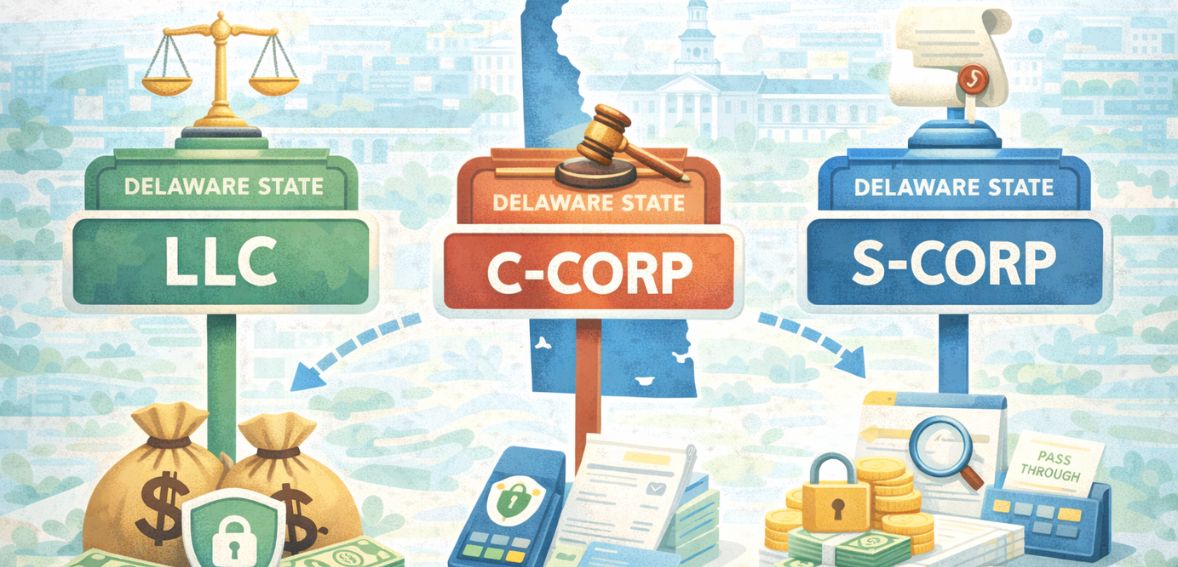
Delaware has long been considered the best place in the US to form a business, drawing in both startups and large corporations. Few states can match its reputation for business-friendly legislation, a specialized court system, and legal predictability. But picking Delaware is just the beginning.
Choosing the appropriate legal structure—LLC, C-Corp, or S-Corp—is the more important choice. Ownership control, compliance requirements, fundraising potential, and long-term scalability are all directly impacted by the unique legal, tax, and operational ramifications of each entity type.
Many founders make hasty decisions based on superficial advice, only to later run into problems. It is crucial to understand how these structures vary under Delaware law to create a business that not only launches successfully but also grows without unnecessary legal or financial friction.
Understanding the Delaware LLC Structure

For businesses seeking flexibility, a Delaware limited liability company is often their first choice. Legally speaking, an LLC offers limited liability protection without strict corporate formalities by combining aspects of corporations and partnerships. Members of LLCs have substantial power over administration, profit distribution, and decision-making authority due to Delaware law, which permits LLCs to be nearly wholly managed by their operating agreements.
In contrast to corporations, LLCs are exempt from holding annual meetings, issuing shares, or appointing boards unless specifically authorized under the operating agreement. LLCs are perfect for family businesses, closely owned companies, and professional services because of this flexibility. Delaware is appealing to single founders since it allows single-member LLCs.
But there are responsibilities associated with this flexibility. Poorly drafted operating agreements can create ambiguity, especially during disputes or ownership transitions, which is why legal precision matters when forming an LLC in Delaware. Business owners considering professional services, such as starting an accounting practice in Delaware, often benefit from the flexibility and simplified compliance of an LLC.
Delaware C-Corporations Explained
The best option for businesses looking to grow rapidly is the Delaware C-Corporation. It is a separate legal entity with different ownership and management, overseen by a board of directors, officers, and shareholders. Strong safeguards for directors are provided by Delaware corporation law, which promotes decisive leadership without undue personal risk.
C-Corps are able to easily draw in institutional investors, offer equity remuneration, and issue several classes of shares. Delaware C-Corps are preferred by venture capital firms due to the structure’s alignment with exit, governance, and funding plans. But complexity is introduced by this form.
Strict procedures, including yearly meetings, record-keeping, and compliance filings, must be followed by corporations. Although these regulations increase the administrative load, they also offer discipline and clarity. For businesses targeting external investment, public offerings, or acquisitions, the Delaware C-Corporation remains the most strategically aligned legal structure.
What Makes an S-Corporation Different
According to Delaware law, an S-Corporation is a federal tax election used to a corporation rather than a distinct organization type. Legally speaking, an S-Corp has the same executives, directors, and stockholders as a regular corporation. The main difference is in taxes. S-Corps circumvent corporate income tax by allowing profits and losses to flow straight to shareholders.
However, there are a lot of limitations to this benefit. S-Corps can only have one class of stock and no more than 100 stockholders, all of whom must be citizens or residents of the United States. These restrictions frequently clash with aspirations for progress.
S-Corps are typically inappropriate for venture-backed organizations, but they can be effective for closely owned corporations looking for payroll tax advantages. In Delaware, many founders begin as C-Corps and later explore S-Corp elections only if growth expectations remain modest and ownership stays simple.
Liability Protection Across Structures

Personal liability protection is one of the reasons business owners select formal corporations. When properly maintained, LLCs, C-Corps, and S-Corps all provide limited liability in Delaware. This implies that owners are typically not held personally liable for business debts or legal actions.
However, if owners disregard legal separateness, Delaware courts will lift the corporate veil. Regardless of structure, owners may be exposed if they mix personal and commercial finances, neglect formalities, or undercapitalize the company. Although LLCs have flexible governance, they still need to maintain operational discipline.
Despite being more formal, corporations frequently offer better insulation because of their more transparent monitoring and paperwork. The distinction is not in the protection per se, but rather in the ease of compromise. Delaware law rewards organizations that exhibit compliance, openness, and good faith governance. Liability protection is strongest when the legal structure is matched with consistent, responsible operational behavior.
Tax Treatment and Practical Impact
Entity choice becomes quite personal when it comes to taxes. Although out-of-state income is not taxed in Delaware, federal tax status varies greatly by structure. By default, LLCs use pass-through taxes, which means that profits go straight to members’ individual tax returns. Although double taxation is avoided, self-employment tax exposure may rise as a result.
Corporate income tax is levied on C-corporations, and dividend payments to shareholders are subject to further taxation. C-Corps profit from lower corporate tax rates, deductible spending, and retained earnings techniques, despite the adverse sound of this double taxation. S-Corps similarly pass through revenue, but when set up properly, they let owners divide profits between salaries and payouts, which lowers payroll taxes.
The legal distinction lies not only in rates but also in the flexibility of planning. All three forms are permitted in Delaware, but making an informed decision necessitates knowledge of revenue trends, reinvestment strategies, and long-term financial goals rather than focusing solely on immediate tax savings.
Governance and Control Considerations
Governance determines who makes decisions and how conflicts are resolved. Maximum control flexibility is provided by Delaware LLCs, enabling members to create unique governance schemes. Management might be fully delegated, decentralized, or centralized.
In contrast, corporations adhere to a clear hierarchy. Directors are chosen by shareholders, officers are appointed by directors, and officers oversee day-to-day operations. Although it restricts flexibility, its framework offers responsibility. Despite their tax distinctions, S-Corps and C-Corps adhere to the same corporate governance regulations. Strong director authority is supported by Delaware law, which frequently defers to board judgment absent blatant wrongdoing.
Governance has an impact on succession planning, dispute settlement, and control retention for founders. While corporations are preferable for shared ownership and investor supervision, LLCs are better for entrepreneurs who desire autonomy. The legal structure sets the rules of engagement long before disagreements arise, making governance one of the most consequential differences between Delaware entities.
Raising Capital and Investor Expectations

Entity selection is frequently determined by capital strategy. Fundraising is dominated by Delaware C-Corporations because they meet investor expectations. In a corporate setting, preferred stock, convertible notes, and equity incentives are simpler to execute.
Although LLCs can generate money, investors frequently oppose their bespoke agreements and pass-through tax implications. Due to shareholder limits that exclude institutional investors, S-Corps are considerably more constrained. Although complex financing arrangements are made possible by Delaware law, only corporations can fully utilize them.
Additionally, regardless of the size of the company, many investors want Delaware C-Corp registration in order to provide financing. This is more about standards and risk management than it is about legality. Early consideration of entity conversion fees is advised for founders who expect outside funding. Choosing the wrong structure can delay funding or force rushed legal changes later. In Delaware, legal flexibility exists, but investor preference strongly shapes practical outcomes.
Compliance and Administrative Burden

Different entities have quite different administrative responsibilities. Other than yearly franchise taxes and registered agent upkeep, Delaware LLCs need very few continuing formalities. Annual reports, shareholder meetings, board decisions, and meticulous record-keeping are among the more organized responsibilities that corporations must fulfill.
Despite the tax distinctions, S-Corps are subject to the same administrative requirements as C-Corps. Formal governance produces documentation that safeguards leadership and makes ownership clear, even though it may seem onerous. The business climate in Delaware is effective, but it demands consistency. Penalties or a loss of good standing may result from noncompliance.
The impact of administrative discipline on legal protection is frequently underestimated by entrepreneurs. The simplicity of LLCs is appealing, but it shouldn’t be confused with informality. Every structure has obligations, and companies that follow Delaware law are rewarded. The true distinction is in the amount of structure owners are willing to maintain, not in the level of complexity.
Franchise Taxes and State Costs
Franchise taxes in Delaware are frequently misinterpreted. Because LLCs pay a single annual franchise tax, expenses are predictable. Based on permitted shares or assumed capital, corporations are subject to variable franchise taxes, which may rise as businesses grow. Yet, Delaware provides computation techniques that enable businesses to strategically control expenses. Since tax elections have no bearing on state filing requirements, S-Corps pay the same franchise taxes as C-Corps.
Despite having greater franchise taxes than some other states, Delaware’s appealing legal framework is funded by these revenues. The advantages outweigh the expenses for a lot of businesses. Founders should, however, accurately predict long-term costs.
Although surprises can put a burden on early budgeting, franchise taxes are rarely deal-breakers. Businesses may make responsible plans and steer clear of needless fines by being informed of how Delaware determines and enforces these tax compliance lapses. When planning your entity type, also consider local labor costs such as the Delaware minimum wage, as payroll obligations can vary with structure and staffing plans.
Conversion and Structural Flexibility
Delaware law permits conversion between entities as businesses change. Corporations can choose S-status, LLCs can become corporations, and ownership can be reorganized through mergers. These changes are made easier by Delaware’s conversion statutes without the original corporation being dissolved.
Conversions, however, have operational, legal, and tax ramifications. A C-Corp conversion from an LLC may result in taxable events or necessitate renegotiation of ownership interests. If eligibility requirements are broken, S-Corp elections may be cancelled or revoked.
Although there is flexibility, early planning makes transitions go more smoothly. The legal system in Delaware encourages foresight. Friction and expense are decreased when an initial structure is selected with future requirements in mind. Delaware law’s structural flexibility is a strength, but it functions best when changes are intentional rather than reactive.
Privacy and Ownership Disclosure

Although there are variations among companies, Delaware is renowned for its commercial privacy. Because ownership information is not made public in formation paperwork, LLCs typically provide more privacy. More transparency is required by corporations, including the disclosure of officers and directors in some filings. S-Corps and C-Corps are subject to the same disclosure regulations.
Even though beneficial ownership reporting is becoming more and more required by federal requirements, Delaware still has more latitude than other states. Asset protection planning, family businesses, and closely held companies all need to take privacy into account. Privacy should not, however, take precedence over compliance.
Delaware strikes a balance between accountability and secrecy, particularly as national transparency regulations change. The amount of information that becomes public record is influenced by an entity’s decision, which may have an impact on operational discretion and personal exposure. Founders can select structures that are in line with their comfort levels and legal requirements by being aware of these distinctions.
Choosing the Structure That Actually Fits
In Delaware, there isn’t a single entity choice that is always right. Goals, growth strategies, ownership dynamics, and risk tolerance all influence the ideal structure. LLCs are excellent at simplicity and flexibility.
Scalability and investment preparedness are dominated by C-Corporations. S-Corps provide certain tax benefits under stringent limits. All three are clearly and consistently supported by Delaware law, but their disparities are not eliminated. Instead of making quick choices, founders should make thoughtful ones.
Legal structure is an operational framework that influences conduct throughout time, not just a filing decision. Delaware becomes more than just a jurisdiction when entity selection is in line with strategy, governance, and financial reality. It turns into a basis for long-term expansion and legal assurance.
Conclusion
Choosing between an LLC, C-Corp, and S-Corp in Delaware is not a matter of which structure is “better,” but which one fits your business reality. Delaware offers a solid legal framework, but how you are taxed, how decisions are made, how capital is raised, and how disputes are settled depend on the corporation you choose.
S-Corps provide targeted tax efficiency with restrictions, C-Corps facilitate scale and investment, and LLCs give simplicity and flexibility. Over time, rather than upon formation, the legal distinctions become more significant.
Structure lowers friction and promotes stability when it is in line with ownership dynamics, growth plans, and risk tolerance. Making a well-considered decision now avoids expensive reorganization later on and enables your company to expand within a framework intended to support growth.
FAQs
Is it always best to establish a business in Delaware?
No. Local businesses might not gain enough from Delaware to warrant additional expenses, but Delaware is perfect for scalable or multi-state enterprises.
In Delaware, is it possible to convert from an LLC to a C-Corp later on?
Yes. Statutory conversions are permitted in Delaware, but you should carefully consider the ownership and tax implications.
What makes Delaware C-Corporations more appealing to investors?
They provide clear case law, predictable governance, and adaptable equity structures that complement venture capital.
Does Delaware law recognize an S-Corp?
No. An S-Corp is not a distinct Delaware entity; rather, it is a federal tax election applied to a qualifying corporation. Fifth.
Which structure offers the strongest liability protection?
All three provide limited liability, but protection depends on proper compliance and separation of personal and business activities.