
If you’ve worked in multi-state retail, you already know sales tax is usually a front-and-center compliance issue. Delaware flips that script. There are no state or local sales taxes, which means retailers generally do not collect sales tax from customers the way they would in most other jurisdictions.
But “no Delaware sales tax” does not mean “no transaction-related tax.” Delaware replaces the familiar sales-and-use-tax model with a system that leans heavily on business licensing and gross receipts tax—a tax imposed on the seller’s receipts rather than the buyer’s purchase.
For accountants, that difference changes how you:
- Set up chart-of-accounts and revenue mapping
- Train staff on pricing and invoicing
- Reconcile POS totals to tax returns
- Assess nexus, registration, and audit exposure
- Advise on expansion into other states where sales tax is absolutely back in play
This guide is written for accountants supporting retailers operating in Delaware—brick-and-mortar, omni-channel, and growing online sellers. It focuses on what you need to know to keep clients compliant, keep books clean, and avoid the most common mistakes that happen when teams assume “no Delaware sales tax” means “nothing to file.”
Delaware Sales Tax Reality: What “No Sales Tax” Actually Means for Retailers
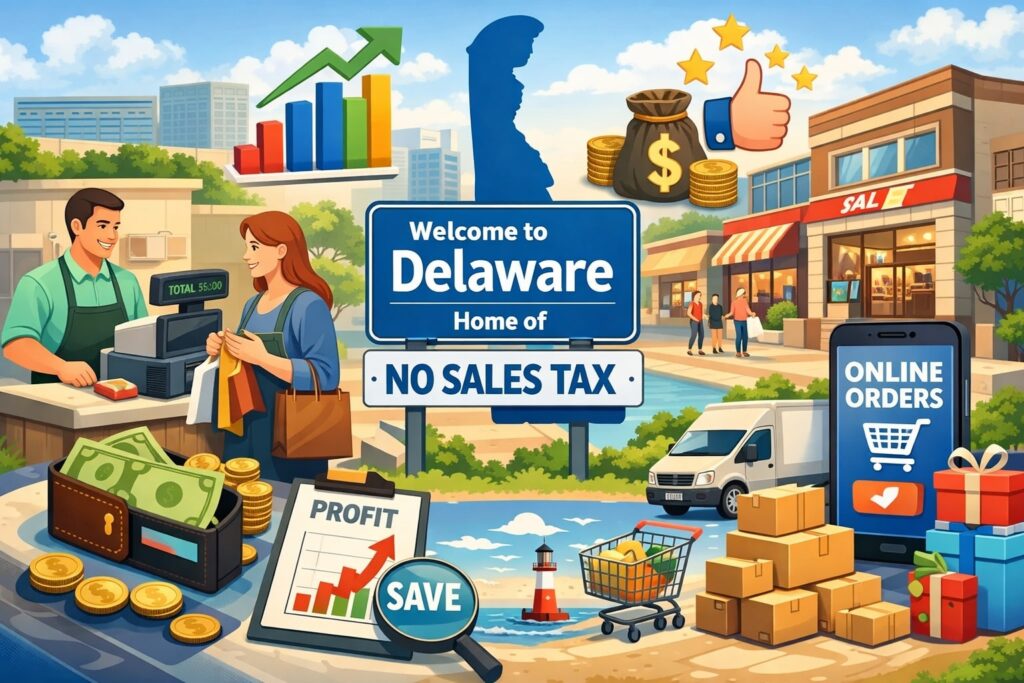
The most important starting point is a sentence that should appear in your onboarding and your client kickoff notes: Delaware has no state or local sales tax, and because of that, the usual paperwork—like “sales tax permits,” reseller certificates for state sales tax, and exemption certificates used in sales tax states—works differently here.
Delaware specifically notes that sales tax exemption and reseller certificates are not applicable because there is no sales tax, and it instead imposes license and gross receipt taxes on many goods and services.
From an accountant’s perspective, this impacts daily operations more than people expect. Retail staff often come from other states and assume they must “add tax” at checkout. E-commerce platforms frequently default to collecting tax if set incorrectly.
And customers sometimes ask why they were not charged “Delaware sales tax.” Your job is to help the business stay consistent: prices, receipts, customer messaging, and POS configuration should reflect that Delaware sales tax is not collected.
However, the tax burden didn’t disappear; it shifted. Delaware uses a business-side model: businesses generally need to hold the right business license and, depending on activity, pay gross receipts tax on taxable receipts.
Delaware’s Division of Revenue describes gross receipts tax as a tax on total gross revenues and emphasizes it is imposed on the seller of goods/services rather than the consumer.
That difference matters in Delaware sales tax conversations because retailers may attempt to treat gross receipts tax like a pass-through sales tax. Delaware’s guidance explicitly warns that these fees are imposed on the seller and may not be passed on to the consumer.
For accountants, that statement affects invoicing language, receipt design, and even how you advise on pricing (build tax cost into margins instead of itemizing it as “tax”).
Gross Receipts Tax: The Real “Delaware Sales Tax” Substitute Accountants Must Understand
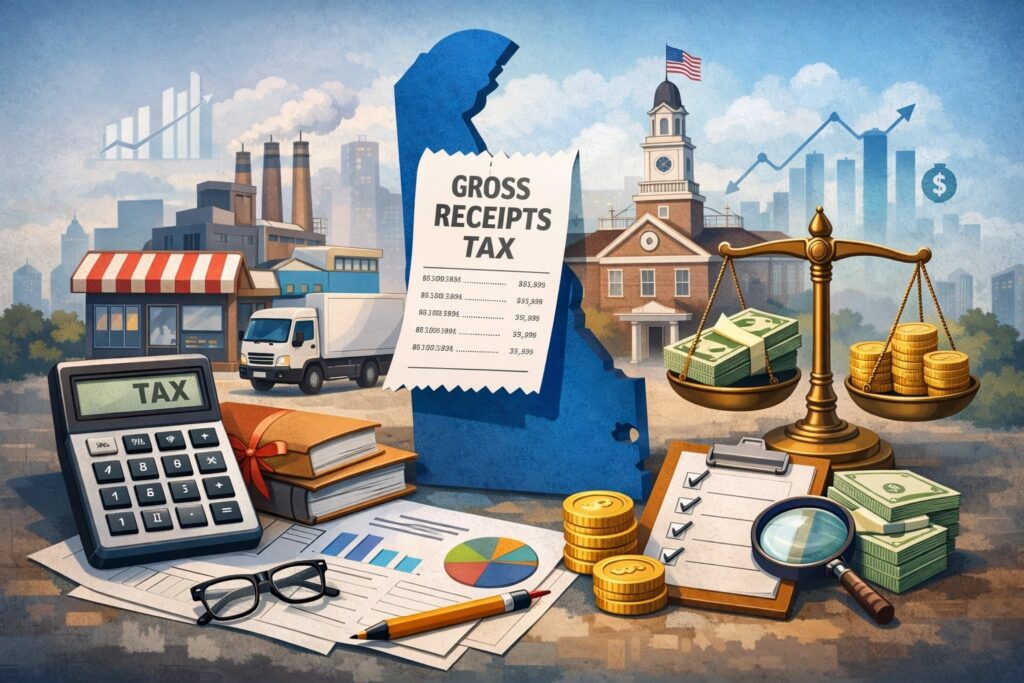
Delaware’s gross receipts tax is the centerpiece of its transaction-related tax approach. Delaware defines the gross receipts tax as a tax on the total gross revenues of a business, regardless of their source, and it is levied on the seller rather than the customer.
This is the point where many accounting teams stumble: gross receipts tax is not a tax on profit. It is not a tax on taxable income. It is not automatically offset by your cost of goods sold. Instead, it is tied to receipts, and that means businesses can owe tax even in low-margin periods.
For retailers, the practical implications are big:
- Revenue classification becomes a tax task: A retailer’s “Delaware sales tax” compliance isn’t about determining taxable vs exempt products, but about ensuring receipts are assigned to the correct license category and rate schedule. The rate you pay can depend on your business activity and licensing classification.
- Returns are a reconciliation project: Your gross receipts tax return is only as accurate as your POS data, your refunds/returns tracking, and your revenue recognition timing. Because it’s receipts-driven, you must define what counts as gross receipts in a way that aligns with Delaware rules and internal records.
- It changes advisory conversations: When clients ask, “Do we need to register for Delaware sales tax?” your answer becomes: “No Delaware sales tax registration exists in the usual sense, but you likely need a Delaware business license and you may owe gross receipts tax.”
Delaware’s own materials emphasize the business license requirement and gross receipts tax structure as a core part of “doing business” in the state.
Gross receipts tax rates vary by business activity, and Delaware’s own FAQ notes rates span a range depending on activity. That range is why accountants should avoid “rule of thumb” estimates and instead confirm the correct category.
How Gross Receipts Tax Differs From Sales Tax: Accounting and Compliance Consequences
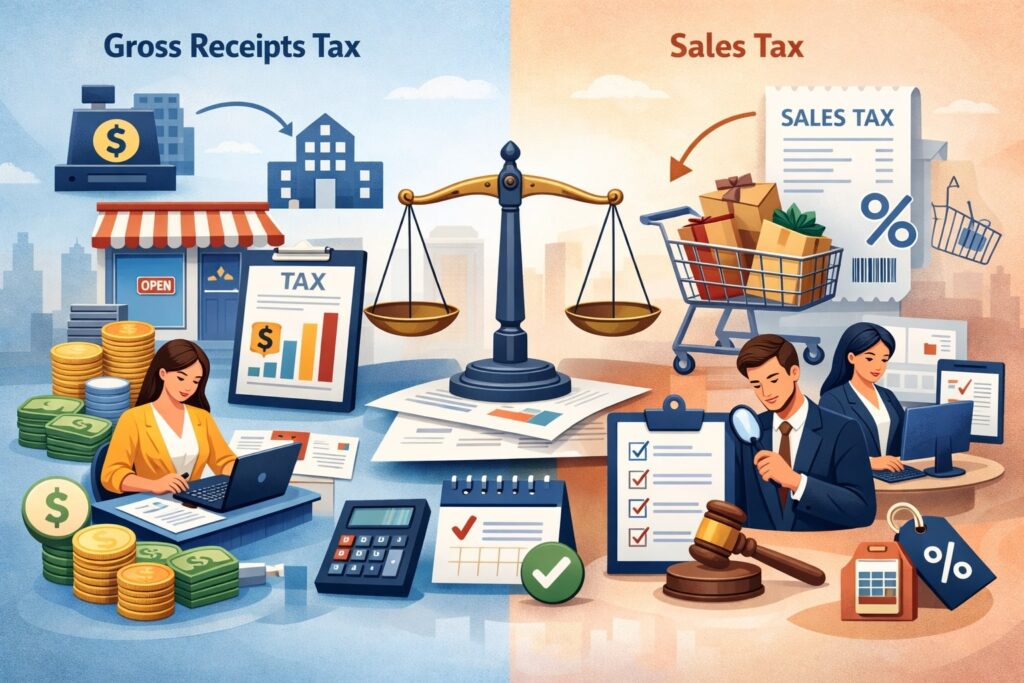
Even though people informally call it “Delaware sales tax,” gross receipts tax is structurally different in ways that show up in accounting workflows.
Sales tax (in sales-tax states) is typically:
- Collected from the customer
- Held in a liability account
- Remitted based on taxable sales
- Driven by product taxability rules and exemptions
Delaware’s model is typically:
- Not collected as “Delaware sales tax” at checkout
- Owed by the business as a cost of operating
- Based on taxable receipts tied to business activity classification
- Managed through licensing and filing schedules
Delaware also states that sales tax exemption and reseller certificates are not applicable, and that sales for resale are not exempt—another detail that surprises accountants used to sales-tax states.
This produces several accounting consequences:
- Chart-of-accounts setup: You generally do not book “Delaware sales tax payable” for in-state transactions. Instead, gross receipts tax is more commonly treated as a tax expense (or included in cost allocations), depending on your accounting policy.
- Pricing strategy: Because Delaware indicates these taxes/fees may not be passed on to the consumer, you generally shouldn’t itemize a “Delaware sales tax” line. You can still raise prices to cover operating costs, but the receipt line-item approach is a risk point.
- System configuration: E-commerce tax engines can misfire if a store is configured like a sales-tax state. If tax is accidentally collected, you create customer service issues and messy cleanup entries.
- Audit narratives: In sales-tax audits, the state often wants to see exemption certificates. In Delaware’s environment, the state expects to see licensing alignment, gross receipts reporting, and clean reconciliation support.
Accountants who treat Delaware sales tax like “nothing to do” often miss that the real work is in classification, licensing, and receipts-based reporting—and those are precisely the areas where internal controls and documentation matter most.
Business Licensing and Registration: The Gatekeeper to Delaware Retail Tax Compliance
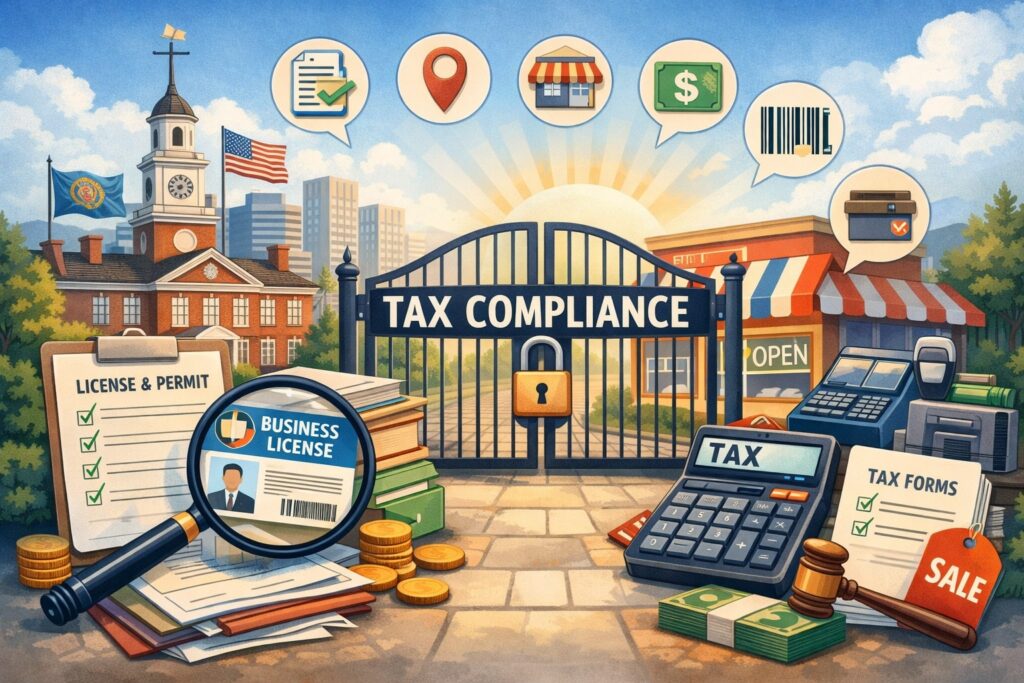
For retailers, compliance typically begins with business licensing. Delaware’s Division of Revenue provides business license FAQ resources and “doing business” guidance that emphasizes licensing as a key requirement for operating.
From an accountant’s standpoint, licensing is not just an administrative step—it drives how gross receipts tax accounts and filing obligations are established.
Key ideas to build into your client onboarding checklist:
- License first, receipts second: Many businesses start selling (especially online) and then discover licensing requirements later. The earlier you align licensing, the easier it is to map receipts correctly.
- Entity and activity matter: Licensing requirements vary by business entity type and whether the business has employees, and Delaware’s “doing business” materials point businesses to registration requirement resources.
- Use official channels. Delaware’s One Stop registration is a common path for registration and licensing, and Delaware’s portal resources guide businesses toward official steps and even mention a nexus questionnaire option when unsure.
What accountants should specifically watch:
- Multiple locations and license fees. The Delaware rate/fee listing includes annual license fees and additional location fees by category. If a retailer expands across locations, licensing costs and classification must be updated.
- Business model changes. If a client adds a new revenue stream (repair services, rentals, restaurant operations, delivery fees, etc.), you may need new licensing classifications and potentially different tax rates.
- Renewals and compliance calendar. The licensing cycle and the gross receipts filing cycle must be tracked like payroll deadlines—misses can compound into notices, penalties, and client stress.
This is where the phrase “Delaware sales tax” can mislead clients: they’ll think “no tax” means “no registration.” In reality, Delaware’s system is heavily dependent on business-side licensing and receipts reporting.
Retail Gross Receipts Tax Rates and Classifications: What Accountants Need to Map Correctly
Because Delaware doesn’t run a standard sales tax, the practical equivalent of “Delaware sales tax rate” for a retailer is the gross receipts tax rate tied to the retailer’s license category.
Delaware provides a detailed list of licenses and tax rates that shows:
- category and business type
- annual fee and additional locations fees
- current tax rate
- return frequency (monthly or quarterly)
- exclusion thresholds in some cases
For common retail operations, the listing includes:
- Retailer – General at a rate shown as 0.007468 with monthly returns and a listed exclusion of 100,000 (as displayed on the rate sheet).
- Grocery Supermarkets at 0.003267 with monthly returns and a 100,000 exclusion shown on the rate sheet.
- Restaurant Retailer at 0.006472 with monthly returns and a 100,000 exclusion shown on the rate sheet.
This is exactly the kind of detail accountants must operationalize:
- Match the POS department structure to the license category: If a retailer has multiple business lines (e.g., grocery + prepared foods + general merchandise), you need to confirm whether those lines map to one license category or multiple categories. Don’t assume; treat it like a chart-of-accounts design question that affects tax outcomes.
- Confirm exclusion rules: The rate sheet includes exclusions for many categories (often listed as 100,000, and other amounts for other categories). You need to understand what the exclusion applies to for that category and how to document it consistently.
- Plan for category drift: Retailers evolve. They add services, subscriptions, rentals, or events. Each addition can change classification and rate exposure.
Accountants should avoid relying solely on third-party summaries for rate selection. Delaware’s own rate listing is a primary resource and is the best anchor for category-to-rate mapping.
Filing Frequency, Due Dates, and the Delaware Tax Portal: Building a Compliance Calendar That Works
Once a retailer is licensed and classified, the next accountant-critical step is keeping filing schedules consistent. Delaware’s rate listing indicates whether returns are due monthly or quarterly by category.
To keep your compliance calendar accurate, you should also anchor deadlines to Delaware’s official due date tables. Delaware publishes gross receipts tax due dates—for example, a table for calendar year 2026 shows monthly and quarterly due dates and distinguishes certain business types versus all other monthly filers.
What accountants should pull from this and operationalize:
- Different monthly filers can have different due dates. The due date table separates certain business types (such as lodging-related categories) from “all other monthly filers,” and those timelines differ.
- Quarterly due dates are not “end of next month” in every case. The table shows the specific due dates for each quarter, and some dates land on the first business day after a weekend/holiday pattern.
- Use the Delaware Tax Portal as the filing anchor. Delaware’s due date table points filers to file through the Delaware Taxpayer Portal.
From a best-practice perspective, treat gross receipts filing like payroll tax operations:
- Create a standing monthly close checklist item: “Reconcile POS gross receipts to tax base.”
- Lock a consistent cut-off time for returns/chargebacks.
- Build a file folder that stores: daily Z-tapes, POS summaries, gateway deposits, refund logs, and return support.
- Keep a “category map” document: which SKU departments roll into which gross receipts tax classification.
Delaware sales tax confusion often causes retailers to overlook this entirely. Your value as an accountant is turning “no Delaware sales tax” into “yes—Delaware still has deadlines, filing, and documentation.”
Invoicing, Receipts, and POS Setup: Avoiding “Delaware Sales Tax” Line-Item Mistakes
One of the most practical accountant tasks in Delaware is preventing the business from accidentally treating gross receipts tax like Delaware sales tax at checkout.
Delaware notes that because there are no state or local sales taxes, exemption and reseller certificates are not applicable, and it imposes license and gross receipt taxes that are imposed on the seller and may not be passed on to the consumer.
That statement should change how you advise clients on:
Receipt Formatting and Customer-Facing Language
If a business prints receipts with a “tax” line, it can confuse customers and potentially create compliance risk. It is safer to show a tax line only when a transaction is shipped to or sourced in a jurisdiction where customer-collected sales tax applies.
For Delaware in-store sales, the common practice is to reflect tax costs in pricing rather than as an itemized add-on.
POS and E-commerce Tax Settings
Most platforms assume a standard sales tax workflow. Accountants should verify settings like:
- destination-based tax rules
- nexus settings by state
- whether “Delaware sales tax” is incorrectly enabled
- marketplace settings (marketplaces may calculate other states’ sales tax on shipped orders)
Bookkeeping Treatment
If a client mistakenly collects “Delaware sales tax,” you need a remediation plan:
- identify the period and total collected
- decide whether refunds are needed (and how to issue them)
- reclassify amounts out of tax payable if booked incorrectly
- document the correction, because a future audit or customer complaint can trigger questions
From an internal control viewpoint, you want a clear policy:
- Delaware sales tax is not collected on Delaware retail sales
- gross receipts tax is a business obligation handled through compliance filings
- any tax shown on customer receipts is tied to other states or specialized taxes clearly authorized for customer pass-through (such as certain lodging-related charges where indicated by Delaware guidance)
This is a high-impact area where accountants prevent costly, brand-damaging mistakes.
Exemptions, “Resale,” and Why Delaware Breaks the Usual Rules
If you’re used to sales tax states, your muscle memory will betray you in Delaware—especially around resale.
In many states, wholesalers and retailers use resale certificates to buy inventory tax-free, and retailers collect sales tax on taxable retail sales while exempting resale transactions.
Delaware explicitly notes that sales tax exemption certificates and reseller certificates are not applicable because there are no state or local sales taxes. It also states that sales for resale are not exempt in this license/gross receipts context.
Accountants should translate that into operational guidance:
- Stop asking for Delaware resale certificates as if this were a sales tax state” If a vendor requests a resale certificate for “Delaware sales tax,” the correct response often involves explaining Delaware’s structure and working with the vendor’s compliance process. Your client may need to provide other documentation, but it won’t be a Delaware sales tax resale certificate in the usual sense.
- Don’t assume resale eliminates gross receipts exposure: Delaware’s model is not built on the retail chain “tax at the end consumer.” It is built on receipts-based taxation and licensing. That changes how you model costs, margins, and compliance.
- Understand exclusions and limited exemptions carefully: The official license/rate listing includes “exclusion” amounts for many categories. The presence of an exclusion is not the same as a sales tax exemption. It typically means there is a threshold or carve-out concept tied to the license category. As an accountant, you must document how you applied it and why.
- Train teams to use the right vocabulary: Internally, keep the keyword “Delaware sales tax” for SEO and common communication, but in accounting procedures, consistently call it:
- business license fees
- Delaware gross receipts tax
- filing frequency and due dates
That vocabulary discipline reduces costly misunderstanding when you hire staff from sales-tax states.
E-Commerce and Interstate Sales: The Hidden Risk Behind “No Delaware Sales Tax”
Retailers love “no Delaware sales tax” for in-state sales, but the trap is assuming the same simplicity applies to out-of-state shipments.
Delaware’s own “doing business” guidance highlights that sales of tangible property are subject to retail/wholesaler licensing and gross receipts taxes and that these are imposed on the seller and remitted on a schedule based on business activity. Meanwhile, Delaware’s gross receipts tax is defined as applying to total gross revenues of a business.
The key accounting insight is this:
- Delaware in-state sales may not require collecting Delaware sales tax.
- But shipments to other states can trigger other states’ sales tax rules, including economic nexus thresholds, marketplace facilitator rules, and product taxability differences.
So your Delaware-based retailer can be perfectly compliant in Delaware and still be noncompliant elsewhere—especially once sales volume grows.
Accountants should put these controls in place:
- Ship-to state reporting: Ensure the POS/e-commerce platform can report sales by destination state, including counts and revenue. This is the raw data needed for nexus tracking.
- Marketplace vs direct sales separation: Marketplaces may collect and remit in many states, but direct-to-consumer sales often remain the seller’s responsibility. Your books should separate marketplace payouts from direct gateway deposits so you can properly evaluate where tax obligations sit.
- Nexus monitoring cadence: Set a monthly or quarterly review that checks sales volume by state against common economic nexus patterns (thresholds vary by state). This is where “no Delaware sales tax” ironically increases audit risk elsewhere because the business may not prioritize sales tax systems until it’s too late.
- Data hygiene: If your shipping address data is messy, your nexus analysis will be wrong. Make address validation part of the financial controls story.
This section matters because, in practice, many Delaware retailers rank highly for “Delaware sales tax” searches, attract out-of-state buyers, then expand without realizing they just stepped into a multi-state compliance world.
Special Delaware Transaction Taxes Retailers Encounter: Lodging, Short-Term Rentals, and More
Even though Delaware has no general Delaware sales tax, it does impose certain transaction-related taxes in specific industries, and retail-adjacent businesses can get pulled in unexpectedly.
Short-Term Rental Lodging Tax (Effective 2025)
Delaware’s Division of Revenue explains a short-term rental lodging tax at 4.5% on rent for short-term rentals, and references the governing code chapter.
- a retailer also operates short-term rental units (common with tourism-focused businesses)
- a property company has an attached gift shop or retail component
- an owner has multiple activities under one umbrella and needs correct classification and reporting
Accountants should treat this like a separate compliance stream with its own rules and documentation.
Hotel/Motel/Similar Occupancy Taxes
Delaware’s license and rate listing indicates an 8% tax for hotels, motels, and tourist homes, collected from the guest and remitted to the Division of Revenue.
If your “retailer” client also runs lodging (even small-scale), you can’t rely on the “no Delaware sales tax” talking point—this is a distinct customer-facing tax with separate handling.
Motor Vehicle and Specialized Retail Fees
The rate sheet includes examples like motor vehicle dealer-related items and special retail fees (e.g., tire fees) that can apply depending on the product line. Retailers who diversify into regulated or specialized product lines should be reviewed annually for licensing and fee exposure.
The accountant’s role is to map each revenue stream to the correct Delaware obligation. Delaware’s system is activity-based. If you treat a diversified business like “one retail bucket,” you’ll miss something.
Audit Readiness, Documentation, and Internal Controls for Delaware Retail Tax Filings
Delaware sales tax audits are not typically about whether you charged the right tax rate on a taxable item—because you generally aren’t charging Delaware sales tax in the first place. Instead, audit risk centers on:
- correct licensing
- correct classification and rates
- completeness of gross receipts reporting
- reconciliation support from books to filed returns
- consistency in handling refunds, voids, discounts, and gift cards
Delaware’s gross receipts tax is described as applying to total gross revenues, and it is imposed on the seller. That framing tells you what auditors care about: whether you underreported receipts or used the wrong category/rate.
Build an audit-ready file package each filing period:
- POS sales summary (by department/category)
- Deposit report (merchant processor settlements + cash deposits)
- Refund/return report (with timestamps and reasons)
- Discounts/promotions report
- Gift card issuance/redemption report
- Any manual journal entries affecting revenue
Then keep a one-page reconciliation:
- POS gross sales
- minus returns/voids (as supported)
- plus/minus timing adjustments
- equals reported gross receipts base
This is also where you guard against the accidental “Delaware sales tax collected” issue: auditors will notice if receipts show tax collected inconsistently with Delaware’s no-sales-tax structure and may ask what those charges were.
If your client operates in multiple states, maintain a separate Delaware-focused reconciliation so Delaware filings remain clean, even while other states’ sales tax compliance runs in parallel.
Future Outlook and Predictions: Where Delaware Retail Tax Compliance Is Headed
Predicting tax policy is never guaranteed, but accountants can still plan based on structural trends and published administrative direction.
Delaware’s model is deeply built around business licensing and gross receipts tax, and official resources continue to emphasize these tools as core to doing business. That makes a sudden shift to a general Delaware sales tax less likely than incremental refinement of the existing system.
Here are realistic forward-looking expectations for retailers and their accountants:
- More digital-first administration: Delaware’s due date table points filers directly to the Delaware Taxpayer Portal for filing. Expect continued push toward portal-only workflows, faster notice cycles, and better matching of filings to third-party data.
- More attention to classification accuracy: As businesses diversify (retail + services + subscriptions), the risk of using the wrong category grows. Delaware already publishes detailed category-based rates and fees, which suggests classification will remain central.
- Growing complexity around lodging/short-term rentals: With Delaware’s 4.5% short-term rental lodging tax now established, businesses with mixed operations will need tighter separation of revenue streams and strong documentation.
- Interstate compliance will matter more than ever: Even if Delaware sales tax remains “none,” e-commerce growth means Delaware retailers are more likely to trigger tax obligations elsewhere (economic nexus, marketplace rules, etc.). That makes proactive data reporting and system configuration the best investment an accountant can recommend.
In short: the future is not “Delaware will start charging sales tax tomorrow.” The future is “Delaware will keep refining a business-side system, while your client’s interstate exposure grows.” Accountants who build processes now will save clients major cleanup later.
FAQs
Q.1: Is Delaware sales tax really 0%, and do retailers need a Delaware sales tax permit?
Answer: Yes—the general Delaware sales tax rate is effectively 0% because the state has no state or local sales taxes. That said, retailers often still need to register and remain compliant through business licensing and gross receipts tax obligations rather than through a traditional sales tax permit.
Delaware’s resources emphasize that businesses have an annual business license requirement and that gross receipts taxes are imposed on the seller and remitted based on business activity.
For accountants, the key is how you answer the client question. If a client asks, “Do I need to register for Delaware sales tax?” The accurate, low-confusion response is: “You don’t register to collect Delaware sales tax because it doesn’t exist—but you likely must obtain a Delaware business license and file gross receipts tax returns depending on your activity.”
This avoids the common trap where businesses skip registration entirely because they assume “no Delaware sales tax” means “no compliance.”
Also, be careful with third-party blogs that talk about “Delaware sales tax permits.” The official framing is licensing and gross receipts tax, not a standard sales tax permit workflow.
Q.2: Can a retailer charge customers a “Delaware sales tax” line on receipts to recover gross receipts tax?
Answer: Delaware’s guidance is clear that because there are no state or local sales taxes, Delaware’s license and gross receipt taxes are imposed on the seller and may not be passed on to the consumer. In practice, that means itemizing a “Delaware sales tax” or “gross receipts tax” charge at checkout is a risky approach.
From an accountant’s advisory perspective, the safer strategy is pricing design: build the cost of doing business—including gross receipts tax—into the product margin rather than adding a visible “tax” line.
This reduces customer confusion (“Why am I paying Delaware sales tax if Delaware has no sales tax?”) and reduces compliance exposure if regulators view the charge as an improper pass-through.
If a client insists they need a separate line item for internal reasons (like a cost recovery metric), advise them to consult qualified legal counsel and obtain written guidance—because the plain-language rule Delaware publishes is that these fees may not be passed to consumers.
Q.3: What gross receipts tax rate applies to a typical retailer, and how do accountants confirm the right classification?
Answer: Delaware publishes a detailed list of licenses and tax rates by category, and that document is the best starting point for classification.
For example, the rate sheet shows Retailer – General with a tax rate listed as 0.007468, filed monthly, with an exclusion amount shown as 100,000. Grocery supermarkets and restaurant retailers are shown with different rates, reinforcing why classification matters.
Accountants should confirm classification by reviewing:
- what the business sells (general merchandise vs grocery vs prepared foods)
- how revenue is recorded in the POS (departments and SKU categories)
- whether the business offers services in addition to goods
- whether there are multiple locations or related entities
A best practice is to build a “rate mapping memo” into the workpapers: cite the business type from the Delaware rate sheet, store a copy of the rate listing used, and document how POS departments roll into the tax reporting base. This becomes critical if the client expands, changes business model, or faces an inquiry.
Q.4: How often do retailers file Delaware gross receipts tax returns, and what deadlines should accountants track?
Answer: Delaware’s rate listing indicates the return frequency by category—many retailer categories are monthly, while some activities can be quarterly.
For deadline management, Delaware publishes annual due date tables that provide specific due dates for monthly and quarterly filers and differentiate certain business types from “all other monthly filers.”
For example, the 2026 due date table shows monthly period end dates with corresponding due dates and provides quarterly due dates for quarter-end periods. The same document directs taxpayers to file through the Delaware Taxpayer Portal, signaling that digital filing is the operational standard.
Accountants should treat these deadlines like payroll deadlines—non-negotiable and calendar-driven. Build a compliance calendar that includes:
- monthly reconciliation close date
- internal review date
- filing date buffer (at least a few business days)
- payment approval timeline
This is where “no Delaware sales tax” creates a false sense of security. The correct practice is to replace sales tax calendars with gross receipts calendars.
Q.5: Are there any special transaction taxes that affect retail-adjacent businesses, even though Delaware sales tax is 0%?
Answer: Yes. While Delaware has no general Delaware sales tax, it does impose certain transaction-related taxes in specific areas that retail-adjacent businesses can encounter.
A major example is the short-term rental lodging tax, which Delaware describes as 4.5% on rent for short-term rentals. If a retail owner also operates short-term rentals (common in tourism areas), that revenue stream needs separate tracking and compliance.
Another example is lodging-related categories where Delaware’s rate listing notes an 8% tax collected from the guest and remitted to the Division of Revenue for hotels/motels/tourist homes. That is structurally different from gross receipts tax and closer to what people think of as a transactional tax.
For accountants, the key is separating business lines. A “retailer” may still have lodging, rentals, services, or specialized product fees that create additional filing and documentation obligations. The fastest way to get into trouble in Delaware is assuming one simple “Delaware sales tax = 0” rule covers the entire business model.
Conclusion
Delaware sales tax is famous for being “nothing”—but in real accounting work, it’s the opposite. Delaware’s lack of sales tax changes the type of compliance, not the need for compliance.
Your accountant playbook should be built around five essentials:
- Don’t collect Delaware sales tax: Delaware has no state or local sales tax, and resale/exemption certificates in the sales-tax sense aren’t applicable.
- License correctly: Delaware’s system depends on business licensing as the gateway to correct reporting.
- Map receipts to the right category and rate: Use Delaware’s published license/rate list to anchor classification decisions and documentation.
- Build a filing calendar and reconcile it like it’s payroll: Use Delaware’s due date tables and portal-first workflow to keep filings timely.
- Watch the future risk: interstate sales tax exposure: The real complexity for Delaware retailers often shows up when they sell into other states and cross economic nexus thresholds.
If your clients understand these principles, “Delaware sales tax” stops being a confusing myth and becomes a manageable, well-documented compliance system—one you can run cleanly, audit-ready, and scalable as the retailer grows.