If you’re an employee trying to confirm you’re being paid correctly—or an employer trying to stay compliant—Delaware wage rules can feel straightforward on the surface and surprisingly detailed once you get into tipped work, payroll timing, meal breaks, youth employment, and newer leave programs.
This guide focuses on Delaware minimum wage requirements and the broader wage-and-hour rules that most commonly trigger complaints, audits, and costly mistakes. It’s written to be practical, readable, and search-friendly—without sacrificing legal accuracy.
Delaware Minimum Wage in 2025: The Current Rate and What It Means in Real Life
As of January 1, 2025, the Delaware minimum wage is $15.00 per hour. This is the “standard” statewide floor for most hourly workers—full-time, part-time, seasonal, and temporary—regardless of whether you’re paid weekly, biweekly, or monthly.
Because Delaware sets the wage at the state level, employers generally can’t use a lower internal “company minimum” if it falls below the Delaware minimum wage.
In day-to-day terms, Delaware minimum wage compliance is not just about the number on your paycheck. It also connects to how your employer counts “hours worked” (for example, required pre-shift setup time), what they deduct from wages, and whether they’re properly handling tipped income.
Many wage disputes happen because employers unintentionally miss compensable time—like required training or mandatory meetings—and the employee’s effective hourly rate drops below the Delaware minimum wage.
Another practical issue is classification. A worker can be labeled “salary,” “manager,” or “independent contractor,” but what matters is the real job duties and how pay is structured. If someone is misclassified, they can lose overtime and end up effectively earning less than Delaware minimum wage after long weeks.
Finally, Delaware minimum wage impacts more than employees. Employers should update payroll systems, offer letters, timekeeping settings, and budgeting assumptions—because wage changes affect overtime calculations, tip-credit math, and sometimes benefit contributions.
Standard Delaware Minimum Wage Rate: Who’s Covered and Who Isn’t
The standard Delaware minimum wage applies broadly, but not universally. Most private-sector employees are covered, and the expectation is simple: the hourly rate paid for all hours worked should not fall below Delaware minimum wage.
However, certain roles can be exempt from minimum wage rules based on long-standing categories (often tied to federal wage law concepts). In practice, exemptions are narrow and frequently misunderstood.
For example, being paid salary does not automatically make someone exempt; the duties must typically meet specific tests (executive/administrative/professional) and pay must meet certain thresholds under federal standards.
From a worker perspective, if you’re paid hourly, you’re almost certainly protected by Delaware minimum wage. If you’re paid salary, you may still be protected depending on your duties and pay structure.
And if you’re treated like an independent contractor, your actual working relationship matters—because misclassification can remove Delaware minimum wage protections on paper even when the reality looks like employment.
From an employer perspective, the safest approach is to assume coverage unless you have a well-documented reason you’re outside the wage law. When disputes happen, state and federal investigators typically focus on time records, actual job duties, and payroll proof—not job titles.
Tipped Employees in Delaware: The $2.23 Cash Wage, Tip Credit, and Common Violations
Tipped work is where Delaware minimum wage compliance most often breaks down. Delaware allows a tipped “cash wage” of $2.23 per hour, as long as the employee’s total earnings (cash wage + tips) equal at least the Delaware minimum wage for each hour worked.
That sounds simple, but the real-world details matter:
- If tips are low in a given pay period and the worker’s total hourly earnings do not reach Delaware minimum wage, the employer must make up the difference.
- Tip policies must be handled carefully: improper tip pooling, managers sharing in tips, or missing notice requirements can create liability under wage-and-hour rules (and can wipe out the ability to claim a tip credit). For general tip-credit rules, the federal wage agency highlights notice and tip-retention requirements.
- Side work and “dual jobs” issues often trigger claims—if a tipped employee is doing substantial non-tipped tasks, employers need to ensure pay practices still satisfy Delaware minimum wage and federal requirements.
If you’re a tipped worker, track your hours and tips. If you’re an employer, document your tip-credit policy, train managers, and run periodic payroll checks to confirm every tipped employee still reaches Delaware minimum wage.
Youth and Training Wages: What Delaware Does (and Doesn’t) Allow Today
Many states allow reduced youth or training wages under certain conditions. Delaware’s scheduled wage increases were designed to move the statewide rate upward, and the current statewide Delaware minimum wage is broadly applied across roles, with limited exceptions and special categories.
In practice, the bigger legal focus for minors in Delaware is not a separate Delaware minimum wage number—it’s work permits and hour restrictions. Employers must be especially careful to comply with youth employment rules, because violations can create penalties even when the teen is paid correctly.
If you’re a teen worker (or parent), you should focus on: (1) whether the job is allowed for your age, (2) whether a permit is required, and (3) whether the hours are legal during school weeks. If you’re an employer, the best practice is to keep work permits on file, build scheduling guardrails into your scheduling system, and train supervisors.
How the Delaware Minimum Wage Reached $15 and What’s Scheduled Next
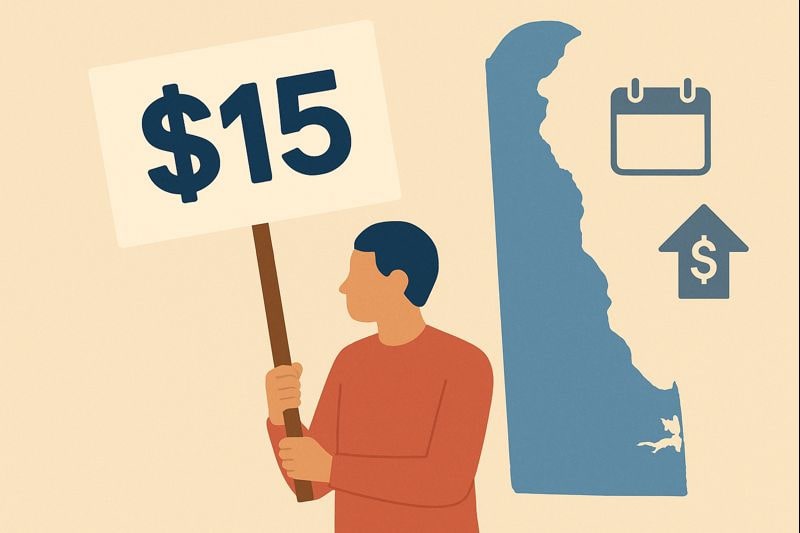
Delaware’s path to $15 was not a one-time jump. It was passed as a scheduled series of increases, culminating in $15.00 on January 1, 2025. State labor-market analysis estimated that the final step to $15 would impact tens of thousands of workers and significantly affect industries like accommodation/food service and retail.
Is another Delaware minimum wage increase already planned?
As of the most recent official state wage-and-hour guidance, $15.00 is the current Delaware minimum wage, effective January 1, 2025.
Public discussions about future increases often focus on inflation, cost-of-living pressures, and whether Delaware should adopt automatic indexing. But unless a new law is passed, employers should assume the Delaware minimum wage stays at $15 and monitor legislative updates each year.
Future prediction (practical, not speculative): over the next few years, it’s reasonable to expect continued debate around (1) whether Delaware minimum wage should rise above $15, (2) whether the tipped cash wage should increase, and (3) whether automatic inflation indexing should be adopted.
The clearest “future change” already on the calendar is the rollout timing of Delaware’s paid leave program (covered later), which becomes a major compliance topic in 2026.
Overtime in Delaware: The 40-Hour Rule, Regular Rate, and Exemptions That Matter
When people search “Delaware minimum wage,” they often also need overtime clarity—because even if the hourly rate meets Delaware minimum wage, overtime mistakes can still create large back-pay exposure.
Delaware generally follows federal overtime principles: non-exempt employees must receive time-and-one-half for hours worked over 40 in a workweek. Key real-life points:
- “Workweek” is fixed. Employers define it (e.g., Sunday–Saturday) and should not change it to avoid overtime.
- Regular rate calculations are tricky. Bonuses, commissions (in many cases), and certain differentials can change the regular rate used to compute overtime.
- Exemptions are not job titles. “Assistant manager” does not automatically mean exempt. Exempt status is tied to duties and pay structure under federal rules.
Workers who are misclassified may be owed not only unpaid overtime but also additional damages in some situations. Employers should audit exempt roles periodically—especially in retail, hospitality, and small businesses where managers often do the same hands-on work as their teams.
Meal Breaks and Time-Off-the-Clock: Delaware’s 30-Minute Rule and Its Exceptions
Delaware has a specific meal break rule: if an employee works 7.5 or more consecutive hours, the employer must allow an unpaid meal break of at least 30 consecutive minutes, scheduled after the first two hours and before the last two hours of the shift.
This is one of the most misunderstood parts of Delaware labor compliance. Employers sometimes believe meal breaks are “optional” because many states do not mandate them for adults.
Delaware does. But there are exceptions—such as when a collective bargaining agreement or certain written agreements provide otherwise, and some specific professional categories are treated differently.
Also, meal breaks must be bona fide: employees should be fully relieved of duties. If a worker is answering phones, watching a register, or responding to customers, that can convert the “break” into paid time.
A common wage claim happens when someone’s timecard shows a meal break every day, but in reality the person worked through it. If that pushes the effective hourly rate below Delaware minimum wage, it becomes a Delaware minimum wage problem too—not just a break issue.
Wage Payment Rules: Pay Frequency, Paydays, Final Paychecks, and Legal Deductions
Delaware wage law is not only about how much you’re paid—it’s also about when and how you’re paid.
Pay frequency and timing
Employers must set regular paydays in advance and pay wages on those paydays at least once per calendar month. In addition, Delaware’s official labor law poster guidance notes wages must be paid at least monthly and generally within a short window after the pay period closes (with exceptions in the statute).
Final paychecks
When employment ends, final pay timing depends on the circumstances and the “next regular payday” concept. Because final pay rules can be fact-specific, employers should rely on the statute and current state guidance when separating an employee.
Deductions from wages
Deductions are another major source of disputes. Delaware rules regulating wage deductions include limits and often require written consent for certain deductions (such as deposits for employer property).
If deductions are taken incorrectly, a worker’s net pay can fall below Delaware minimum wage—creating liability even if the “base rate” looked compliant.
Best practice: workers should keep pay stubs; employers should keep signed deduction authorizations and a clear written policy.
Child Labor in Delaware: Work Permits, Hour Limits, and Break Rules for Minors
Delaware child labor compliance is strict, and it’s a separate risk area from Delaware minimum wage. The state requires employers to maintain work permits for employees under 18, and the official work permit instructions highlight the minimum age and legal hour guidance.
Common rules that matter in real scheduling:
- For ages 14–15, work time is limited and restricted to certain hours of the day (especially during school weeks).
- For ages 16–17, Delaware guidance often focuses on limits combining school + work in a day and not requiring work during school hours.
- Minors also have break protections—for example, the work permit instructions note a minor may not work more than a set number of hours continuously without an uninterrupted non-work period.
For parents and teens: don’t assume “everyone is hiring” means every job task is legal for your age. For employers: treat youth labor as a system—permits, scheduling constraints, task restrictions, and supervisor training.
Paid Leave and Protected Time Off: The Healthy Delaware Families Act and 2026 Readiness
Delaware’s paid leave landscape is changing, and this affects both employees planning leave and employers budgeting for compliance.
Delaware created a paid family and medical leave insurance program through the Healthy Delaware Families Act, and the Delaware Department of Labor provides an official program overview and regulatory updates.
While details such as contribution timing, covered leave types, and employer-size rules require close attention to the current regulations, the big compliance reality is this: many employers are preparing for the program’s rollout in 2026, and recent amendments have continued to refine how it interacts with employer-provided PTO.
- Practical employee takeaway: paid leave programs usually require documentation and notice. If you expect to use paid family or medical leave, you should learn what proofs are required and how benefit applications work.
- Practical employer takeaway: treat 2025 as the planning year—update handbooks, align PTO policies with new rules, set payroll processes for contributions (if applicable), and train HR on how requests will be handled.
- Future prediction: because paid leave programs typically evolve after launch, expect additional clarifications and rulemaking after the rollout—especially around documentation, employer coordination with existing benefits, and dispute processes.
Compliance Checklist for Employers: The Fastest Way to Avoid Wage Claims
Most Delaware minimum wage disputes are preventable. Employers who build compliance into payroll and scheduling systems usually avoid the big-ticket problems.
Here’s a practical Delaware minimum wage and wage-and-hour checklist:
- Confirm all hourly rates meet Delaware minimum wage ($15.00 as of Jan 1, 2025).
- Re-check tipped roles: cash wage, tip-credit notices, tip pooling rules, and weekly audits to ensure total pay meets Delaware minimum wage.
- Lock down timekeeping: no “off-the-clock” work, record pre-shift and closing tasks, pay for required training.
- Overtime controls: define the workweek, train managers, and ensure the regular rate is calculated correctly.
- Meal break compliance for shifts of 7.5+ consecutive hours, including correct timing.
- Payday and final pay procedures: publish paydays in advance and follow Delaware wage payment rules.
- Deduction paperwork: get written authorization where required and avoid deductions that reduce effective pay below Delaware minimum wage.
- Youth employment system: permits, scheduling rules, and task restrictions.
- Prepare for paid leave changes tied to the Healthy Delaware Families Act rollout.
A strong compliance process is cheaper than a wage investigation—especially because wage cases often expand from “Delaware minimum wage” to overtime, deductions, recordkeeping, and retaliation claims.
FAQs
Q.1: What is the Delaware minimum wage right now?
Answer: The Delaware minimum wage is $15.00 per hour, effective January 1, 2025.
Q.2: What is the tipped minimum wage in Delaware?
Answer: Delaware allows a tipped cash wage of $2.23 per hour, but the employee’s total pay (wage + tips) must still reach the Delaware minimum wage.
Q.3: Does Delaware require overtime pay after 8 hours in a day?
Answer: Overtime is generally tied to hours over 40 in a workweek, following federal overtime principles.
Q.4: Are meal breaks required in Delaware?
Answer: Yes. If an employee works 7.5 or more consecutive hours, Delaware requires an unpaid 30-minute meal break, with timing rules and some exceptions.
Q.5: How often must employees be paid in Delaware?
Answer: Employers must establish regular paydays in advance and pay wages at least once per calendar month (at minimum).
Q.6: Do minors need a work permit in Delaware?
Answer: Yes—Delaware’s work permit guidance states employers are required to have permits for employees under 18 and provides legal hour rules.
Q.7: Is Delaware launching a paid family and medical leave program?
Answer: Delaware created a paid leave insurance program under the Healthy Delaware Families Act, with official program guidance and ongoing regulatory updates from the Delaware Department of Labor.
Conclusion
The headline is simple: Delaware minimum wage is $15.00 per hour as of January 1, 2025. But real compliance—and real protection for workers—depends on the details: tipped wage math, overtime classification, meal break timing, payroll deadlines, legal deductions, and youth employment safeguards.
If you’re an employee, the best protection is documentation: track hours, keep pay stubs, and understand when your “effective hourly pay” drops below Delaware minimum wage due to missed time or improper deductions.
If you’re an employer, the best protection is systems: clear written policies, accurate timekeeping, manager training, and periodic audits.
Looking ahead, the most important “next wave” of Delaware labor compliance is paid leave readiness for 2026 under the Healthy Delaware Families Act, plus continued public debate about whether Delaware minimum wage should rise above $15 or change how tipped wages work.