

Running a business from home can be one of the most practical ways to start, test, and grow a small business in Delaware. A home office can reduce overhead, simplify daily operations, and make entrepreneurship more accessible for freelancers, consultants, online sellers, creators, contractors, and local service providers.
But operating from a residential address does not mean the business is automatically exempt from registration, licensing, taxes, zoning, or compliance responsibilities.
Delaware home-based business rules are best understood as several layers working together. You may need to form or register a business entity, obtain a Delaware home-based business license, check local zoning requirements, review home occupation rules, set up tax accounts, protect customer data, maintain records, and follow restrictions tied to your lease, homeowners association, neighborhood, or county code.
This guide explains the key Delaware home business requirements in a practical way, so you can understand what to check before launching or expanding a home-based business in Delaware.
It is for general educational purposes only and is not legal, tax, accounting, zoning, or regulatory advice. Requirements can vary by business activity, city, county, ownership structure, residential rules, professional licensing, and agency requirements.
What Counts as a Home-Based Business in Delaware?
A Delaware home-based business is generally any business activity operated from a residence instead of a traditional commercial office, retail space, warehouse, studio, or storefront.
The business may be full-time, part-time, seasonal, online-only, appointment-based, or mostly administrative. What matters is that the home is being used as the base for business operations.
Common examples include freelance writing, consulting, bookkeeping, tutoring, web design, online retail, ecommerce fulfillment, content creation, home office management for a contractor, professional services, remote administrative work, virtual assistance, digital marketing, handmade product sales, photography editing, coaching, and certain low-impact service businesses.
Some owners never meet customers at home, while others may want occasional appointments, storage, deliveries, or equipment.
The key point is that a home-based business is still a business. Delaware One Stop allows entrepreneurs to register and license a business through a centralized portal, and the Delaware Division of Revenue provides business taxpayer resources covering business type, licensing and registration, gross receipts taxes, and withholding taxes.
A home-based business may be simple from an operational standpoint, but Delaware home business regulations can still apply if you are earning income, selling goods or services, using a trade name, hiring workers, accepting online payments, maintaining business records, storing inventory, or marketing to customers.
A home office used only for administrative work may face fewer local restrictions than a home-based retail operation with customer visits and product storage.
An online seller shipping products from a spare room may have different concerns than a consultant who works through video calls. A contractor who uses a home address for bookkeeping but stores vehicles and equipment elsewhere may have different zoning issues than someone who receives deliveries daily.
Why Delaware Home-Based Business Rules Matter
Delaware home-based business rules matter because a residence is primarily regulated as a place to live, not as a commercial location. State agencies may focus on registration, licensing, tax accounts, and entity filings, while local governments may focus on zoning, land use, parking, customer traffic, signs, noise, storage, deliveries, and neighborhood impact.
This distinction is important. Forming an LLC does not automatically give you zoning approval. Getting a Delaware small business license does not automatically override HOA restrictions. Registering a trade name does not automatically satisfy tax registration.
Receiving landlord approval does not necessarily mean your county or municipality allows the activity from that home. New Castle County’s home occupation guidance makes this layered approach clear.
It says operating a home business may generally be allowed if the business meets the county’s permitted home occupation definition and conditions, but it also notes that property owners, tenants, and operators should check deed restrictions or covenants and that zoning compliance does not remove the responsibility to obtain other licenses, permits, and clearances that may apply.
For entrepreneurs, this means compliance is not one single filing. It is a checklist. You may need to review:
- Business registration and entity formation
- Delaware business license requirements
- Trade name or DBA registration
- Local zoning requirements
- Home occupation rules
- HOA rules or deed restrictions
- Lease or landlord approval
- Professional or industry-specific permits
- Tax registration and gross receipts tax
- EIN setup
- Business banking and bookkeeping
- Insurance and contracts
- Payment processing and data security
Ignoring these areas can create avoidable problems. A business might receive a notice because neighbors complained about parking. A seller might discover that inventory storage violates residential zoning rules.
A freelancer might use a personal bank account for months and then struggle to organize tax records. A renter might launch a business that violates lease restrictions.
The goal is not to make home-based entrepreneurship feel overwhelming. The goal is to identify risks early so your business can operate more smoothly. Delaware home business rules are manageable when you separate state, local, tax, property, and operational requirements.
Business Registration and Entity Setup for Home Businesses

Business registration is one of the first decisions for a home-based business in Delaware. Some owners begin as sole proprietors, while others form an LLC, corporation, partnership, or other entity. The right structure depends on liability concerns, tax treatment, management needs, future growth plans, financing, ownership, and professional advice.
Delaware’s Division of Corporations handles entity formation for structures such as LLCs and corporations. The Division of Revenue and Delaware One Stop are also involved in licensing and tax-related registration.
These are different steps, and home business owners should not treat them as interchangeable. The Division of Corporations is the official state resource for entity filing matters, while Delaware One Stop supports registration and licensing for businesses operating in the state.
For related background, entrepreneurs may find it helpful to review how to register your business in Delaware and business licensing requirements in Delaware when comparing registration, licensing, and tax setup steps.
Sole Proprietorship Requirements
A sole proprietorship is often the simplest structure for a freelancer, consultant, creator, or side business operator. In this setup, one person owns the business directly. There may be fewer formation steps than an LLC or corporation, but that does not mean there are no Delaware business license requirements.
A sole proprietor may still need a Delaware business license, tax registration, local permit checks, and possibly a trade name filing if operating under a name that is not the owner’s legal name. The owner should also separate business records from personal records, track income and expenses, review home office documentation, and consider liability exposure.
For example, a freelance designer working from a home office may not need a storefront or customer parking, but they may still need to register the business activity and keep accurate records. A home-based tutor may need to think more carefully about customer visits, parent drop-offs, parking, background checks, insurance, and local zoning rules.
Sole proprietorships can be practical, but the owner and business are not legally separate in the same way as a formed entity. That is one reason many home business owners discuss liability, contracts, and insurance with qualified professionals before signing client agreements or accepting higher-risk work.
LLC Setup for Home Businesses
An LLC is a common choice for Delaware home-based business owners who want a formal entity structure. It can help separate the business from the owner personally when properly formed and maintained, though it does not eliminate every risk or replace good contracts, insurance, bookkeeping, or compliance.
A Delaware LLC generally involves filing formation documents with the Delaware Division of Corporations and maintaining a registered agent with a physical address in Delaware. A registered agent receives official and legal documents for the entity.
If the business operates from a home office, owners should think carefully about which address appears on public records, contracts, websites, invoices, and payment accounts.
An LLC may be useful for consultants, ecommerce sellers, contractors, professional service providers, and creators who want a more formal structure for banking, contracts, taxes, and growth. But forming the LLC is only one step.
The business may still need a Delaware home-based business license, tax registration, zoning review, industry permits, and local approvals.
An LLC should also be operated as a real business. That means using a business bank account, documenting owner contributions, keeping records, signing contracts in the business name, and avoiding the habit of mixing personal and business funds.
Trade Name or DBA Registration
A trade name or DBA may be needed when a business operates under a name different from the legal name of the owner or entity.
For example, if a sole proprietor named Jordan Smith runs a home-based bookkeeping business as “First State Bookkeeping Studio,” that business name may need to be registered as a trade name. An LLC may also use a brand name different from its legal entity name.
A trade name is not the same as forming an LLC or corporation. It does not by itself create liability protection, issue a business license, authorize zoning approval, or register the business for taxes. It is primarily about the name under which the business operates.
Home-based businesses should also check whether the name is available, whether it conflicts with another business, and whether it creates trademark concerns. Online sellers and creators should also check domain names, social media handles, marketplace store names, and customer-facing branding before investing in packaging or marketing.
Registered Agent Considerations
A registered agent is especially important for Delaware LLCs, corporations, and other formed entities. The registered agent must be available to receive official notices and legal documents. For home-based business owners, this role also connects to privacy and address planning.
Some owners use a commercial registered agent because they do not want their home address tied to public-facing entity information.
Others use a business mailing address for customer communications, while still complying with agency rules that require accurate physical location information. The correct setup depends on the type of filing, the agency, and the purpose of the address.
A registered agent is not a substitute for a business license, business address strategy, tax registration, or local zoning approval. It is one part of the entity compliance system. If you form an entity, make sure you understand annual obligations, franchise taxes, renewal deadlines, and the consequences of falling out of good standing.
Delaware Home-Based Business License Requirements

Many home business owners assume they do not need a Delaware home-based business license because they do not have a storefront. That assumption can cause problems. In Delaware, licensing is tied to doing business, not only to having a commercial location.
The Delaware One Stop portal states that businesses can register and license a business in the state and can add, renew, change, or close licenses for a registered business. The Delaware Division of Revenue also lists business taxpayer resources for licensing and registration, gross receipts taxes, and withholding taxes.
A home-based consultant, online seller, remote service provider, contractor, freelancer, or creator may still be operating a business for licensing purposes. The specific Delaware small business license category and requirements can depend on the business activity.
Business License Application
The Delaware business license application process generally starts with identifying your business activity. A consultant may be treated differently than a retailer, contractor, professional service provider, or ecommerce seller. Some businesses may need more than one license if they perform multiple taxable or regulated activities.
Before applying, gather basic details such as:
- Legal name and business name
- Entity type
- Business address and mailing address
- Owner or officer information
- Federal EIN, if applicable
- Business activity description
- Start date
- Employee information, if any
- Industry-specific details
When completing a Delaware home-based business license application, be accurate about where the business is operated. A home office business should not pretend to have a commercial location.
If you use a mailing address, virtual address, registered agent address, or coworking address, make sure you understand which address the agency wants for each purpose.
License renewal is also part of compliance. A business license is not a one-time task that can be forgotten. Add renewal deadlines to a compliance calendar, especially if your business also has local permits, professional licenses, contractor registrations, or entity filing obligations.
Local Permit Checks
A Delaware home business permit may be required at the local level depending on where the home is located and what the business does. Local rules can come from a city, town, county, zoning office, building department, or special district.
Local permit checks are especially important if your business involves:
- Customer or client visits
- Employee or contractor visits
- On-site lessons or appointments
- Product pickup
- Frequent deliveries
- Inventory storage
- Equipment storage
- Signage
- Food products
- Childcare
- Personal care services
- Repairs or trade work
- Vehicles or trailers
- Noise, odors, dust, or waste
Some local offices may call the approval a zoning permit, home occupation permit, use approval, certificate, or business location approval. The name matters less than the function: the local government wants to confirm that the business activity fits the residential zoning rules for that property.
New Castle County, for example, provides specific guidance for home uses and occupations, including the idea that the business should not change the essential residential character of the property.
Sussex County’s Planning & Zoning Office provides zoning information for building permits and coordinates inspections to support zoning compliance, according to its publicly available planning and zoning information.
Professional and Industry-Specific Licensing
Some home-based businesses need more than a general business license. Professional, health-related, food-related, construction, financial, childcare, beauty, transportation, environmental, and other regulated activities may have separate rules.
For example, a consultant providing general business advice may have fewer licensing issues than a professional offering regulated services. A home-based ecommerce seller shipping packaged goods may have different requirements than someone preparing food products at home. A contractor using a home office may still need contractor-related licensing or registrations.
Do not assume that working from home lowers the standard for regulated work. If an activity would require a professional license, inspection, certification, or permit in a commercial space, it may still require one when operated from a home office.
Local Zoning, Home Occupation Rules, and Residential Restrictions
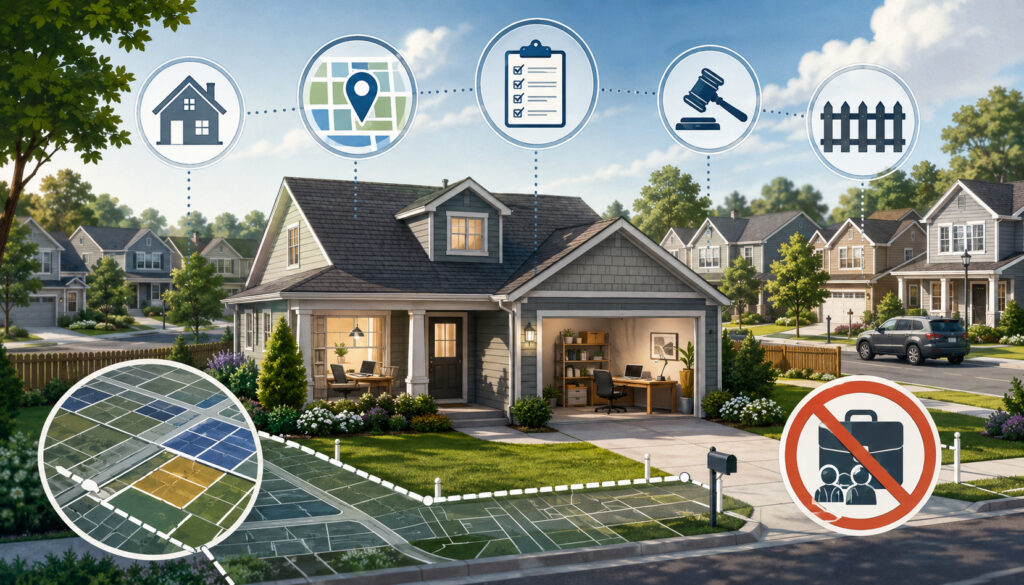
Zoning is one of the most important parts of Delaware home business rules because it determines whether a business activity is allowed at a specific residential property. State-level registration and licensing do not automatically answer the zoning question.
Residential zoning usually aims to preserve neighborhood character. That means local rules often focus on whether the business is visible, disruptive, traffic-generating, noisy, storage-heavy, or more like a commercial operation than a home office.
New Castle County’s home occupation FAQ defines a home occupation as a service, profession, occupation, or trade conducted within a residential dwelling that does not change the essential character of the residential use. It also emphasizes that other licenses, permits, and clearances may still be required.
Zoning Approval
Zoning approval may be simple for a low-impact home office, but more complicated for activities that bring customers, employees, deliveries, inventory, or equipment to the property. The same business may be treated differently depending on whether it is in a city, town, unincorporated county area, apartment building, townhouse community, or subdivision with deed restrictions.
A remote consultant who works alone on a laptop may be viewed differently from a home-based retail seller with daily package pickups. A music instructor with students arriving throughout the day may raise parking and noise concerns. A contractor who parks trucks, stores materials, or loads equipment from home may face restrictions even if all paid work happens off-site.
When checking Delaware zoning requirements, be ready to describe your business honestly. Local officials may ask:
- What type of work will be done at home?
- Will customers or clients visit?
- Will employees work at the residence?
- Will inventory, tools, or equipment be stored there?
- Will deliveries or pickups occur?
- Will there be signs?
- Will the business create noise, odors, waste, or traffic?
- Will any part of the home be altered?
Zoning approval is easier to evaluate before you launch than after a complaint is filed.
Home Occupation Restrictions
Delaware home occupation rules are typically designed to allow small, low-impact businesses while preventing residential properties from functioning like commercial sites.
The exact rules vary by location, but common restrictions may involve customer traffic, parking, signs, outside storage, employees, floor area, deliveries, noise, and changes to the home’s appearance.
A home occupation may need to remain secondary to the residential use. That means the home should still look and function like a home. If neighbors can tell from the street that a commercial business is operating there, that may be a warning sign.
Common restrictions may include limits on:
- Exterior signage
- Outdoor display of goods
- Customer visits
- Number of employees
- Commercial vehicles
- Business-related parking
- Outdoor storage
- Hazardous materials
- Noise or vibration
- Hours of operation
- Structural changes
- Product pickup or retail sales
Not every home-based business faces all of these restrictions. A freelance editor, virtual assistant, remote bookkeeper, or online consultant may have very few zoning impacts. But a business involving lessons, repairs, product storage, food production, or frequent visitors should be reviewed more carefully.
HOA, Deed, and Landlord Rules
Even when a city or county allows a home-based business, private property rules may create additional limits. Homeowners associations, condominium associations, deed restrictions, apartment leases, and rental agreements can restrict or prohibit certain business activities.
Renters should review the lease before starting a home-based business in Delaware. Some leases prohibit commercial activity, customer visits, signage, inventory storage, increased utilities, or business-related deliveries. Others may allow quiet remote work but require written permission for anything beyond ordinary home office use.
HOA rules may also restrict signs, parking, deliveries, noise, exterior changes, and business activity visible from outside the property. A business that is fully online may be less likely to create issues, but a home-based service business with clients arriving at the property could conflict with community rules.
Online Businesses, Freelancers, Consultants, and Service Providers
Online businesses and remote service providers often believe Delaware home business regulations do not apply because customers do not visit the home. In many cases, online and service-based businesses are lower impact from a zoning perspective, but they may still have registration, licensing, tax, contract, payment, and data security responsibilities.
Delaware online business requirements depend on where the business is operated, what is sold, where inventory is stored, whether employees are involved, and whether the business is formed or managed in Delaware.
An ecommerce seller operating from a spare bedroom is still running a business. A consultant working from a home office is still selling services. A creator earning income through digital products, sponsorships, subscriptions, or online courses is still engaged in commercial activity.
Online Business Requirements
An online business may not need a storefront, but it still needs a compliance foundation. This may include entity setup, a Delaware business license, tax registration, trade name registration, privacy practices, payment processing, bookkeeping, and recordkeeping.
Online sellers should pay special attention to inventory and fulfillment. Storing a few boxes of products at home may be acceptable in some areas, while large-scale storage, frequent freight deliveries, customer pickups, or garage-based warehousing may create zoning or safety concerns. If the business grows, it may be better to use third-party fulfillment, a storage unit, or commercial space.
Ecommerce businesses should also consider customer-facing policies. Refund terms, shipping timelines, privacy notices, subscription terms, chargeback handling, and product descriptions should be accurate and documented.
If collecting customer information, the business should limit access, use secure systems, and avoid storing payment card data unless properly supported by compliant tools.
Creators and digital product sellers should track income from multiple platforms. Marketplace payouts, payment processor reports, affiliate income, sponsorships, and direct sales should be reconciled regularly so tax records are not reconstructed at the last minute.
Freelance Business Setup
Freelancers often start quickly, sometimes with only a laptop, portfolio, and client referral. That speed is useful, but it can lead to missed setup steps. A freelance business may need a Delaware home-based business license, trade name registration, EIN, business bank account, written contracts, bookkeeping system, and insurance depending on the work.
A freelance designer, writer, developer, marketer, bookkeeper, consultant, or virtual assistant should clearly define services, fees, deadlines, intellectual property terms, revision limits, confidentiality obligations, and payment terms.
This is especially important for remote work because misunderstandings can happen when everything is handled by email, video calls, or messaging platforms.
Freelancers should also decide whether to operate under their personal legal name or a business brand. If using a brand name, check trade name requirements and make sure invoices, contracts, tax records, and payment accounts match the chosen setup.
A home office business should also create boundaries. Even if the work is flexible, keep regular records, separate business files, store client information securely, and avoid using personal messaging accounts for sensitive client communications.
Consultants and Remote Service Providers
Consultants and remote service providers often handle confidential client data, strategy documents, financial information, login credentials, marketing accounts, or operational details. Delaware home business rules for this group are not only about licenses and zoning. They also include professional standards, contracts, data security, insurance, and scope control.
A consultant working from home should use written agreements that explain the services provided, what is excluded, how fees are billed, how confidential information is handled, and how either party can end the engagement. This protects both sides and supports better client relationships.
Remote service providers should be careful with business address visibility. Publishing a home address on a website, invoices, marketplace profiles, or public filings can create privacy concerns. Depending on the situation, a business mailing address or registered agent may help, but owners should make sure each agency receives the address type it requires.
Tax Registration, Gross Receipts Tax, EIN, and Business Banking
Tax setup is a major part of Delaware home business requirements. A home-based business should understand state tax registration, federal tax identification, gross receipts tax, bookkeeping, estimated taxes, and financial separation.
The Delaware Division of Revenue’s business taxpayer resources include guidance areas for determining business type, requirements, licensing and registration, gross receipts taxes, and withholding taxes.
Delaware’s gross receipts tax FAQs explain that returns and payments may be due monthly or quarterly depending on total gross receipts, using a look-back period to determine filing frequency.
Tax Registration and Gross Receipts Tax
Delaware does not approach business tax compliance only through income tax concepts. Businesses may need to understand gross receipts tax, withholding if employees are hired, and other tax obligations connected to the type of business.
Gross receipts tax is based on receipts from business activity, and filing frequency can depend on the business’s volume and classification. A home-based business should not wait until tax season to understand whether it has filing obligations.
If you sell goods, provide taxable services, or operate multiple lines of business, ask a qualified tax professional or the Division of Revenue how your activity is classified.
Online sellers should also think beyond Delaware. Selling through websites or marketplaces can create obligations in other jurisdictions depending on sales volume, marketplace rules, inventory location, and economic nexus standards.
That does not mean every small seller has the same obligations, but it does mean ecommerce tax compliance should be reviewed as the business grows.
Bookkeeping is the practical foundation. Track gross receipts, refunds, fees, shipping income, platform charges, supplies, home office expenses, professional fees, software costs, mileage, and contractor payments. Good records help with taxes, license renewals, loan applications, audits, and business decisions.
EIN Setup
An EIN is a federal tax identification number used for business tax and financial purposes. The IRS states that an EIN can be obtained for free directly from the IRS online, and IRS resources explain that EINs are used by employers, sole proprietors, corporations, partnerships, estates, trusts, and other entities for tax filing and reporting purposes.
Not every sole proprietor without employees is required to have an EIN, but many home-based business owners choose to get one because it can help with opening a business bank account, setting up payment processing, issuing tax forms, hiring, and reducing the need to share a personal tax identification number in business contexts.
Be careful when applying. Use the official IRS website and avoid paying unnecessary third-party fees for a service the IRS provides directly. Keep the EIN confirmation notice with your permanent business records.
An EIN does not replace Delaware registration, a business license, zoning approval, trade name registration, or professional licensing. It is one part of the setup process.
Business Bank Account
A business bank account helps separate personal and business finances. This is important for bookkeeping, taxes, credibility, financial controls, and liability management. For LLCs and corporations, separation is especially important because mixing personal and business funds can weaken the practical value of having a formal entity.
Before opening a business bank account, you may need formation documents, EIN confirmation, business license, ownership information, operating agreement, trade name documentation, and personal identification. Requirements vary by financial institution and business structure.
Once the account is open, use it consistently. Deposit business income into the business account and pay business expenses from it. Avoid using personal cards for business purchases unless you have a reimbursement process. Reconcile accounts monthly and keep receipts organized.
Insurance, Liability, Contracts, and Recordkeeping Basics
Home-based business owners sometimes assume their homeowner’s or renter’s insurance automatically covers business activity. That can be a costly assumption. Personal policies may exclude or limit business-related claims, inventory, equipment, customer injuries, professional mistakes, cyber incidents, or business property losses.
Insurance needs depend on what the business does. A consultant may need professional liability coverage. An ecommerce seller may need product liability coverage. A home-based service provider may need general liability coverage.
A creator with expensive equipment may need business property coverage. A contractor may need industry-specific coverage, vehicle coverage, or bonds.
Contracts are also essential. Even small jobs should have written terms. A contract can define the scope of work, payment timing, cancellation rules, ownership of work product, confidentiality, limitations, responsibilities, and dispute handling. For online businesses, terms of service, privacy policies, shipping policies, and refund policies can serve a similar function.
Recordkeeping supports every part of compliance. Keep copies of:
- Business formation documents
- EIN confirmation
- Delaware business license
- Local zoning or home occupation approvals
- Trade name filings
- Insurance policies
- Contracts and invoices
- Receipts and expense records
- Bank and payment processor statements
- Tax filings
- Employee or contractor documents
- Customer policies
- Compliance correspondence
Data privacy belongs in this section too. Even a small home office business may store customer names, emails, phone numbers, addresses, payment records, contracts, login credentials, or project files. The FTC’s data security guidance encourages businesses to collect only what they need, keep it safe, and dispose of it securely.
Customer Visits, Deliveries, Signage, Inventory, and Employees
The more a home-based business looks or behaves like a commercial location, the more likely it is to raise zoning, lease, HOA, insurance, or neighborhood concerns. Customer visits, deliveries, signage, inventory, employees, equipment, parking, and noise are often the practical triggers.
A quiet Delaware home office business that operates through email and video calls may have minimal local impact. A business with customer appointments, product pickups, large deliveries, storage racks, employees arriving daily, or signs in the yard requires more careful review.
Customer Visits
Customer visits can affect zoning approval, parking, insurance, safety, privacy, and neighborhood expectations. A tutor, coach, consultant, notary, repair specialist, or personal service provider should check whether appointments are allowed at the residence and whether limits apply.
Even occasional visits can matter. Local rules may restrict the number of customers per day, hours of operation, on-street parking, waiting areas, or exterior visibility. If clients enter the home, consider safety, accessibility, household privacy, pets, children, and insurance coverage.
A practical alternative is to meet clients virtually, at their location, in a rented meeting room, coworking space, library meeting room, or other appropriate off-site location. This can reduce zoning friction and protect privacy.
Deliveries and Inventory Storage
Deliveries and inventory are common issues for ecommerce businesses, creators, and product-based sellers. Small quantities of supplies may be reasonable for many home businesses, but large inventory storage can create fire safety, parking, pest, clutter, lease, HOA, or zoning concerns.
Think about the type and amount of inventory. Clothing, books, handmade crafts, packaged accessories, and office supplies may be lower risk than chemicals, food, flammable materials, heavy equipment, or bulky goods. Frequent freight deliveries may also create more concern than occasional parcel shipments.
As the business grows, consider shifting inventory to commercial storage, third-party logistics, dropshipping arrangements, manufacturer fulfillment, or a small warehouse. Growth is positive, but your home may not remain the right operational base forever.
Signage, Parking, and Employees
Signage is often restricted in residential areas. Even a small yard sign, window sign, or vehicle wrap may violate local rules, HOA covenants, or lease terms. Online marketing, local listings, and professional directories may be safer than exterior signs, but make sure public listings do not expose a home address unnecessarily.
Employees and contractors can also change the analysis. A solo business owner working from a home office is different from several people reporting to a residence each day. Employees may trigger payroll registration, withholding, unemployment insurance, workers’ compensation, workplace safety considerations, parking issues, and zoning review.
Contractors should be handled carefully. Misclassifying workers can create tax and labor problems. If you hire help for bookkeeping, shipping, design, content, installation, delivery, or customer service, document the relationship and ask a qualified professional if you are unsure how the worker should be classified.
Payment Processing, Data Security, and Online Transaction Considerations
Accepting payments is a normal part of running a home-based business, but it brings responsibilities. Whether you accept credit cards, debit cards, ACH payments, online invoices, marketplace payouts, mobile payments, or recurring subscriptions, your setup should be secure, documented, and separate from personal finances.
A merchant account, payment processor, online checkout, invoicing tool, or ecommerce platform can help manage transactions, but the business owner remains responsible for understanding fees, refund policies, chargebacks, settlement timing, tax reporting, and customer data protection.
If you accept payment cards, PCI DSS may apply through card brand and payment network rules. Educational resources on PCI compliance explain that the Payment Card Industry Data Security Standard is designed to protect cardholder data and reduce card fraud.
The FTC also provides cybersecurity guidance for small businesses, including practical steps for protecting networks, information, and business systems.
For a home-based business, good payment practices include:
- Use reputable payment tools instead of collecting card numbers manually
- Avoid storing full card details
- Require strong passwords and multifactor authentication
- Limit access to customer and payment data
- Keep software and devices updated
- Use secure Wi-Fi and separate business devices when possible
- Reconcile payment deposits with invoices and orders
- Document refunds, disputes, and chargebacks
- Keep customer data only as long as needed
Online sellers should also understand platform rules. Marketplace accounts, social commerce shops, subscription platforms, and payment processors may have their own policies for prohibited products, reserves, disputes, identity verification, tax forms, and account holds.
Service providers should invoice clearly. Include the business name, contact information, payment terms, scope reference, due date, accepted payment methods, late fee policy if used, and refund or cancellation terms where applicable.
Common Delaware Home Business Mistakes to Avoid
Many Delaware home-based business mistakes come from assuming that a small business does not need formal setup. The business may start as a side project, hobby, freelance gig, or weekend ecommerce store, then grow before the owner has time to organize licenses, taxes, banking, zoning, and records.
One common mistake is assuming no Delaware business license is needed because there is no storefront. A home-based business can still be operating in Delaware and may still need a license. Another mistake is forming an LLC but never completing licensing, tax registration, local permit checks, or bookkeeping setup.
Zoning is another frequent issue. Owners may assume online activity has no zoning relevance, then begin storing inventory, receiving deliveries, inviting customers, or parking work vehicles at home. A business that begins quietly can become noticeable as it grows.
Privacy mistakes are also common. A home address may appear on websites, invoices, state filings, marketplace accounts, business directories, shipping labels, and payment accounts. Sometimes that is unavoidable or required for certain records, but owners should make intentional address decisions instead of discovering the exposure later.
Other common mistakes include:
- Ignoring lease restrictions or HOA rules
- Using a personal bank account for business income
- Failing to track gross receipts
- Missing license renewals
- Forgetting trade name registration
- Not getting an EIN when needed
- Storing too much inventory at home
- Accepting customer visits without zoning review
- Operating without appropriate insurance
- Using weak passwords for payment or customer systems
- Keeping poor records for contractors
- Treating all workers as contractors without review
- Assuming a business license equals zoning approval
- Waiting until tax filing season to organize records
Avoiding these mistakes starts with a simple mindset: treat the business like a business from the beginning. Even if revenue is modest, set up clean systems. That way, growth does not create a compliance mess.
Delaware Home-Based Business Rules Checklist
Use this checklist to evaluate your Delaware home office business before launch and during growth. It is not a substitute for professional advice, but it can help you identify what to check.
| Requirement Area | What to Check | Why It Matters | Common Mistake to Avoid |
| Business activity | Define exactly what you sell or provide | Licensing and taxes often depend on activity | Using a vague description that does not match the real business |
| Entity structure | Decide whether to operate as a sole proprietorship, LLC, corporation, or another structure | Structure affects liability, tax treatment, filings, and banking | Forming an entity without understanding ongoing obligations |
| Trade name or DBA | Check whether the business name must be registered | A brand name may differ from the legal owner or entity name | Assuming a website name automatically creates legal name rights |
| Delaware business license | Review Delaware business license requirements through state resources | Many businesses operating in Delaware need licensing | Assuming a home business is exempt because it has no storefront |
| Local zoning | Contact the city, town, or county zoning office | Residential zoning may limit business activity | Waiting until a neighbor complains |
| Home occupation rules | Ask about customer visits, signs, employees, storage, parking, and deliveries | These details often determine whether the activity is allowed | Describing the business as “online” while storing products or hosting appointments |
| Lease or HOA rules | Review private restrictions and get approval when needed | Private rules may be stricter than local zoning | Relying on verbal permission |
| Tax registration | Confirm gross receipts tax, withholding, and other tax obligations | Tax duties may apply even to small operations | Tracking only profit instead of gross receipts |
| EIN | Apply through the IRS if required or useful | EINs support tax, banking, payroll, and payment setup | Paying unnecessary third-party fees for an EIN |
| Business bank account | Separate business and personal funds | Clean finances support taxes, liability management, and reporting | Mixing payments in a personal account |
| Insurance | Review general liability, professional liability, property, cyber, and product coverage | Personal insurance may not cover business claims | Assuming homeowner’s insurance covers business activity |
| Payment processing | Use secure tools for cards, ACH, invoices, and online checkout | Payment systems affect cash flow, disputes, security, and reporting | Storing card data manually |
| Data security | Protect customer files, passwords, devices, and payment records | Small businesses can still face cyber and privacy risks | Using shared household devices for sensitive business data |
| Recordkeeping | Save licenses, filings, receipts, invoices, contracts, and tax records | Records support compliance, audits, financing, and decisions | Reconstructing records months later |
| Compliance calendar | Track renewals, tax filings, annual entity obligations, and insurance renewals | Deadlines can be missed when the business is busy | Treating compliance as a one-time launch task |
A checklist is most useful when it becomes part of your routine. Review it at launch, after your first major sale, before hiring help, before adding customer visits, before expanding inventory, and before moving to a new home.
For broader startup planning, you may also find this guide on legal requirements for starting a business in Delaware useful, especially when comparing formation, licensing, taxes, and compliance steps.
Practical Examples of Delaware Home-Based Business Rules
A freelance consultant working from a spare bedroom may need a Delaware home-based business license, EIN, business bank account, contracts, bookkeeping system, and data security practices.
Zoning concerns may be limited if there are no client visits, signs, employees, or inventory. Still, the consultant should check local home occupation rules and lease or HOA restrictions.
An ecommerce seller storing products at home may need the same business setup steps, plus more attention to inventory, deliveries, shipping materials, product liability, refund policies, sales records, and marketplace rules. If the seller begins receiving pallets, storing boxes in a garage, or offering local pickup, zoning review becomes more important.
A home-based tutor may have fewer inventory concerns but more customer visit issues. Parking, drop-off times, child safety, background checks, insurance, and local occupancy rules may matter. Virtual tutoring may reduce zoning impact, but the business still needs proper registration and records.
A contractor using a Delaware home office for scheduling, invoicing, and bookkeeping may have a relatively simple home office setup if tools, materials, vehicles, and employees are not based at the residence. However, contractor licensing, insurance, vehicle use, and local rules may still apply.
A creator selling digital products, memberships, sponsorships, and online courses may not have physical inventory, but they still need to track income across platforms, use secure payment tools, maintain customer privacy, understand intellectual property terms, and keep records for taxes.
These examples show why Delaware home business requirements vary so much. The question is not simply, “Can I run a business from home?” A better question is, “What exact business activity will happen at the home, and which rules apply to that activity?”
What are Delaware home-based business rules?
Delaware home-based business rules are the state, local, tax, zoning, property, and operational requirements that may apply when someone runs a business from a residence.
They can include business registration, Delaware business license requirements, local zoning approval, home occupation restrictions, tax registration, trade name filings, EIN setup, insurance, recordkeeping, and data security.
The exact rules depend on the business activity, location, entity type, customer visits, employees, inventory, signage, deliveries, and whether the home is owned, rented, or subject to HOA rules.
Do home-based businesses need a Delaware business license?
Many businesses operating in Delaware need a business license, even if they operate from home instead of a storefront. Delaware One Stop supports business registration and licensing, and the Division of Revenue provides business taxpayer resources for licensing and registration.
The license category and requirements depend on the business activity. A freelancer, consultant, online seller, service provider, contractor, or creator should check the applicable license type before starting.
Do online businesses operated from home need to register?
An online business operated from a Delaware home may still need business registration, a Delaware home-based business license, tax setup, and possibly a trade name filing. Operating online does not automatically remove business license or tax responsibilities.
Online sellers should also review inventory storage, shipping, marketplace income, payment processing, customer privacy, and multi-location tax issues as the business grows.
What zoning rules apply to Delaware home businesses?
Zoning rules depend on the city, town, county, and specific property. Local home occupation rules may restrict customer visits, parking, employees, signage, deliveries, equipment, inventory storage, noise, and exterior changes.
New Castle County’s home occupation guidance states that a home occupation should not change the essential character of the residential use, and it reminds owners to check deed restrictions, covenants, and other required licenses or permits.
Can renters run a business from home in Delaware?
Renters may be able to run a quiet home office business, but they should review their lease and get written landlord approval when required. A lease may restrict commercial activity, customer visits, signage, inventory storage, deliveries, or business-related property use.
Even if the landlord approves, the renter may still need to follow Delaware home business regulations, local zoning requirements, business licensing rules, and tax registration requirements.
Do home-based businesses need an EIN?
Some home-based businesses are required to have an EIN, especially if they have employees or operate as certain entity types. Others may choose to get one for banking, payment processing, tax reporting, or privacy reasons.
The IRS provides EINs for free through its official online application process, and an EIN is used for business tax identification purposes.
What mistakes should Delaware home business owners avoid?
Common mistakes include assuming no license is needed, ignoring zoning rules, failing to check HOA or lease restrictions, mixing personal and business finances, missing tax registration, using a home address without considering privacy, storing too much inventory, accepting customer visits without approval, and failing to keep records.
Another mistake is treating compliance as a one-time task. Delaware home business rules should be reviewed whenever the business changes.
How can a home-based business stay compliant?
Start with a written checklist. Confirm your entity setup, Delaware business license, local zoning status, tax registration, EIN, trade name, insurance, payment processing, recordkeeping, and renewal deadlines.
Then create a compliance calendar. Review it monthly and update it whenever you add products, hire help, change locations, accept customer visits, store more inventory, or expand into new services.
Conclusion
Delaware home-based business rules are not a single form or one-time approval. They are a practical framework covering business registration, licensing, zoning, taxes, permits, property restrictions, insurance, banking, payment processing, data security, and ongoing recordkeeping.
For many entrepreneurs, freelancers, consultants, online sellers, creators, contractors, and service providers, a home office is a smart and efficient starting point. But the business still needs to be treated seriously.
A small operation can still require a Delaware home-based business license, tax registration, zoning review, trade name filing, EIN, business bank account, and insurance.
The most important step is to separate the layers. Entity formation is different from licensing. Licensing is different from zoning. Zoning is different from HOA or lease approval. Tax registration is different from getting an EIN. A payment account is different from a business bank account. Each piece has its own role.
A well-prepared home business owner asks better questions early: Is my activity allowed at this residence? Do I need a Delaware small business license? Are there local home occupation rules? Will customers visit? Will I store inventory? Do I need a trade name? How will I protect customer data? How will I track gross receipts? What deadlines must I remember?
By answering those questions before problems arise, you can build a stronger foundation for your Delaware home-based business. Keep records, review requirements regularly, use reliable agency resources, and ask qualified professionals when your situation involves legal, tax, zoning, insurance, or regulatory uncertainty.
That careful approach helps your home office business operate with more confidence, fewer surprises, and better long-term stability.