

Starting a business involves more than choosing a name, setting up a website, or making your first sale. One of the earliest compliance steps that matters most is understanding Business Licensing Requirements in Delaware.
It is the part many owners rush past, yet it is often what determines whether a business is actually ready to operate, hire, open a location, or serve customers without preventable compliance problems.
For new founders, local operators, and growing startups, licensing can feel confusing because it sits at the intersection of business formation, tax registration, industry regulation, and local approval. A business may be properly formed as an LLC or corporation and still not be ready to legally operate.
In many cases, the owner also needs a Delaware business license, tax-related registrations, and possibly additional state or local permits depending on the activity, location, and whether employees are involved.
Delaware’s own guidance also makes clear that licensing needs can vary based on whether the business has a location in the state, employees working in the state, or sales generated in the state.
This guide breaks down Delaware business license requirements in a practical, reader-friendly way. You will learn how business licensing Delaware rules generally work, how the Delaware business license application process fits into startup compliance, when local or industry-specific permits may come into play, and what steps help reduce surprises.
For related background on entity setup and early planning, it can also help to review guides on how to register your business in Delaware, how to choose the right business structure in Delaware, and regulatory requirements for startups in Delaware.
What a business license is and why it matters
A business license is a government-issued authorization connected to a specific type of commercial activity. In Delaware, the general rule is straightforward: businesses operating in the state generally need a business license from the Division of Revenue before engaging in licensable trade or business activity.
The state’s Business First Steps guidance says that all businesses operating in Delaware need a business license from the Division of Revenue, while the Division of Revenue also explains that businesses with property or a business location in Delaware, employees working in Delaware, or sales generated in Delaware may need to register and apply for a license.
That does not mean every business needs only one document or that all businesses go through the same process. The “business license” piece is often just one layer.
Depending on what the business actually does, an owner may also need professional licensing, food permits, construction-related approvals, health-related licensing, environmental permits, local zoning clearance, employer registrations, or occupation-specific approvals.
Delaware’s Business First Steps portal lists a wide range of regulated industries and activities, which shows why it is risky to assume a single general license covers every situation.
Licensing matters for several practical reasons. It can affect whether you can lawfully open your doors, whether you can renew compliance documents, whether your tax accounts are properly set up, and whether you can avoid penalties for operating before approval.
It also helps create a cleaner foundation for banking, leasing, insurance, payroll setup, and vendor relationships. Even when the process feels administrative, it is often one of the clearest ways to show that a business has moved from “idea” to “operationally compliant.”
Delaware also ties business licensing closely to tax classification and business activity categories, which means the license process can influence how the business is tracked for revenue reporting and related obligations.
Business formation, registration, and licensing are not the same thing

One of the most common sources of confusion is assuming that once a business entity exists, the business is fully authorized to operate. In practice, business formation, tax registration, and business licensing solve different problems.
Entity formation is the legal creation of the business itself. That usually means choosing a structure such as a sole proprietorship, partnership, LLC, or corporation and, if applicable, filing formation documents with the appropriate state office.
This step establishes the legal shell of the business. It addresses ownership structure, liability framework, naming, and governance, but it does not automatically handle every operational requirement.
Delaware’s business guidance separates legal structure from licensing, and Business First Steps specifically notes that getting a Division of Revenue general business license is the second part of the licensing process after choosing the legal structure and business name.
Registration is broader. It can include registering the business for tax purposes, registering as an employer, registering a trade name if the business uses one, or registering an out-of-state entity to do business in Delaware if required.
Delaware One Stop connects business registration and licensing in a single workflow, but the state still distinguishes these underlying pieces.
Businesses with employees may need withholding, workers’ compensation, and unemployment-related registrations, while trade names are now handled through Delaware One Stop under the Division of Revenue’s statewide registry process.
Licensing is the permission-to-operate layer. This is where the state or local government asks, “What kind of business activity will you conduct, where will you conduct it, and are there extra approvals tied to that activity?”
A retail shop, contractor, restaurant, and therapist may each have very different compliance paths even if all are formed as LLCs. That is why a founder can be “registered” but still not fully “licensed.”
Formation creates the business; licensing authorizes the activity
A useful way to think about it is that formation gives your business a legal identity, while licensing looks at what the business is actually going to do in the real world.
For example, filing to create an LLC can establish ownership and legal existence, but that filing does not automatically grant permission to sell products, operate a food establishment, perform regulated professional services, or open a storefront in a municipality with location-specific rules.
Delaware’s guidance reflects this layered approach by separating legal structure, registration, and the general business license, and by pointing business owners to additional topic-specific requirements through Business First Steps.
This distinction matters because many owners assume the entity filing is the hardest part. In reality, the more important operational questions often come later: Will customers visit the site? Is food prepared? Are licensed professionals providing services? Are employees working in Delaware? Is the business using a trade name? Does the county, city, or town require local approvals? Those answers usually shape the actual compliance path more than the entity type alone.
Tax registration is connected to licensing, but it is not a substitute for it
A second misunderstanding is treating tax setup as if it replaces licensing. Delaware’s business rules show that the two are related but not interchangeable. The state explains that businesses in Delaware generally face an annual business license requirement and gross receipts tax obligations, and businesses with employees may also need employer-related registrations.
The general business license itself requires businesses to classify their activities into recognized categories that carry different tax obligations.
That means you should not assume, for example, that getting a federal EIN or registering a withholding account means you are done. Those steps are important, but they serve different functions.
An EIN is primarily a federal tax identifier. State withholding accounts help employers handle payroll tax responsibilities. Unemployment and workers’ compensation registrations address employee-related compliance. The Delaware business license application, by contrast, is one of the central state-level operating permissions for the business activity itself.
Core Delaware business license requirements to understand before operating

When people search for Delaware business license requirements, what they usually want to know is whether Delaware expects most businesses to get a general license before they begin operating.
The practical answer is yes: Delaware’s Business First Steps page states that all businesses operating in Delaware need a business license from the Division of Revenue, and the state’s registration guidance points to licensing when a business has property or a location in Delaware, employees working in Delaware, or sales generated in Delaware.
The state also makes clear that licensing is tied to business activity classification. On the General Business License page, Delaware explains that the license asks you to define your business activity within recognized categories and that these categories carry different tax obligations.
That detail matters because the right classification can affect the business’s reporting responsibilities and the type of license needed, particularly for retail, wholesale, service, and more specialized activity types.
Another important point is that Delaware licensing is not necessarily the whole story. The Business First Steps system specifically warns that its listings are comprehensive but not fully exhaustive and encourages business owners to confirm whether there are additional requirements through the appropriate agencies.
That is a strong reminder that business registration and licensing Delaware owners complete through One Stop may still need to be supplemented by local permits, professional licensing, or industry-specific approvals.
When a general business license usually comes into play
The state’s own guidance offers a practical trigger test. If the business plans to have property or a business location in Delaware, have employees working in Delaware, or generate sales in Delaware, Delaware One Stop says the business will need to register with the Division of Revenue by applying for a business license.
That framework is especially useful for entrepreneurs who are not sure whether their model counts as “doing business” in a way that requires state licensing.
For many small businesses, this means the general business license becomes part of the standard startup sequence rather than an optional extra.
A home-based consultant with Delaware clients, a storefront retailer, a local service provider, a restaurant, and an online seller with qualifying Delaware activity can all face licensing questions, even though their operating models look very different.
Delaware also notes that internet-based businesses should review separate internet sales guidance, which is another clue that online activity does not automatically fall outside the licensing system.
Because the state also references a nexus questionnaire for uncertain situations, businesses that operate digitally, across state lines, or without a traditional storefront should be especially careful about making assumptions. A “no physical shop” model is not the same thing as “no licensing obligation.”
Employees, business locations, and sales can change the compliance picture
A business with employees generally faces more than just the Delaware business license application. Delaware’s One Stop materials explain that if you have employees working in Delaware, you may also need workers’ compensation, unemployment insurance, and withholding-related registrations.
The Department of Labor’s guidance likewise explains that employers with employees in Delaware must determine unemployment insurance liability and report as required.
A physical location can also trigger added review. A business with a storefront, office, workshop, kitchen, salon, or warehouse may need to confirm zoning compatibility, building-related permits, occupancy approvals, fire or health-related inspections, and local municipal permissions.
Delaware’s local guidance specifically says that your principal business location and additional sites where you provide sales and services will determine whether you need county, city, or town licenses or permits.
Sales activity matters as well. Delaware explains that the state does not have state or local sales tax, but it does have an annual business license requirement and a gross receipts tax imposed on sellers of goods and providers of services.
That detail often surprises business owners who are used to thinking only in terms of sales tax permits. Delaware’s system is different, and that is one reason the activity classification in the licensing process matters so much.
How the Delaware business license application process typically works
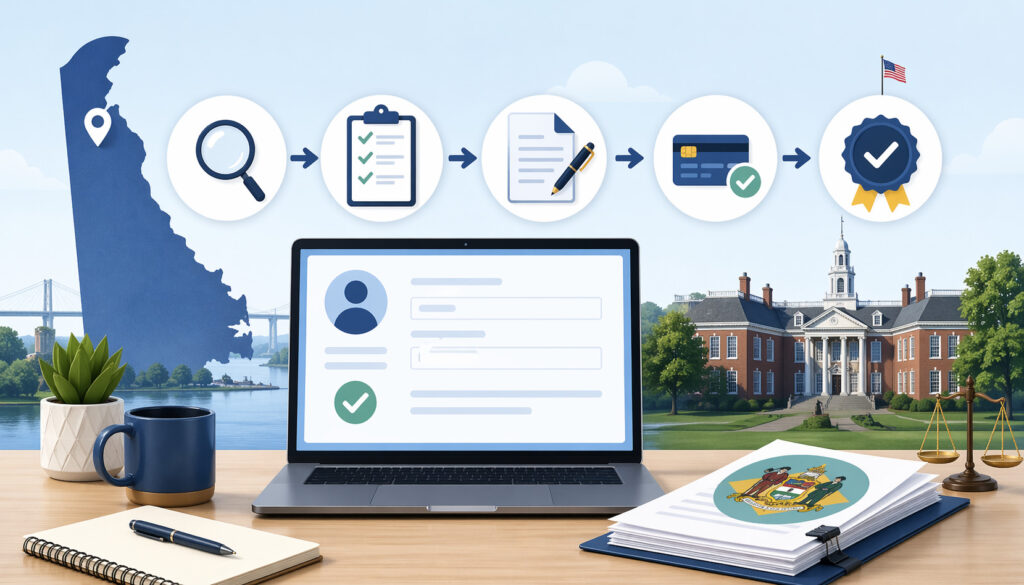
The Delaware business license application process is easier to understand when you treat it as a sequence rather than a single form. Delaware One Stop is the state’s central online registration and licensing system, and the state points users there for registering and licensing a business to operate in Delaware.
Business First Steps also frames licensing as part of a wider startup path that includes setting up the legal structure, getting a federal EIN, registering and licensing the business, and then opening operations.
Most businesses move through several common steps. The exact order can vary slightly depending on the structure or industry, but the general flow is consistent.
Choose a business structure and set up the legal identity first
Before you get a business license Delaware requires, you need clarity on the legal identity of the business. That includes deciding whether you are operating as a sole proprietorship, partnership, LLC, or corporation, selecting a compliant name, and handling formation filings if your structure requires them.
Business First Steps explicitly places legal structure and business name ahead of the general business license in the startup sequence.
This step matters because license applications usually need accurate legal entity information. The name on the license should align with the legal business record, and if you will operate under a separate public-facing name, you may also need a trade name registration.
Delaware One Stop notes that trade names are now managed by the Division of Revenue through the statewide One Stop process, which is especially important for businesses that market under a brand name different from the legal entity name.
For startups, getting the structure right early also affects bank account setup, contracts, ownership documentation, and later compliance. It is much easier to complete the licensing process cleanly when your legal setup is already consistent.
Handle tax and employer registrations where required
Once the business identity is in place, the next layer is usually tax and employer registration. Delaware’s state guidance connects licensing with tax obligations and notes that business activity categories may carry different tax treatment.
Businesses with employees may also need employer-related registrations, including withholding, unemployment insurance, and workers’ compensation processes.
This is where many new owners start to see how licensing and tax compliance overlap. You may need a federal EIN for banking, payroll, or entity operations. You may need to register for withholding if you are paying wages.
You may need unemployment-related filings shortly after beginning business operations if you have covered employees. And you may need to align your Delaware license category with the kind of revenue you expect to earn.
A good working mindset is that tax registrations tell the government how your business earns and reports money, while licensing tells the government what kind of activity you are authorized to perform. They are related, but both need attention.
Apply for the general business license and then check for added permits
After structure and registration basics are in place, many businesses move into the general license stage through Delaware One Stop. Delaware directs business owners to the online portal for registration and licensing, and the General Business License page points users to apply online there as well.
But this is the point where smart business owners slow down and ask a second question: “What else applies to my specific activity?” Delaware’s Business First Steps topic index includes food establishments, contractors, professions, health-related operations, transportation, environmental activities, real estate, gaming, special events, and many other regulated areas.
That means the general license may be necessary, but not always sufficient. A restaurant may need food establishment approvals. A medical practice may involve professional licensure. A contractor may face trade-specific requirements. A business with a storefront may need occupancy or zoning review at the local level.
How licensing requirements can vary by business type, structure, and operating model
A major reason Delaware licensing for small businesses feels complicated is that requirements do not hinge on one factor alone. The legal structure matters, but so do the industry, whether customers visit the site, whether regulated services are performed, whether employees work in Delaware, and whether the business is home-based, mobile, online, or storefront-based.
The state’s guidance repeatedly points owners toward business type, location, and employee status when determining requirements.
A sole proprietor may have a shorter startup checklist than a multi-owner corporation, but that does not necessarily mean the sole proprietor has fewer licensing issues.
A one-person home bakery, for example, may face more operational permitting than a consulting corporation with no office open to the public. Similarly, an online seller may not need the same local occupancy approvals as a restaurant, but it may still need state licensing depending on its Delaware business activity.
This is why the best Delaware business permit guide is not just a list of forms. It is a way of thinking through how the business actually functions.
Storefront, home-based, online, and employer-based businesses face different questions
A storefront business usually has the most visible checklist. It may need a general business license, location-based local approvals, zoning review, signage permissions, and possibly building or occupancy-related sign-off depending on the type of site and improvements.
Local Delaware guidance specifically tells businesses to check county, city, and town requirements based on where they locate or provide services.
A home-based business can look simpler, but it can still run into issues. The business may still need a general state license, and local rules may restrict customer visits, exterior signage, parking impacts, business storage, or certain kinds of activity in residential areas.
Owners often assume “working from home” means “no permits,” but zoning and local land-use rules can still matter. Delaware’s local resources point businesses to county and municipal zoning pages, which is especially relevant for home-based operations.
Online businesses are another area where assumptions cause trouble. Delaware’s general license guidance references internet-based businesses separately, and Delaware One Stop also uses sales generated in Delaware as one of its licensing triggers.
That means a digital or ecommerce model should still be reviewed carefully rather than treated as automatically exempt.
Businesses with employees add another layer because payroll, workplace insurance, and unemployment responsibilities can arise quickly. If your first hire is already scheduled, your licensing and employer setup should be reviewed together rather than one at a time.
Regulated services and licensed professions need a second level of review
Some businesses need more than a business license because the service itself is regulated. Delaware’s Division of Professional Regulation handles many professional licenses and renewals, and the state’s boards and professions system covers a wide range of fields.
Business First Steps also lists many health, real estate, counseling, engineering, beauty, veterinary, and related professions separately.
This is especially important for practices built around an individual’s credentials. A general business license may be necessary for the business entity, but the people providing the professional service may need individual licensure, facility registration, or board-specific approval as well.
A therapy office, salon, pharmacy, real estate practice, or medical-related business should never assume that business formation plus a state revenue license covers professional compliance.
The same logic applies to highly regulated commercial activities outside the professional world. Food handling, child care, gaming, environmental operations, transportation, automotive activities, and construction-related functions may each have their own licensing path. Delaware’s topic index is a strong reminder that “business licensing” often means more than one approval.
Common business categories that often need extra licenses or permits
The most practical way to understand Delaware business permits is to look at the categories where a general license often is not the end of the process.
Food businesses, restaurants, and similar operations
Food businesses are among the clearest examples of layered licensing. Delaware’s Business First Steps materials say the Division of Public Health issues permits to thousands of food establishments and strongly encourages prospective operators to contact the Office of Food Protection early, before purchasing, constructing, or changing the premises.
The state specifically highlights food establishments such as restaurants, food trucks, bakeries, caterers, frozen dessert stands, butchers, and food delivery-related operations.
That early-contact advice is important because food businesses often need more than paperwork. Layout, sinks, refrigeration, sanitation systems, plan review, plumbing considerations, inspections, and occupancy-related issues can all affect whether the business is ready to open.
A founder who signs a lease first and asks licensing questions later can end up with expensive buildout revisions or delayed opening timelines.
Restaurants are also a good example of why local review matters. In addition to the general business license and food establishment permits, a restaurant may need zoning approval, signage permits, building permits for renovations, fire-related approvals, and possibly alcohol licensing if applicable. A simple phrase like “I’m opening a small café” may actually involve multiple agencies and approval tracks.
Contractors, automotive businesses, real estate, health services, and general service companies
Contractor-related businesses can involve trade-specific licensing, building permits, or agency-specific registration depending on the work performed.
Delaware’s Business First Steps system includes a broad construction and contractor section covering everything from electricians and HVACR to plumbing and large-area construction activity. Businesses bidding on certain public work can face separate DelDOT registration requirements as well.
Automotive businesses are not one-size-fits-all either. Delaware’s topic listings include auto body shops, emission repair technicians, motor vehicle dealers, medical transport vehicles, and other transportation-related categories.
A garage, dealer, or specialized vehicle operation should expect activity-specific rules rather than relying on a generic retail or service label.
Real estate and health-related businesses also tend to involve a dual structure: the business itself may need a general license, while the professional side may require board or agency-specific licensing.
The same is often true for accountants, counselors, cosmetology-related operators, salons, pharmacies, veterinary practices, and related service businesses. Delaware’s professional regulation and Business First Steps topic pages both reinforce that point.
General service companies sometimes assume they are exempt because they do not sell products or operate a storefront. That may be wrong.
Delaware’s business licensing and gross receipts framework applies to many service providers too, so consultants, agencies, cleaners, repair businesses, and home-service operators should still review state and local requirements carefully.
Local licensing, zoning, signage, and occupancy considerations
One of the biggest blind spots in business licensing Delaware planning is local approval. State-level registration feels like the “official” step, so many owners stop there. But Delaware’s Business First Steps local page says your principal business location and any additional sites where you provide sales and services may determine whether you need added county, city, or town licenses or permits.
It also notes that some municipalities defer certain approvals to county governments, which makes location-specific checking even more important.
This means two businesses with the same state license can still have different local requirements depending on where they operate. A boutique in one municipality may have different signage or zoning issues than the same boutique in another.
A home-based service provider may be allowed in one area with minimal friction and restricted in another due to land-use rules or neighborhood standards. That is why local review should happen before signing a lease, beginning renovations, or inviting customers to the site.
Zoning, occupancy, and signage are operational issues, not afterthoughts
Zoning asks whether a property can legally be used for the type of business activity you plan to conduct. Occupancy-related approvals typically deal with whether the site is safe and appropriately configured for the intended use. Signage rules can control size, placement, lighting, and approval procedures.
These are not minor details. They can affect whether a business can open on schedule or use a location as intended. Delaware’s local page points businesses directly to county and municipal zoning, building permit, and related pages as starting points.
For retail and hospitality businesses, these issues are obvious because the public visits the premises. For home-based and office-based businesses, they are easier to overlook.
Yet even a small operation can run into questions about parking, exterior changes, storage, client traffic, noise, or whether a residential property may be used for that activity. If your business depends on a particular location, local approval work should begin early.
Municipal and county review can matter even when state licensing is complete
Delaware’s local resource page lists counties and many cities and towns, along with business, permit, zoning, and land-use resources. That alone shows how often local review enters the picture.
A state business license does not automatically substitute for county or municipal approval. The reverse is also true: a city permit does not eliminate the need for state licensing. Both layers may matter.
This is especially relevant for businesses expanding to a second location, adding mobile operations, changing use within an existing site, or starting in a town where local rules are more active.
It is also important for businesses serving customers at multiple sites, since Delaware’s local guidance mentions both principal and additional sites where sales and services are provided.
Renewals, updates, and ongoing compliance after the license is issued
Getting licensed is the start of compliance, not the end. Delaware’s General Business License guidance states that licenses generally run for a one-year term expiring on December 31, unless another date is prescribed by law, and it also notes an optional three-year renewal path for eligible license holders. The same page points businesses to renewal information through Delaware One Stop.
That matters because many businesses focus intensely on launch and then neglect maintenance. Renewals can involve fees, continued tax compliance, updated addresses, new locations, or revised activity classifications.
If the business grows into new services or revenue streams, the original license setup may no longer match operations. Delaware One Stop also provides pathways to add, renew, or modify business licenses, which signals that licensing is meant to evolve with the business rather than remain static.
For professional and regulated businesses, renewals can be even more layered. The Division of Professional Regulation handles application, renewal, status, and contact updates for many professional licenses.
That means the business owner may need to manage both the company’s business license renewal and separate professional credential renewals tied to owners, managers, or staff.
Another maintenance issue is address or trade name changes. If the business relocates, adds a new location, adopts a new public-facing name, or expands into a new activity, the original records may need to be updated.
Delaware’s One Stop environment is now central to trade name registration and licensing changes, so owners should treat that account as part of their ongoing compliance infrastructure, not something used only once at startup.
For many small businesses, good maintenance comes down to calendar discipline. Track renewal dates, confirm whether tax filings are current, review whether local permits are still valid, and revisit your licensing categories if your business model changes.
If you want more context on how tax mistakes can spill into broader compliance problems, the article on common tax mistakes Delaware businesses make is a useful companion resource.
Common mistakes business owners make with Delaware startup compliance
Many licensing problems do not come from unusual legal issues. They come from ordinary assumptions that turn out to be wrong.
The first major mistake is assuming formation alone is enough. Owners file an LLC or corporation, receive confirmation, and believe they are done.
As discussed earlier, formation creates the business, but it does not automatically complete tax registration, employer setup, or licensing. Delaware’s own materials separate legal structure from the general business license and from other operational requirements.
A second mistake is skipping local checks. This happens often with lease signings, home-based businesses, and expansions into a second location. Delaware specifically directs businesses to county, city, and town resources because local permits and zoning can depend on where the business is located or where services are provided.
A third common mistake is underestimating regulated activity. Many owners think, “I’m just offering services,” without realizing their service falls into a licensed profession, health-related category, construction trade, or food-related activity. Delaware’s long topic index should be read as a warning against oversimplifying what counts as regulated business activity.
A fourth mistake is ignoring employee-triggered obligations. Hiring even one employee can expand your compliance duties quickly. Delaware’s guidance links employees to withholding, workers’ compensation, and unemployment-related filings, so a business that was manageable as a solo operation may need a new compliance workflow once payroll begins.
A fifth mistake is treating online or home-based businesses as automatically exempt. Delaware’s licensing triggers include sales generated in Delaware, and the state separately points online businesses toward internet-sales guidance.
Meanwhile, home-based businesses can still run into zoning or local-use restrictions. Those models may be simpler in some respects, but they are not “no-rules” models.
Real-world examples: how licensing needs can differ from one business to another
A retail startup opening a small storefront in Wilmington may need a general Delaware business license, the right business activity classification, local zoning and signage review, and possibly occupancy-related approvals before opening to the public.
If the owner hires staff, the compliance list expands again. The state-level and local-level paths work together here, not as substitutes.
A home-based service business, such as a bookkeeping or marketing practice, may have a lighter checklist but should not assume there is none.
The owner may still need a general business license, may need a trade name registration if operating under a brand, and should still review local zoning or home-occupation rules before meeting clients onsite or using signage.
A restaurant has one of the most layered paths. In addition to the general business license, it may need food establishment approvals, plan review, health-related inspections, plumbing or buildout approvals, and local location-based permissions.
Delaware’s own guidance encourages restaurant and food-establishment operators to contact the Office of Food Protection early, which shows how important pre-lease and pre-construction planning can be.
A contractor may need the general business license plus trade-specific licensing or permitting depending on the work performed, and public works-related operations can involve separate registration requirements. Contractors often also face local permit issues when work intersects with land use, building approvals, or specialized systems.
An online seller can be deceptively complex. Even without a storefront, the business may still need state licensing if it generates sales in Delaware or otherwise meets the state’s operating triggers.
Depending on the goods sold, there may also be specific classifications or added requirements. The safest approach is to review the actual activity rather than relying on the label “online business.”
Practical checklist to get a business license in Delaware and stay organized
If you want to get a business license Delaware entrepreneurs can actually build around, organization matters as much as accuracy. The checklist below helps translate the rules into action.
| Step | What to do | Why it matters |
| 1 | Define exactly what the business will sell or do | Licensing depends on activity, not just the business name |
| 2 | Choose the legal structure and business name | Formation and naming come before the general license process |
| 3 | Decide whether a trade name will be used | A public-facing name may need separate registration through Delaware One Stop |
| 4 | Get an EIN if needed for banking, payroll, or entity operations | Common early registration step tied to practical setup |
| 5 | Complete tax and employer registrations where required | Employees can trigger withholding, unemployment, and workers’ compensation processes |
| 6 | Apply for the general business license through Delaware One Stop | Core state licensing step for many operating businesses |
| 7 | Search for professional, industry, and topic-specific permits | Many businesses need more than the general license |
| 8 | Check county, city, or town requirements | Location-based permits, zoning, signage, and occupancy may apply |
| 9 | Keep copies of approvals, account numbers, and renewal dates | Makes renewals, audits, and expansion easier |
| 10 | Revisit licensing when your business changes | New employees, services, locations, or trade names may require updates |
Here is a more detailed startup compliance checklist you can use:
- Write a one-paragraph description of your actual business activity.
- Identify whether you will operate as a sole proprietor, partnership, LLC, or corporation.
- Confirm your legal business name and whether you need a trade name.
- Determine whether you will have a storefront, office, home-based setup, mobile operation, or online-only model.
- Identify whether customers will visit your location.
- Determine whether you will hire employees working in Delaware.
- Use Delaware One Stop and Business First Steps to review state licensing categories.
- Review Business First Steps topic pages for your industry.
- Check county, city, or town pages for local permits, zoning, signage, and building-related requirements.
- Put every renewal, filing, and permit expiration into one calendar.
Frequently Asked Questions
Conclusion
Understanding Business Licensing Requirements in Delaware is really about understanding how several compliance layers fit together. Forming a business is important, but it is only one part of the process.
Most owners also need to think through tax registration, the general Delaware business license, possible professional or industry-specific permits, employer-related registrations, and local approvals tied to the actual place where the business operates.
Delaware’s state resources make that layered structure clear, and they also make clear that requirements can vary by activity, location, and business model.
The most practical path is to slow down before launch and work in order: choose the right structure, register the business correctly, identify the activity you will actually perform, complete the Delaware business license application, review local permit needs, and then maintain renewals and updates as the business grows.
If you approach Delaware business license requirements with that mindset, you will be in a much stronger position to open with confidence, avoid preventable compliance gaps, and build a business that is ready to operate on solid ground.