
Delaware comes up again and again in business formation conversations because it has a long-established corporate law system, a well-known court for business disputes, and a reputation for being friendly to companies of many sizes.
It is also home to a very large number of business entities, including a substantial share of public companies and large private businesses. That visibility has created a lot of half-true advice online, especially around taxes.
The result is a common pattern: founders hear that Delaware is “the best state to incorporate,” then assume that forming there automatically reduces taxes across the board. In practice, the Delaware corporate tax structure is more nuanced than that.
Delaware may offer legal and governance advantages, but the tax consequences depend on your entity type, where you actually operate, where you have employees or property, and where your income is sourced.
That is why corporate tax Delaware explained should never stop at one sentence. A Delaware corporation may owe franchise tax to Delaware because it exists under Delaware law, yet owe income tax somewhere else because that is where it does business.
Another company may owe both Delaware franchise tax and Delaware corporate income tax. Still another may form in Delaware, register in another state as a foreign corporation, and end up handling compliance in multiple jurisdictions at once.
This article breaks down the Delaware corporate tax structure in a practical, reader-focused way. It explains what Delaware corporate taxes include, what they do not include, why Delaware franchise tax is not the same thing as Delaware corporate income tax, how Delaware company tax requirements can vary by business model, and what ongoing compliance responsibilities often surprise founders. This is educational information only, not legal, tax, or accounting advice.
What the Delaware Corporate Tax Structure Includes and What It Does Not
When people talk about the Delaware corporate tax structure, they often blend several separate topics together. That is where confusion starts. Delaware taxes and compliance obligations can come from different agencies, apply for different reasons, and affect corporations and other entity types in different ways. Understanding the structure starts with separating those layers.
At a high level, Delaware corporate taxes may include franchise tax for corporations formed in Delaware, annual reporting obligations, possible Delaware corporate income tax if the corporation does business in Delaware, and additional business-level obligations if the company is actually operating in the state.
Those operating-state obligations may include licensing, gross receipts tax exposure for certain activities, employer-related tax issues, and other registrations depending on how the business earns money.
What the Delaware corporate tax structure does not mean is that every Delaware corporation automatically pays Delaware income tax on all of its revenue. Delaware’s corporate income tax applies based on federal taxable income allocated and apportioned to Delaware, not simply because the corporation filed its certificate of incorporation there.
The state’s official guidance specifically ties corporate income tax to doing business in Delaware and to Delaware apportionment factors such as property, wages, and sales in Delaware relative to everywhere else.
It also does not mean that every Delaware business is a corporation. LLCs, partnerships, S corporations, and C corporations can all connect to Delaware in different ways, but their state-level tax treatment is not identical.
That is one reason it helps to review entity differences before assuming Delaware business tax rates will work the same for every structure. A useful background resource is LLC vs C-Corp vs S-Corp in Delaware: Legal Differences That Matter, which explains how structure affects taxes, governance, and fundraising expectations.
The core pieces most corporations need to understand
For most readers, the main pieces of the Delaware corporate tax structure are easier to follow when viewed as separate buckets. A corporation formed in Delaware typically deals first with entity-level maintenance under Delaware corporate law.
That includes keeping a Delaware registered agent, filing an annual report, and paying Delaware franchise tax if required. Delaware states that all corporations incorporated there must file an annual report and pay franchise tax, while exempt domestic corporations do not pay the tax but still must file the annual report.
Then there is the operating-tax side. If the corporation is actually doing business in Delaware, Delaware corporate income tax may apply. Delaware’s published corporate income tax guidance says corporations that conduct business in Delaware are required to file the relevant corporate return, and the corporate income tax rate is 8.7% of federal taxable income allocated and apportioned to Delaware.
A third bucket involves broader operational compliance. Businesses operating in Delaware may need a business license and may face gross receipts tax obligations depending on activity.
Delaware’s “Doing Business in Delaware” guidance notes that the state does not have a general state or local sales tax, but it does impose annual business license requirements and gross receipts tax on sellers of goods or providers of services.
Why confusion happens so often
The reason Delaware company tax requirements get misunderstood is simple: formation, taxation, and compliance do not all follow the same map. Your legal home can be Delaware while your tax footprint spreads across multiple states.
A founder may file in Delaware, hire a team elsewhere, sell nationwide, hold inventory in another state, and work remotely from yet another state. That reality turns “Delaware corporate taxes” into a multi-jurisdiction issue, not a one-state answer.
Online advice also tends to over-focus on why venture-backed companies like Delaware, while under-explaining the day-to-day obligations that matter more to a small or operating business. Legal predictability, investor familiarity, and strong corporate governance norms can be compelling reasons to choose Delaware.
But those benefits should not be confused with a universal tax discount. The legal and tax analysis are related, yet they are not the same decision.
That is especially important for founders comparing “forming a corporation in Delaware taxes” against forming at home. You are not just choosing a filing state. You are choosing a compliance framework, a governance model, and potentially an extra layer of annual administration.
Delaware Franchise Tax vs. Delaware Corporate Income Tax

One of the biggest mistakes readers make when learning the Delaware corporate tax structure is treating franchise tax and corporate income tax as interchangeable. They are not. They arise for different reasons, are administered differently, and can apply even when the other one does not.
Delaware franchise tax is essentially a charge tied to the corporation’s existence under Delaware law. If you formed a corporation in Delaware, you generally need to file the corporation’s annual report and pay franchise tax.
Delaware’s official Division of Corporations guidance states that all corporations incorporated in the state are required to file an annual report and pay franchise tax, with exempt domestic corporations still filing the report even if they do not pay the tax.
Domestic corporate annual reports and franchise taxes are due on or before March 1, and late filing brings a $200 penalty plus 1.5% monthly interest on tax and penalty.
Delaware corporate income tax, by contrast, is an income-based tax for corporations doing business in Delaware. The official rate published by the Delaware Division of Revenue is 8.7% of federal taxable income allocated and apportioned to Delaware using an equally weighted three-factor method based on property, wages, and sales in Delaware versus everywhere else.
That is a fundamentally different concept from franchise tax. It is not a fee for existing as a Delaware corporation; it is a tax on apportioned taxable income connected to Delaware business activity.
So a corporation may owe Delaware franchise tax simply because it incorporated there, even if most or all business operations are elsewhere. A different corporation may owe Delaware corporate income tax because it does business in Delaware, even if formation is only one part of its story. And a corporation actively operating in Delaware may owe both.
How franchise tax works in real life
For many founders, Delaware franchise tax is the first recurring Delaware-specific obligation they encounter. It is not based on whether the company is profitable.
It is also not a tax that disappears just because the company is inactive, pre-revenue, or operating elsewhere. If the corporation is still active under Delaware law, the annual report and franchise tax process usually still matters.
This catches early-stage companies off guard. A startup may have no revenue yet, no Delaware office, and a tiny team spread across other states, but it can still owe Delaware franchise tax because the entity itself was formed there.
That is why founders sometimes describe the bill as surprising. They expected taxes to follow income; instead, one of their main Delaware business tax obligations follows formation status.
The exact amount can vary depending on the corporation’s structure and calculation method, which is why startups with high authorized share counts often need to understand Delaware franchise tax early rather than treating it as routine paperwork. Even where the tax is manageable, missing the filing deadline can trigger avoidable penalties and interest.
How corporate income tax works differently
Delaware corporate income tax becomes relevant when the corporation conducts business in Delaware. The state’s own guidance is explicit on that point and explains that income is allocated and apportioned to Delaware rather than automatically taxing all corporate income. That is a major practical point for businesses with multistate activity.
Suppose a corporation is incorporated in Delaware but has no Delaware office, no Delaware employees, no Delaware inventory, and no meaningful Delaware sales. Its Delaware franchise tax obligations may still exist, but its Delaware corporate income tax analysis may look very different from a corporation with a warehouse, staff, or substantial customer activity in Delaware.
Delaware’s nexus materials make clear that the existence of a tax filing obligation depends on facts used to determine whether nexus exists.
That is why “Delaware corporate income tax” should never be reduced to a simple headline rate. The real issue is whether the corporation is doing business in Delaware and, if so, how much income is apportioned there.
Why “Incorporated in Delaware” Does Not Mean You Only Deal With Delaware Taxes
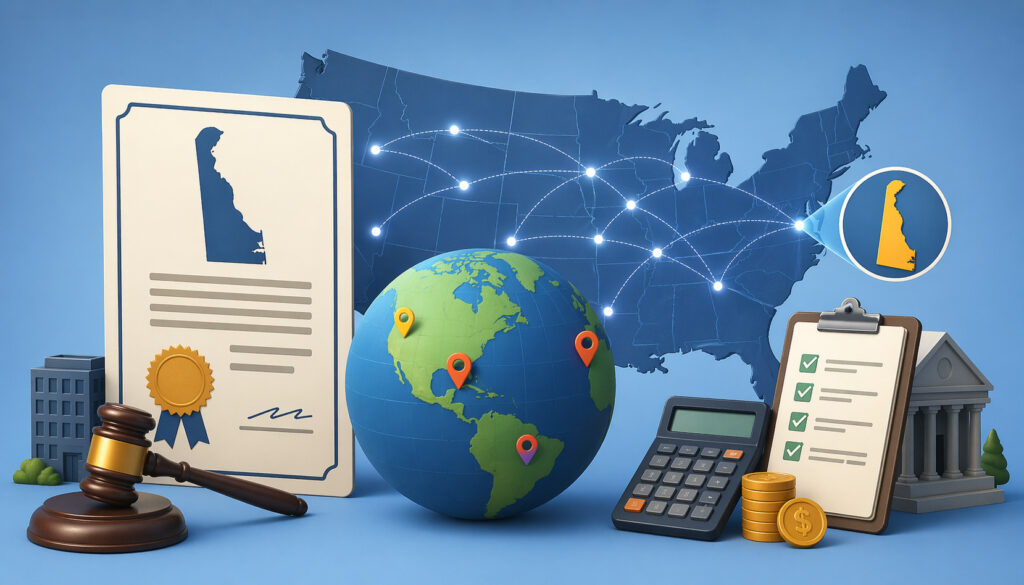
This is where many founders need the clearest explanation. Being incorporated in Delaware does not mean Delaware is the only state that matters for tax and compliance. Incorporation determines the company’s legal home.
It does not erase tax obligations in the places where the business actually operates, has people, stores inventory, signs leases, or earns state-connected income.
That distinction matters because some business owners equate the certificate of incorporation with the company’s entire tax identity. In reality, the state of incorporation and the state of operations can be very different.
Delaware itself points businesses toward broader operating rules, licenses, and tax requirements for those actually doing business in the state, while its nexus guidance emphasizes that tax obligations depend on whether sufficient business connections exist.
A Delaware corporation operating mainly in another state may need to register there as a foreign corporation, pay taxes there, and comply with local annual reporting requirements there, all while still maintaining its Delaware corporate status.
This is often the moment when founders realize that “forming a corporation in Delaware taxes” is not just a Delaware question. It is a Delaware-plus-other-states question.
That broader compliance picture is one reason it helps to read practical formation and startup compliance guides alongside tax materials. For example, How to Choose the Right Business Structure in Delaware and Navigating Regulatory Requirements for Startups in Delaware both reinforce that entity selection and compliance obligations should be evaluated together rather than in isolation.
Incorporation state vs. operating state
The easiest way to think about this is to separate your legal charter from your business footprint. Delaware may be where your corporation was born. Your operating state or states are where the business actually lives day to day.
Those operating states often care about payroll, sales activity, physical presence, service delivery, real estate, licensing, and tax nexus. Delaware does not replace those states just because the certificate says “Delaware corporation.”
This is why a local service business with one office, one city, and one owner often gets different advice from a venture-backed software startup. The local company may gain little from adding Delaware on top of home-state compliance if it does not need Delaware’s legal framework.
The venture-backed company may decide the Delaware structure is worth it for governance and financing reasons, while still accepting that tax and registration obligations will also arise wherever the team and customers are located.
Foreign qualification and multistate exposure
When a Delaware corporation starts doing business in another state, it often needs foreign qualification there. That is not just a corporate filing formality.
It may trigger annual report duties, franchise or similar state fees, registered agent requirements in that other state, and state tax filings. This is one of the most frequently missed parts of Delaware business tax obligations for remote-first and online businesses.
The practical problem is not just tax cost. It is compliance fragmentation. You may need:
- Delaware annual report and franchise tax filings
- A Delaware registered agent
- Foreign registration in one or more other states
- Income, employer, or other state tax filings in those states
- Business licenses where operations occur
A founder who ignores this can end up in an expensive cleanup process later, especially during fundraising, due diligence, banking reviews, or a sale of the business. That is why understanding taxes for Delaware corporations requires looking beyond Delaware itself.
Entity Type Matters: C Corporations, S Corporations, LLCs, and Other Common Structures

The Delaware corporate tax structure is most commonly discussed in the context of corporations, especially Delaware C corporations. Still, business owners often compare corporations to LLCs or talk about S corporation taxation without realizing that legal entity type and tax election are not always the same thing.
That distinction matters because Delaware company tax requirements depend partly on what kind of entity you formed and, in some cases, how it is taxed.
A Delaware C corporation is generally the classic corporate form people mean when they discuss Delaware franchise tax, stock issuance, board governance, and venture financing.
Delaware’s franchise tax and annual report framework clearly applies to corporations incorporated there. If that corporation also does business in Delaware, corporate income tax rules may come into play as well.
An S corporation is still a corporation under state law, but it may have different federal and state tax treatment. Delaware’s corporate tax filing guidance specifically references a Delaware S-Corporation Reconciliation and Shareholders Return for corporations that conduct business in Delaware.
That alone shows why readers should not assume that “S corp means no state filings.” Entity-level and shareholder-level consequences can still require attention.
LLCs are different again. Delaware’s official alternative entity tax instructions state that domestic and foreign LLCs, LPs, and GPs formed or registered in Delaware are required to pay an annual tax of $300 and do not file an annual report in the same way corporations do; the annual tax is due on or before June 1.
That means readers comparing an LLC to a corporation in Delaware are not just comparing management style or liability. They are comparing different annual state-level compliance frameworks.
For a deeper entity comparison, How to Register Your Business in Delaware and Legal Requirements for Starting a Business in Delaware both help frame the legal and operational side of these choices in a useful way.
Why corporations remain the main focus in Delaware discussions
Corporations get most of the attention because Delaware’s reputation is strongly tied to corporate law, investor expectations, and the needs of scalable companies.
Delaware is especially well known for its established corporate statutes and Court of Chancery, and its business ecosystem is widely familiar to institutional investors, boards, and lawyers working on financings and exits.
That legal predictability can matter a lot for venture-backed businesses or companies planning complex equity arrangements. In those cases, the conversation is not just about Delaware business tax rates.
It is about governance standards, stock mechanics, financing norms, fiduciary frameworks, and exit readiness. Tax still matters, but it is only one piece of the decision.
For many smaller businesses, though, the best entity is often the one that balances taxes, administration, liability, and growth plans realistically. That may still be a Delaware corporation. But sometimes the better answer is an LLC or a home-state entity that creates less complexity.
Why entity selection mistakes can be expensive
A common mistake is choosing a Delaware corporation because it sounds sophisticated, without thinking about whether the company actually needs corporate governance and Delaware-specific maintenance.
Another is choosing an LLC for simplicity, then discovering later that conversion is needed for fundraising. A third is electing S corporation status or forming a corporation without understanding payroll, ownership restrictions, shareholder issues, or multistate tax implications.
These mistakes are not always fatal, but they can become expensive when the business grows. Cleanup can involve amended filings, missed taxes, foreign qualification issues, cap table complications, accounting rework, and diligence friction. That is why readers should treat entity choice as a strategic business decision, not a branding move.
Delaware Company Tax Requirements and Ongoing Compliance Responsibilities
The day a company forms is only the beginning. One of the most overlooked parts of the Delaware corporate tax structure is the maintenance burden that follows formation. Delaware company tax requirements do not end with filing a certificate of incorporation. If the corporation remains active, it needs an ongoing compliance rhythm.
For Delaware corporations, that rhythm usually includes maintaining a registered agent in Delaware, filing the corporation’s annual report, and paying franchise tax by the required deadline.
Delaware’s Division of Corporations publishes online services for these tasks and states that active domestic corporation annual reports and franchise taxes are due on or before March 1. Failure to comply can lead to penalties and interest.
If the corporation also does business in Delaware, it may need to handle Delaware corporate income tax filings, possible business licensing, and other business-tax registrations depending on the activity.
Delaware’s business taxpayer services resources and doing-business guidance make clear that state-level business obligations can extend beyond formation filings alone.
For many businesses, the hardest part is not one major tax bill. It is missing the system: not calendaring filing dates, not tracking registered agent notices, not recognizing when a second state filing becomes necessary, or not understanding which obligations follow the entity and which follow the business footprint. That is where otherwise healthy businesses slip out of good standing.
Registered agent requirements
Every Delaware corporation needs a registered agent with a physical address in Delaware. This is not just a mailing preference. It is a legal requirement connected to service of process and official state communications. Delaware’s Division of Corporations provides specific registered-agent information through its business services resources.
Business owners sometimes treat the registered agent as a minor line item, but it plays an important compliance role.
If your registered agent arrangement lapses, if notices are ignored, or if annual service is not maintained properly, you can miss tax notices, annual report reminders, or legal documents. In other words, a registered agent is part of your compliance infrastructure, not just an address on file.
This matters even more for companies formed in Delaware but run elsewhere. If you are physically based in another state, the registered agent is one of the main bridges between your legal home and your real operating team.
Annual reports, deadlines, and practical recordkeeping
Annual reports are often described as simple, but “simple” does not mean unimportant. Delaware requires domestic corporations to file annual reports online, and those filings are paired with franchise tax compliance.
Missing the deadline can trigger penalties and monthly interest, which means a minor oversight can quickly turn into a recurring problem.
Good recordkeeping supports this process. Corporations should maintain updated officer and director information, capitalization records, governing documents, and board approvals as needed. That helps not only with the annual report but also with investor diligence, banking relationships, and future tax or legal reviews.
A practical compliance table
| Obligation | Who it generally applies to | Why it exists | Typical timing |
| Delaware registered agent | Delaware corporations | Maintains legal contact in Delaware | Ongoing |
| Delaware annual report | Delaware corporations | Corporate maintenance and reporting | Due annually by March 1 |
| Delaware franchise tax | Delaware corporations, unless exempt status applies | Entity-level Delaware obligation tied to incorporation | Due annually by March 1 |
| Delaware corporate income tax return | Corporations doing business in Delaware | Income tax on apportioned Delaware taxable income | Based on tax filing requirements |
| Delaware business license / gross receipts compliance | Businesses operating in Delaware, depending on activity | Operating-state business tax and licensing compliance | Ongoing / periodic |
| Foreign qualification in other states | Delaware corporations operating outside Delaware | Allows legal operation in other states | As operations expand |
Real-World Examples: How the Delaware Corporate Tax Structure Plays Out for Different Businesses
Theory is useful, but examples make the Delaware corporate tax structure much easier to understand. The same Delaware corporation rules can feel very different depending on whether you are a pre-revenue startup, an online seller, a local operating company, or a venture-backed company scaling across multiple states.
Scenario 1: A startup corporation with no revenue yet
Imagine two founders form a Delaware C corporation because they want clean equity issuance, standard investor-ready governance, and the option to raise outside capital later. The company has no revenue yet and no Delaware office. It is run remotely by founders living in another state.
In that situation, the founders may still have Delaware annual reports and franchise tax obligations because the corporation exists under Delaware law.
What they may not automatically have is Delaware corporate income tax on all business income simply because they incorporated there. The Delaware income tax question depends on whether the corporation is doing business in Delaware and what income is apportioned there.
This is a good example of why “Delaware tax-friendly” can be misleading. The company might have light Delaware operating tax exposure at the beginning, but it still has Delaware maintenance obligations. It may also need to think about foreign qualification or tax registration where the founders are actually working.
Scenario 2: An online business selling across many states
Now imagine an online brand forms in Delaware because the owner heard it was the best place to incorporate. The business has remote staff in multiple states, uses a third-party warehouse network, and sells nationally.
This company’s tax reality is unlikely to be “Delaware only.” Delaware franchise tax and annual report duties may still apply if it is a Delaware corporation. But nexus, foreign qualification, payroll tax issues, and income or gross receipts tax exposure can arise in the states where employees, property, inventory, or significant activity exist.
Delaware’s nexus materials and broader operating guidance reinforce that state tax compliance is driven by facts on the ground, not just where the certificate was filed.
Scenario 3: A local operating company with one physical location
Consider a company with one office, one local market, and no real plan to raise venture capital. The owner is deciding whether to incorporate in Delaware even though all operations will happen in the home state.
This is where the practical value question becomes important. Delaware may still offer legal advantages, but the owner should weigh them against the added burden of Delaware franchise tax, a Delaware registered agent, Delaware annual reporting, and foreign qualification back into the home state where the company actually operates.
For some local businesses, that extra layer is worth it. For many others, it adds cost and complexity without solving a real business problem.
The point is not that Delaware is wrong. It is that the right answer depends on business goals, operating footprint, and compliance tolerance.
Scenario 4: A venture-backed company preparing to scale
Now take a venture-backed company issuing preferred stock, maintaining a board, granting equity compensation, and preparing for future financing rounds. Delaware may make strong sense here because investors, lawyers, and acquirers are used to its corporate framework. Its legal predictability can reduce friction in major transactions.
But even this company should not oversimplify Delaware corporate taxes. It still needs to handle Delaware franchise tax and annual reporting, plus tax and registration obligations in the states where it has offices, engineers, sales staff, or customers that create nexus. In other words, Delaware may be the right corporate home and still be only one piece of the tax map.
Common Mistakes Founders Make When Interpreting Delaware Corporate Taxes
The most expensive Delaware tax mistakes usually do not come from obscure legal theory. They come from very normal misunderstandings. Founders hear a simplified version of Delaware’s benefits, then build the rest of their compliance assumptions on top of it.
A common mistake is assuming Delaware incorporation automatically lowers all taxes. That is not how the system works. Delaware franchise tax can apply because the corporation exists there, while income-tax obligations may arise in Delaware only if the company is doing business there and in other states if the company is operating there.
Another common mistake is treating “no Delaware sales tax” as if it means “no Delaware business taxes.”
Delaware does not impose a general state or local sales tax, but businesses operating in Delaware may still face annual business license requirements and gross receipts tax, depending on what they do. That is a very different tax structure from a traditional retail sales tax state.
Founders also routinely underestimate how much entity choice affects taxes for Delaware corporations and alternative entities. An LLC, a C corporation, and an S corporation do not carry the same Delaware maintenance obligations. That is why structure should be chosen with both tax and governance in mind.
Mistake 1: Ignoring compliance because the business is small
Many small businesses assume compliance can wait until revenue arrives. But Delaware franchise tax and annual report obligations for corporations are not purely revenue-based. They follow the corporation’s existence. A pre-revenue or lightly active corporation can still incur penalties if deadlines are missed.
This mistake often starts with good intentions. The founders are busy building products, landing clients, or hiring. State paperwork feels secondary. Then a missed filing snowballs into penalties, lost good standing, or an urgent cleanup before a bank account review, financing round, or contract negotiation.
Small businesses benefit from simple systems here: one compliance calendar, one responsible owner, and one recurring review of state obligations.
Mistake 2: Forgetting the home state or operating state
Some founders spend so much energy on Delaware that they overlook the state where the business actually operates. That can lead to missed foreign qualification, unregistered payroll accounts, overlooked state income filings, or licensing problems.
Delaware may be the company’s legal home, but the operating state often has the loudest practical voice in day-to-day tax compliance.
This mistake is common with remote-first businesses, service firms, and ecommerce brands. Because the company feels “online,” the owner assumes physical-state obligations are limited. In reality, employees, inventory, and operational touchpoints can still create filing duties.
Mistake 3: Choosing an entity for image rather than fit
A corporation can sound more formal or impressive than an LLC, but image is a poor basis for entity selection. Some founders pick a Delaware corporation because they think it signals seriousness, only to realize later that the business would have been simpler and cheaper to run in another form.
Others choose an LLC because it feels easy, then discover that investors strongly prefer a Delaware corporation.
The better question is not “Which entity sounds best?” It is “Which entity fits our ownership, funding path, profit model, and compliance capacity?”
Why Some Businesses Choose Delaware Anyway
If the tax story is more complicated than many people assume, why do so many businesses still choose Delaware? The answer is that the decision is often not about taxes alone.
For many corporations, Delaware’s value comes from legal predictability, investor familiarity, and governance infrastructure rather than from a blanket promise of lower taxes.
Delaware is widely recognized for its corporate legal system and its role in serving a very large number of business entities, including many public companies. That ecosystem matters for businesses expecting outside investment, multiple financing rounds, equity compensation planning, acquisitions, or complex board governance.
Investors and counsel often know the Delaware framework well. That familiarity can reduce friction in negotiations and documentation. Standardization has real value when a company is trying to move quickly through funding or strategic transactions.
In that sense, the decision to choose Delaware may be more about future optionality and legal efficiency than about today’s tax bill.
That said, those advantages are not universal. A local business with no outside investors, no multi-owner complexity, and no likely exit event may not need Delaware’s legal machinery. A simple operating company might care more about minimizing duplicative filings and costs. The right answer depends on the business, not on Delaware’s reputation alone.
A Practical Checklist for Deciding Whether a Delaware Corporate Structure Fits Your Business
If you are trying to decide whether a Delaware corporation makes sense, use a practical checklist rather than a slogan. The best decision usually comes from matching the company’s real-world needs to the compliance and tax consequences of the structure.
Ask yourself:
- Are you planning to raise venture capital or institutional investment soon?
- Do you need a standard corporate structure for stock issuance, preferred equity, or board governance?
- Are your investors or advisors specifically expecting a Delaware corporation?
- Will the business actually operate in Delaware, or mostly somewhere else?
- If operations are elsewhere, are you ready for foreign qualification and multistate compliance?
- Do you understand that Delaware franchise tax is separate from Delaware corporate income tax?
- Do you have a plan for annual reports, registered agent maintenance, and tax filing deadlines?
- Are you choosing a corporation because it fits your growth path, or just because you heard it was “best”?
- Would an LLC or home-state entity better match your current size, ownership, and profitability?
- Have you considered how payroll, inventory, employees, and service delivery may create tax obligations outside Delaware?
A good decision is not one that minimizes a single fee in isolation. It is one that creates a manageable, coherent structure for how the business will actually operate.
Frequently Asked Questions
Does every Delaware corporation pay Delaware corporate income tax?
No. A Delaware corporation may still owe Delaware franchise tax and annual report obligations because it is incorporated there, but Delaware corporate income tax generally applies when the corporation does business in Delaware and has taxable income apportioned to the state.
Is Delaware franchise tax the same as an annual report fee?
No. They are related, but they are not the same. The annual report is a filing requirement, while Delaware franchise tax is a separate obligation tied to maintaining a corporation formed under Delaware law.
If my business is incorporated in Delaware but operates elsewhere, what happens?
You may still need to maintain Delaware compliance, including a registered agent, annual report, and franchise tax obligations. At the same time, you may also need foreign qualification and tax compliance in the state or states where the business actually operates.
Does Delaware have sales tax for corporations?
Delaware does not impose a general state or local sales tax, but businesses operating in Delaware may still have other obligations, such as business licensing or gross receipts tax depending on the nature of the activity.
Are LLC taxes in Delaware the same as corporate taxes?
No. Delaware corporations and Delaware LLCs follow different compliance and tax frameworks. Corporations typically deal with annual reports and franchise tax, while LLCs are generally subject to a different annual tax structure.
Why do venture-backed companies often pick Delaware?
Many choose Delaware because of its established corporate law framework, investor familiarity, and predictable governance standards. These benefits can be especially useful for companies planning to raise outside capital or scale through multiple funding rounds.
Conclusion
The best way to understand the Delaware corporate tax structure is to stop looking for one simple answer. Delaware corporate taxes are not one thing. They are a combination of entity-level obligations, possible income-tax consequences, and ongoing compliance rules that interact with where the business actually operates.
For many corporations, the first key distinction is the one that clears up most confusion: Delaware franchise tax is not the same as Delaware corporate income tax. Franchise tax usually follows incorporation in Delaware.
Corporate income tax follows doing business in Delaware and the amount of taxable income apportioned there. On top of that, other states may still matter if your people, property, customers, or operations are located outside Delaware.
That is why Delaware corporate tax structure analysis should always be practical, not myth-based. The right structure depends on entity type, funding goals, governance needs, operating footprint, and compliance discipline.
For some businesses, Delaware is the right corporate home because the legal and investor advantages are worth the added maintenance. For others, especially smaller operating businesses, the better answer may be simpler and closer to where the company actually does business.
If you are weighing Delaware company tax requirements for your own business, focus on the real questions: what kind of entity you need, where you will operate, what tax filings follow that footprint, and whether you are prepared to maintain the structure correctly.
That is the clearest path to understanding taxes for Delaware corporations without getting lost in oversimplified advice.