
Delaware may not impose a general retail sales tax, but a Delaware business selling into another state can still become subject to that state’s sales-tax rules once it creates sufficient nexus there.
That distinction matters for ecommerce sellers, retailers, wholesalers, service businesses, SaaS companies, startups, and other Delaware businesses serving customers across state lines. Delaware’s tax system does not travel with your company and override another state’s laws.
A business formed or operating in Delaware may establish an economic nexus because of the amount or type of business it conducts in another state. It may also establish physical nexus through employees, inventory, offices, warehouses, representatives, fulfillment arrangements, or other activities.
Once nexus exists, the business may have to register for sales tax, determine which transactions are taxable, collect the correct state and local tax, file returns, remit the money collected, and maintain appropriate records.
The important point is that selling out of state from Delaware requires a state-by-state analysis. There is no single national economic nexus threshold, no universal rule for marketplace sales, and no assumption that every remote seller becomes responsible at $100,000 or 200 transactions.
This guide explains how Delaware businesses can evaluate those obligations without confusing Delaware’s tax structure with the sales-tax laws of their customers’ states.
Why Delaware’s “No Sales Tax” Rule Has Limits
Delaware does not impose a general state or local retail sales tax. Instead, Delaware imposes other business taxes, including its Gross Receipts Tax on certain sellers of goods and providers of services doing business in the state.
That distinction is important because Delaware Gross Receipts Tax, or GRT, is not simply another name for conventional sales tax.
A typical sales tax is generally imposed on a taxable retail transaction and collected by a registered seller from the purchaser. Delaware describes its Gross Receipts Tax as a tax imposed on the seller’s business receipts, with the applicable treatment depending on the business activity.
For more Delaware-specific background, see Best of 302’s guides to Delaware sales tax considerations for retailers and the broader Delaware corporate tax structure. Those distinctions become especially important when a Delaware company begins operating in multiple states.
What Delaware does not do is give its businesses immunity from another state’s sales-tax system.
Suppose a Delaware ecommerce company sells products from its own website to customers in Colorado, Texas, Washington, and California. Whether that company must collect tax in those jurisdictions depends primarily on the laws of those jurisdictions and the company’s contacts with them.
Those contacts may include:
- Sales volume into the state
- Nature of the products or services sold
- Employees or contractors in the state
- Inventory stored there
- Warehouses or fulfillment facilities
- Marketplace activity
- Physical locations or business property
- Representatives or other in-state activities
A corporation’s or LLC’s Delaware formation is therefore only one fact about the business. It does not determine where sales tax is owed.
What Is the Sales Tax Nexus?
Sales tax nexus is the level of connection between a business and a taxing jurisdiction that is sufficient for the jurisdiction to impose sales-tax responsibilities on that business.
For Delaware companies, nexus becomes relevant whenever business activity extends beyond Delaware. A seller may have no storefront, branch office, or permanent location in another state and still become subject to that state’s sales-tax rules.
Two broad concepts matter most: physical nexus and economic nexus.
They overlap, but they should be monitored separately. A seller below an economic nexus threshold might nevertheless have nexus because it maintains inventory or has personnel in the state.
| Nexus Type | Typical Basis | Example |
| Physical nexus | People, property, inventory, offices, or other physical activity | Inventory stored in an out-of-state fulfillment center |
| Economic nexus | A sufficient amount of sales or economic activity | Remote sales exceeding a state’s statutory threshold |
| Both | Economic activity plus physical contacts | Large sales volume plus a remote employee in the state |
The significance of nexus is practical. Once the connection is sufficient under applicable law, a seller may need to register and comply with that jurisdiction’s sales and use tax requirements.
Physical Nexus
The physical nexus traditionally focuses on tangible connections with a state.
Examples can include an office, store, warehouse, employee, inventory, sales representative, equipment, or another form of business property or activity. Temporary activities such as trade shows, installation work, service calls, or representatives visiting customers may also matter depending on the state’s law and the nature and duration of the activity.
The list is not exhaustive.
For ecommerce businesses, one frequently overlooked issue is inventory stored by a third-party fulfillment provider. A seller may think of itself as a Delaware-only company because its owners and headquarters are in Delaware, while some of its inventory is physically sitting in warehouses in several other states.
That can materially change the nexus analysis.
Remote employees deserve similar attention. Hiring an employee who works from a home in another state can create tax and registration consequences that have nothing to do with sales volume.
Economic thresholds therefore should never be treated as universal safe harbors. A company with a physical nexus may have obligations even when its sales remain below a state’s remote-seller threshold.
Economic Nexus
Economic nexus allows a state to establish a sales-tax connection based on a seller’s economic activity even when the seller does not have a traditional physical presence there.
A state might measure that activity using gross receipts, retail sales, taxable sales, sales of particular products or services, or another statutory measure.
Consider a Delaware retailer that has no employees, offices, or inventory in another state. If customers there purchase enough goods from the retailer, the retailer may nevertheless cross that state’s economic nexus threshold.
This is the concept behind modern remote seller sales tax requirements.
Economic nexus rules are particularly important for businesses selling through:
- Ecommerce websites
- Mobile apps
- Online ordering systems
- Catalogs
- Telephone orders
- Subscription platforms
- Digital delivery
- Marketplaces
The difficult part is not simply tracking total revenue. Each jurisdiction may define the threshold differently, use a different measurement period, specify different types of sales to include, and establish a different date on which collection must begin.
That is why accurate multistate compliance requires more than a spreadsheet containing one standard dollar threshold.
How South Dakota v. Wayfair Changed Remote Sales Tax
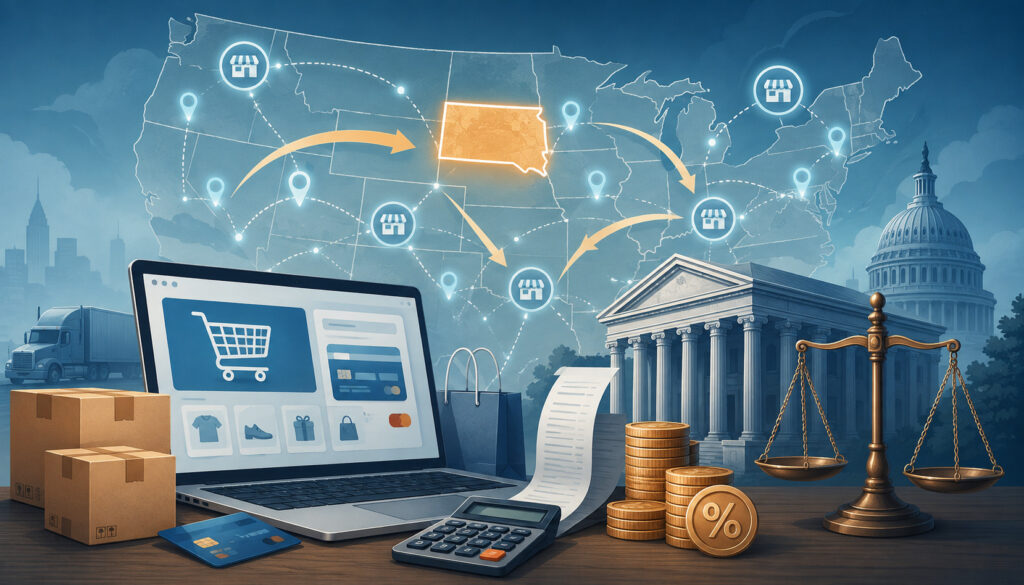
The modern remote-seller framework is closely tied to the Supreme Court’s decision in South Dakota v. Wayfair, Inc.
Before Wayfair, the Court’s earlier precedent generally limited states’ ability to impose sales-tax collection obligations on sellers that lacked physical presence. In Wayfair, the Supreme Court rejected that physical-presence rule, allowing substantial nexus to exist without a traditional physical footprint.
The decision did not create one national sales threshold.
Instead, it opened the door for states to enforce economic nexus statutes against qualifying remote sellers. States subsequently adopted or enforced their own requirements, and those requirements have evolved over time.
This history matters to a Delaware business because being geographically distant from a customer is no longer enough to avoid a collection obligation.
A seller in Wilmington, Dover, or anywhere else in Delaware can conduct enough business with customers elsewhere to trigger that jurisdiction’s laws without opening a store, renting office space, or sending employees there.
The practical lesson from the Supreme Court’s Wayfair decision is therefore not “everyone uses South Dakota’s threshold.” It is that states can impose qualifying remote-seller obligations without requiring the physical presence that earlier case law had demanded.
Businesses should analyze the actual current statutes, regulations, and tax-agency guidance in every relevant jurisdiction.
Economic Nexus Thresholds Explained
Economic nexus thresholds are among the most misunderstood parts of interstate ecommerce sales tax.
A threshold answers a specific question: How much qualifying activity can a remote seller conduct in a state before that state’s economic nexus rules apply?
The answer varies considerably.
One state may measure gross revenue. Another may use retail sales. Another may focus on taxable remote sales. Some rules expressly count exempt sales, resale transactions, or marketplace activity. Certain jurisdictions have retained transaction-count elements, while others have modified or eliminated them.
Measurement periods also differ. Depending on the jurisdiction, the test might examine:
- The current calendar year
- The previous calendar year
- Current or previous calendar year activity
- A rolling period
- Several preceding sales-tax quarters
- A preceding number of calendar months
Marketplace transactions require additional attention. Some states include marketplace sales when determining whether the marketplace seller has crossed an economic threshold even though the marketplace facilitator collects the tax. Other states provide different treatment.
For example, Washington currently instructs remote sellers to calculate its $100,000 gross-receipts threshold using Washington activity that includes retail sales through facilitators as well as the seller’s own website, and it also includes exempt sales.
Texas, by contrast, describes a $500,000 remote-seller safe harbor based on total Texas revenue during the preceding 12 calendar months and specifies that taxable and nontaxable transactions, resale sales, and sales to exempt entities are included in that measure.
These examples show why there is no reliable nationwide shortcut.
Economic Nexus Threshold Comparison
A limited, verified sample is more useful than an outdated fifty-state chart. The following examples illustrate how dramatically state rules can differ and why every jurisdiction should be checked individually before a business relies on a threshold.
| State | Current Economic Nexus Rule for Typical Remote Sellers | Measurement Period | Marketplace/Other Sales Considerations | Official Source |
| California | More than $500,000 in qualifying sales of tangible personal property for delivery in California, including sales of related persons under the rule | Preceding or current calendar year | Threshold rules require careful review of combined qualifying California sales | California Department of Tax and Fee Administration |
| Colorado | $100,000 or more in qualifying annual retail sales removes the small-retailer exception | Current and previous calendar years are relevant | Rule focuses on qualifying Colorado retail sales | Colorado Department of Revenue |
| New York | More than $500,000 of gross receipts from qualifying tangible personal property and more than 100 qualifying sales | Immediately preceding four sales-tax quarters | Both statutory conditions matter | New York State Department of Taxation and Finance |
| Texas | $500,000 safe harbor based on total Texas revenue | Preceding 12 calendar months | Includes taxable and nontaxable sales, resale sales and sales to exempt entities under Texas guidance | Texas Comptroller |
| Washington | More than $100,000 of combined gross receipts sourced or attributed to Washington | Current or prior calendar year | Washington says marketplace, direct and exempt sales can enter the calculation | Washington Department of Revenue |
California’s current guidance uses the $500,000 standard rather than the earlier $100,000-or-200-transaction formulation that appeared in superseded guidance.
New York illustrates another important variation. Its current official guidance requires both more than $500,000 of specified gross receipts and more than 100 qualifying sales during the immediately preceding four sales-tax quarters.
These differences explain why copying an old internet threshold chart into a compliance system can create serious errors.
How to Know When Your Delaware Business Has Crossed a Threshold

A Delaware business selling out of state should use a repeatable nexus-review process rather than waiting for a tax notice.
Start with where your customers actually receive products or services. Then match those transactions with the threshold definitions used by each relevant state.
A practical process looks like this:
- Identify every state where customers are located: Use shipping, service, billing, or sourcing data as appropriate for the transaction.
- Measure sales using each state’s definition: Do not assume “taxable sales” is always the correct numerator.
- Separate direct and marketplace sales: Then determine whether the jurisdiction requires them to be combined for threshold purposes.
- Review physical nexus independently: Check employees, inventory, property, representatives, fulfillment facilities, and temporary activity.
- Compare your activity with current official guidance: Use the state’s Department of Revenue, Taxation, Comptroller, or equivalent agency.
- Document when the applicable threshold was reached.
- Determine the required registration date.
- Determine when collection must begin.
- Configure tax collection only after the applicable registration requirements are addressed.
- Continue monitoring even after registration.
Washington demonstrates why timing deserves separate attention. Its current guidance states that a remote seller crossing the threshold during the current year generally begins collection on the first day of a month beginning at least 30 days after the threshold date.
Colorado has a different timing structure. Its Department of Revenue currently states that a remote retailer exceeding $100,000 during the current year must obtain a license and begin collecting by the first day of the first month beginning at least 90 days after the threshold is crossed.
Texas uses another approach, generally requiring a qualifying remote seller that exceeds its safe harbor to begin collection no later than the first day of the fourth month after the month in which the safe harbor is exceeded.
Registration Threshold vs. Collection Start Date
A threshold crossing date and a tax collection date are not necessarily the same thing.
One state may require collection rapidly after the threshold is reached. Another may provide a defined transition period. A seller that exceeded a threshold in the prior year may face a different rule from one that first crosses it during the current year.
Therefore, a useful nexus log should include at least four separate fields:
- Threshold measurement period
- Date the threshold was crossed
- Registration deadline
- Collection effective date
Do not simply write “nexus: yes” in a spreadsheet.
That approach loses the timing information needed by accounting teams, ecommerce administrators, and tax professionals.
Should You Register Before Crossing a Threshold?
Voluntary registration can sometimes make business sense, but businesses should not assume that registering everywhere “just in case” is harmless.
Registration can create continuing filing obligations. Once an account is established, a state may expect returns according to the assigned filing frequency until the account is formally closed or the state confirms otherwise.
A registered seller may therefore need to file even when it owes little or no tax.
Before registering voluntarily, consider expected sales growth, physical nexus, product taxability, customer expectations, administrative costs, and whether registration creates obligations beyond sales-tax collection.
When exposure is uncertain, review the state’s rules or seek qualified multistate tax advice rather than automatically registering or automatically refusing to register.
Delaware Ecommerce Sales Tax and Marketplace Selling

Delaware ecommerce sales tax questions often begin with the wrong assumption: “Our business is in a no-sales-tax state, so why would checkout need sales tax?”
The better question is: Where does the transaction create a tax obligation?
A Delaware online store can potentially have dozens of different compliance profiles because the customer’s destination, sales channel, product, threshold calculation, and physical contacts can all matter.
Selling Through Your Own Website
A seller making direct sales through its own website generally retains responsibility for monitoring its nexus exposure.
If the business establishes nexus in a jurisdiction and sells taxable products or services there, it may need to register, configure its ecommerce platform to collect the proper tax, file returns, and remit the amount collected.
Checkout configuration should not be treated as the first step.
Before turning tax collection on, the seller should know whether it is registered, whether the product is taxable, how the sale is sourced, which state and local taxes apply, and when collection is legally required to begin.
The same principles apply to custom storefronts, mobile apps, telephone orders, subscriptions, and other direct channels.
Selling Through a Marketplace
Marketplace facilitator laws shift certain collection responsibilities from marketplace sellers to qualifying marketplace facilitators.
In a typical facilitated sale, the marketplace may calculate, collect, and remit applicable sales tax on the seller’s behalf.
That can significantly reduce the marketplace seller’s transaction-level collection burden, but it does not mean the seller can stop monitoring nexus.
For example, Washington instructs remote marketplace sellers to include marketplace activity when applying its gross-receipts threshold and notes that other Washington taxes and filing obligations may remain even when a facilitator collects retail sales tax.
Texas provides a different example: a remote seller that sells only through a marketplace provider that certifies it collects and reports tax on the seller’s behalf generally does not need a Texas tax permit solely for those marketplace transactions, though recordkeeping requirements remain.
Selling Through Both
Hybrid sellers require especially careful tracking.
Imagine a Delaware retailer generating $80,000 in direct website sales into a state and another $50,000 through marketplaces. Whether that business has exceeded an economic nexus threshold cannot be determined simply by saying, “The marketplace handles tax.”
The state might require the two channels to be combined for nexus purposes.
Once registered, the seller may also have to distinguish marketplace-facilitated transactions from direct sales on its return so that tax already remitted by the marketplace is not incorrectly remitted again.
Maintain marketplace reports, facilitator documentation, direct-channel data, returns, and reconciliation records together.
Marketplace Facilitator Laws and Major Online Marketplaces
A marketplace facilitator is generally an entity operating a marketplace and meeting statutory requirements that cause it to become responsible for collecting and remitting tax on qualifying facilitated transactions.
The underlying merchant is commonly called a marketplace seller.
Major online marketplaces often perform collection functions under these laws, but a Delaware marketplace seller should still verify four questions in every important state:
- Do facilitated sales count toward my own economic nexus threshold?
- Is the marketplace collecting tax on the products I sell?
- Do I still need to register?
- If registered, must I report facilitated sales or file returns even when the marketplace remitted the tax?
New York provides a useful illustration. Its marketplace rules require qualifying marketplace providers to collect tax on covered facilitated transactions, while a registered marketplace seller remains responsible for tax on taxable transactions it makes outside the marketplace.
For sellers using Amazon, eBay, Etsy, or comparable platforms, the platform’s tax collection is therefore only one part of the analysis.
The seller should maintain evidence showing which transactions were facilitated, where the goods were delivered, what tax the marketplace collected, and how the transactions were reported.
Marketplace collection is not a universal substitute for tax compliance.
Physical Nexus, Remote Employees, and Inventory Outside Delaware
Economic nexus receives most of the attention after Wayfair, but physical nexus remains critical.
A Delaware company can create obligations through physical activity before it comes close to a remote-seller economic threshold.
Potential triggers include:
- Employees working in another state
- Inventory stored there
- Offices or coworking locations
- Company-owned equipment
- Sales representatives
- Third-party warehouses
- Installation or repair activity
- Trade shows and temporary events
- Fulfillment operations
- Retail or service locations
Whether a particular activity creates nexus depends on the jurisdiction and facts. Businesses should not assume that occasional or outsourced activity is automatically irrelevant.
Inventory Stored Outside Delaware
Inventory placement is particularly important for ecommerce operations using distributed fulfillment.
A business might send inventory to one fulfillment provider and later discover that the provider moved units among warehouses in several states. From an operational perspective, the seller may see one vendor relationship. From a tax perspective, those inventory locations may need individual analysis.
California’s official remote-seller materials expressly distinguish economic nexus from other contacts that can independently make a retailer engaged in business in California, and its guidance has historically identified inventory and other physical contacts as relevant.
The appropriate response is not to assume every warehouse creates precisely the same obligations everywhere. Instead, obtain inventory-location reports and compare them with each state’s current physical nexus rules.
Can a Remote Employee Create Nexus?
A remote employee can create significantly more than payroll obligations.
Depending on the state, the employee’s presence and activities may affect sales-tax nexus, income or franchise taxes, unemployment insurance, withholding, business registration, and other requirements.
A Delaware startup that hires its first out-of-state employee should therefore notify whoever handles tax compliance before the employee starts work.
Human resources systems and tax systems often operate separately. That creates a common gap: payroll knows an employee moved to another state, while the person responsible for sales tax does not.
Economic nexus dashboards cannot detect that problem.
What Happens After the Economic Nexus Is Created?
Crossing a threshold is the beginning of a compliance workflow, not the end of the analysis.
A Delaware business should generally move through the following process:
- Confirm nexus: Validate the applicable sales numbers, physical contacts, threshold definition, and effective period.
- Register with the appropriate tax authority: Do this according to that state’s registration rules before collecting tax.
- Configure rates correctly: Include applicable state and local taxes.
- Determine sourcing: Identify the jurisdiction to which each sale is assigned.
- Classify taxable products and services.
- Collect tax on taxable transactions when required.
- File required returns.
- Remit tax by the applicable deadline.
- Maintain exemption certificates and supporting records.
- Continue monitoring changes in laws and business activity.
Registration typically produces some form of sales-tax account, permit, license, certificate, or authorization, though terminology varies by jurisdiction.
A business should register directly through the appropriate revenue authority or an approved registration mechanism. Participating Streamlined Sales Tax states may also provide registration options through the Streamlined Sales Tax system.
Why You Should Not Collect Tax Before Proper Registration
Businesses should generally avoid simply adding a “sales tax” line to invoices because someone notices that sales are increasing in a state.
Sales tax collected from customers is regulated money. States typically require sellers to register or obtain the applicable authorization to collect before treating themselves as tax collectors.
The correct sequence is to determine the obligation, identify the registration rule, complete required registration, establish the collection start date, and configure the sales system accordingly.
Collecting tax without understanding the underlying registration and reporting requirements can create accounting problems, customer issues, and potential state-law concerns.
Destination Sourcing, Local Rates, and Taxability
Knowing that nexus exists does not tell you how much tax to charge.
The seller still needs to determine where the sale is sourced and what tax applies there.
For many interstate remote sales, the customer’s delivery destination plays an important role. Washington, for example, instructs remote sellers to report direct sales by location and states that retail sales tax is collected based on where the sale is sourced or delivered under its rules.
Texas similarly states that local use tax for remote sellers generally follows the Texas location where an order is shipped or delivered when the order is not received or fulfilled from a Texas place of business, subject to Texas’s specific remote-seller provisions and options.
That does not mean every jurisdiction follows an identical destination rule in every circumstance.
State and Local Sales Tax Rates
The customer’s tax may contain several components, such as:
- State sales or use tax
- County tax
- Municipal tax
- Transit tax
- Special district tax
- Other local components
Consequently, knowing the state alone may not be enough to calculate a transaction accurately.
ZIP-code-only calculations can also be unreliable in areas where a ZIP code crosses local taxing boundaries. Address-level tax determination is often preferable where available.
Product and Service Taxability
A product being taxable in one state does not guarantee that it is taxable in another.
Tax treatment may differ for:
- Tangible personal property
- Groceries and prepared food
- Clothing
- Digital products
- Downloadable software
- Cloud software
- Subscriptions
- Shipping and handling
- Installation
- Repairs
- Data processing
- Professional services
The classification may be as important as the rate.
If a seller configures a tax engine to treat every product identically, even perfect rate data can produce incorrect results.
Service Businesses, SaaS, and Digital Products
Service businesses should not assume they are outside the economic nexus discussion.
States differ significantly in which services they tax and how they source those services. A Delaware consulting, design, information-services, software, or technology company can therefore encounter a more complicated analysis than a retailer shipping ordinary physical goods.
The starting questions include:
- What exactly is being sold?
- Is the transaction a service, license, lease, digital good, software product, or bundled offering?
- Is it taxable in the customer’s jurisdiction?
- How does that state source the service?
- Does revenue from the service count toward the state’s nexus threshold?
SaaS and Digital Products
SaaS illustrates the classification problem well.
States do not use one nationwide rule for remotely accessed software. One jurisdiction may treat a particular SaaS offering as taxable software or a taxable service, while another may exempt or differently classify the same transaction.
Downloadable software can receive different treatment from remotely accessed software. Digital books, streaming content, data products, subscriptions, information services, and bundled offerings can create additional distinctions.
California’s current tax matrix, for example, provides specific treatment for certain electronically transferred software and distinguishes it from software delivered on tangible media.
That California treatment should not be generalized to another state.
For SaaS and service businesses, nexus monitoring should therefore track both revenue by state and the tax classification of each revenue stream.
Resale Certificates, Exempt Sales, and Documentation
Not every transaction made after nexus is established will necessarily be taxable.
A customer might purchase products for resale. Another may be a qualifying exempt organization. A transaction may involve an exempt product or use.
The seller generally needs appropriate documentation to support exemptions.
Depending on the jurisdiction and transaction, that may include:
- Resale certificates
- Exemption certificates
- Direct-pay permits
- Government documentation
- Industry-specific certificates
- Other prescribed records
The details are state-specific.
An important distinction is that an exempt transaction may still count toward an economic nexus threshold when the state’s threshold definition includes exempt or gross sales.
Texas expressly includes sales for resale and sales to exempt entities in its total Texas revenue calculation for the remote-seller safe harbor. Washington likewise states that exempt sales are included when applying its gross-receipts threshold.
A business could therefore cross a nexus threshold even though a large portion of its transactions ultimately produces no retail sales tax.
Sales Tax Registration, Filing Frequency, and Zero Returns
Sales tax registration is generally completed through the applicable state revenue or taxation authority.
Once registration is approved, the agency may issue an account number, certificate, permit, license, or similar authorization.
Registration does more than authorize collection. It usually places the business into that jurisdiction’s filing system.
Filing Frequency
A state may require returns monthly, quarterly, annually, or on another schedule.
The assigned frequency may depend on the seller’s tax volume, business category, registration characteristics, or state rules. States can also change a business’s filing frequency after reviewing its activity.
Never assume that filing frequency is the same across registrations.
Maintain a compliance calendar listing:
- Jurisdiction
- Account number
- Filing frequency
- Return due date
- Payment due date
- Responsible employee or provider
- Marketplace reporting treatment
- Last return filed
Zero Returns
A common multistate sales tax mistake is assuming that no tax due means no return is required.
Once registered, a business may be required to file a return for each assigned period even if it made no taxable sales or owes no tax. The exact rules depend on the jurisdiction and registration status.
This issue often arises with seasonal businesses and marketplace sellers whose facilitator collected all sales tax.
Do not silently stop filing. Determine whether the account should remain active, whether zero or informational returns are required, or whether formal cancellation is appropriate.
Multistate Sales Tax Compliance and Automation
Multistate sales tax becomes difficult because businesses are managing several moving parts simultaneously.
A growing Delaware business may eventually need to coordinate:
- Multiple registrations
- Different threshold calculations
- Product taxability rules
- Local tax rates
- Marketplace deductions
- Exemption certificates
- Filing schedules
- Payments
- Amended returns
- Notices
- Employee and inventory changes
- Legislative updates
The challenge increases when sales data exists in multiple systems.
A company might receive direct website orders through one platform, marketplace orders through several others, wholesale invoices through accounting software, and subscription revenue through a separate billing system.
What Sales Tax Software Can Help With
Automation tools can help with:
- Address-based rate calculation
- Nexus monitoring
- Product tax codes
- Filing preparation
- Return workflows
- Marketplace reconciliation
- Exemption management
- Transaction reporting
However, software cannot determine business facts it was never given.
If the system does not know that inventory moved to another state, a remote employee relocated, or a product was misclassified, automation may confidently produce the wrong result.
Software also does not replace responsibility for understanding the legal classification being configured.
Use automation to execute a reviewed tax policy, not to invent one.
Delaware Gross Receipts Tax vs. Other-State Sales Tax
Delaware Gross Receipts Tax and another state’s sales tax can affect the same business, but they are separate tax systems.
The Delaware Division of Revenue states that Delaware does not impose a state or local sales tax and instead imposes Gross Receipts Tax on sellers of goods or providers of services conducting applicable business activity in Delaware.
Understanding that separation prevents a common bookkeeping mistake: treating Delaware GRT as though it were customer sales tax.
| Issue | Delaware Gross Receipts Tax | Other-State Sales Tax |
| Basic tax base | Business gross receipts as determined under Delaware law and business classification | Taxable transactions under the applicable jurisdiction’s sales/use tax law |
| Who generally bears/remits tax | Imposed on the seller under Delaware’s structure | Commonly collected by registered seller from purchaser and remitted |
| Business activity relevance | Tied to Delaware’s Gross Receipts Tax rules | Nexus and taxable activity in the taxing jurisdiction matter |
| Customer location relevance | Delaware-specific sourcing and activity rules apply | Customer destination or other sourcing rules often matter |
| Nexus concept | Delaware’s own jurisdictional rules | Physical and/or economic nexus under the other jurisdiction’s rules |
| Filing authority | Delaware Division of Revenue | Applicable state or local revenue authority |
Delaware also states that certain interstate shipments can receive different Gross Receipts Tax treatment depending on the transaction and documentation, illustrating why even Delaware GRT should not be reduced to a simple “percentage of everything” rule.
Common Nexus Mistakes Delaware Businesses Should Avoid
Multistate tax errors often begin with a reasonable assumption that turns out to be incomplete.
The most common problems include:
- Assuming Delaware formation eliminates sales tax: It does not control another state’s taxing authority.
- Using one threshold nationwide: State economic nexus thresholds and definitions differ.
- Tracking only taxable sales: A state’s threshold may include exempt, wholesale, marketplace, or other revenue.
- Ignoring marketplace sales: Marketplace collection and nexus measurement are different issues.
- Ignoring the physical nexus: Employees, inventory, offices, and representatives can matter independently.
- Overlooking third-party inventory: Fulfillment networks may place inventory in several jurisdictions.
- Missing remote employee moves: HR changes can alter the company’s nexus footprint.
- Collecting before registration: Collection should follow the applicable registration process.
- Missing returns after registration: Filing obligations can continue even during periods with little activity.
- Ignoring zero-return requirements: No tax due does not necessarily mean no filing.
- Using old threshold charts. Transaction-count rules and dollar thresholds can change.
- Confusing GRT with sales tax: Delaware Gross Receipts Tax is a separate seller-level tax system.
These issues are best prevented through communication between finance, ecommerce, human resources, fulfillment, legal, and operations teams.
Sales-tax compliance is not merely an accounting function. Operational decisions create the facts that accounting must report.
Economic Nexus Monitoring Checklist
An effective monitoring system should track both economic and physical changes.
| Item | What to Track | Suggested Review Approach |
| Sales by state | Relevant revenue and transaction amounts | Monitor continuously or frequently enough to catch threshold movement |
| Direct sales | Website, invoice and other non-marketplace transactions | Reconcile each reporting cycle |
| Marketplace sales | Facilitated sales by destination | Reconcile marketplace reports regularly |
| Transaction counts | Number of qualifying transactions where relevant | Track only using current state definitions |
| Inventory locations | Warehouse and fulfillment locations | Review whenever inventory movement changes |
| Employees | Work state and relocation | Review during hiring and address changes |
| Registration status | Permit/account status | Maintain centralized register |
| Filing deadlines | Return and payment dates | Maintain compliance calendar |
| Taxability changes | Product/service classifications | Reassess when offerings or rules change |
There is no universal review frequency that works for every business.
A seller generating a few interstate transactions per month faces a different risk from a rapidly growing ecommerce business approaching thresholds in several states during a holiday period.
Review frequently enough that a threshold cannot be crossed unnoticed for a prolonged period.
Businesses experiencing rapid growth may need automated alerts and more frequent monitoring. Companies entering new markets should conduct a review before launching significant marketing or fulfillment changes rather than waiting until after sales increase.
What if You Already Crossed a Threshold and Did Not Register?
Discovering a missed nexus obligation is serious, but guessing at a solution can make matters worse.
Begin by determining when the nexus actually arose.
Reconstruct historical sales by jurisdiction, confirm the threshold definition that applied during each relevant period, and separately review physical nexus. Then estimate how much tax should have been collected and whether customers were charged any amount.
Potential next steps can include:
- Identifying the first date nexus existed
- Quantifying historical taxable transactions
- Determining applicable interest and penalty exposure
- Reviewing current registration requirements
- Investigating whether a state offers voluntary disclosure or another remediation process
- Evaluating customer billing implications
- Consulting a qualified multistate sales-tax professional or attorney
Avoid automatically filing old returns before understanding available remediation options.
Certain voluntary disclosure programs may have eligibility requirements that can be affected by previous contact or registration activity. A qualified adviser can help evaluate the available route based on the actual state and facts.
The objective should be to correct the compliance position methodically and establish a reliable process going forward.
Economic Nexus and Business Expansion
Nexus should be reconsidered whenever a business changes how or where it operates.
An expansion that appears purely commercial can create a tax consequence.
Examples include:
- Launching a new ecommerce channel
- Joining a marketplace
- Hiring employees in new states
- Opening warehouses
- Switching fulfillment providers
- Holding inventory closer to customers
- Offering installation or repair services
- Opening pop-up stores
- Attending trade shows
- Purchasing another company
- Expanding SaaS or digital subscriptions nationally
The right time to ask about nexus is before these changes become routine.
A Delaware business that plans to shift from shipping all goods from Delaware to using a national fulfillment network should map the potential warehouse footprint before inventory starts moving.
Similarly, a startup adopting a work-from-anywhere policy should give tax and payroll teams visibility into employee locations.
Questions Delaware Businesses Should Ask Regularly
A periodic nexus review should produce specific answers rather than a general statement that “sales tax looks okay.”
Ask:
- Where are our customers located?
- How much have we sold into each jurisdiction?
- How does each state currently define its economic nexus threshold?
- Are gross, taxable, retail, exempt, resale, or marketplace sales included?
- Are marketplace sales counted toward the threshold?
- Do we have physical nexus anywhere?
- Where is our inventory currently stored?
- Have employees started working from new states?
- Which products and services are taxable?
- Are our tax classifications still accurate?
- When does registration become necessary?
- When must collection begin?
- Are marketplaces collecting the tax they are supposed to collect?
- Do we still have filing obligations for marketplace transactions?
- Are zero returns required for existing registrations?
- Are resale and exemption certificates current?
- Are filing frequencies and deadlines documented?
- Have threshold rules changed since our last review?
A company that can answer these questions from organized records is in a much stronger position than one that waits for a state notice to reveal its footprint.
Frequently Asked Questions
Does a Delaware business have to collect sales tax in other states?
Yes, potentially. Delaware’s lack of a general retail sales tax does not prevent another state from requiring a Delaware seller to collect that state’s tax. The obligation generally depends on whether the seller has a nexus there, whether its products or services are taxable, and whether another party such as a marketplace facilitator is legally responsible for collection.
A business should review physical nexus and economic nexus separately and use the customer’s state tax authority for the current rules.
What is the economic nexus for out-of-state sales?
Economic nexus is a sufficient tax connection created through economic activity rather than traditional physical presence. A remote seller may establish a nexus when its sales or other qualifying receipts in a state exceed that state’s statutory threshold.
The measurement can be based on gross sales, retail sales, taxable sales, transaction counts, or other criteria depending on the jurisdiction. There is no nationwide economic nexus calculation.
Does Delaware’s no-sales-tax status protect online sellers?
No. Delaware’s tax system applies within Delaware’s jurisdiction; it does not override another state’s law. An online seller operating from Delaware may need to collect another state’s sales or use tax when it has sufficient nexus there and makes taxable transactions. Delaware formation is therefore not a strategy for avoiding legitimate out-of-state sales-tax obligations.
What is the sales-tax nexus threshold?
A sales-tax nexus threshold is the level of in-state economic activity that can trigger remote-seller obligations under a jurisdiction’s economic nexus rules. Thresholds vary substantially.
For example, current official guidance uses different dollar amounts, measurement periods, definitions, and transaction requirements in California, Colorado, New York, Texas, and Washington.
Is there one economic nexus threshold for every state?
No. Businesses should never apply a universal $100,000 or 200-transaction rule. Some states use higher thresholds. Some no longer use transaction tests that once appeared in their rules. New York currently uses a combined dollar-and-transaction test, while Texas applies a different $500,000 total-revenue safe-harbor framework for remote sellers.
Do marketplace sales count toward economic nexus?
Sometimes, and the answer must be checked state by state. Washington expressly instructs remote sellers to include sales made through marketplace facilitators when calculating its gross-receipts threshold.
A business should therefore never remove marketplace transactions from a nexus calculation solely because the marketplace collected the tax.
Does Amazon or another marketplace handle sales tax for sellers?
A qualifying marketplace facilitator generally collects and remits tax on transactions covered by the applicable marketplace law. However, that does not necessarily eliminate every obligation of the marketplace seller.
Registration, reporting, other state taxes, direct-channel sales, nexus monitoring, and recordkeeping may remain relevant. Verify each state’s marketplace rules and retain marketplace reports showing what was collected.
Can inventory stored in another state create a nexus?
Yes, physical inventory can be a significant nexus factor. This is especially important for sellers using third-party fulfillment networks because inventory may be moved among warehouses without the seller focusing on each physical location. Obtain periodic inventory-location reports and review the physical nexus rules of every jurisdiction where goods are stored.
Can a remote employee create a sales-tax nexus?
Potentially. An employee working from another state creates physical activity there, and the tax consequences can extend beyond payroll withholding. Depending on the jurisdiction and facts, the employee may affect sales-tax nexus, income or franchise taxes, licensing, and other obligations.
Companies should include the tax team when hiring out-of-state workers or approving permanent employee relocations.
When should a Delaware business register for sales tax?
Registration timing depends on the state and the reason nexus exists. Economic nexus rules may specify when registration and collection are required after a threshold is exceeded, while physical nexus can result in different timing.
For example, Washington, Colorado, and Texas currently use different transition rules after qualifying remote sellers cross their respective thresholds.
Do service businesses have an economic nexus?
They can. Whether revenue from a service contributes to a sales-tax nexus threshold and whether the service itself is taxable are separate questions. State rules differ on both issues.
Consulting, data processing, information services, repairs, installation, digital services, and other offerings should therefore be analyzed based on the specific state’s threshold definition and taxability rules.
Are SaaS and digital products subject to sales tax?
It depends on the jurisdiction and the product’s legal classification. States can treat remotely accessed software, downloaded software, digital content, data products, and subscriptions differently. Businesses selling SaaS or digital products should maintain state-specific taxability rules rather than applying one classification nationally.
What happens if a business crosses a nexus threshold and does not register?
Potential consequences can include uncollected tax liabilities, interest, penalties, filing obligations, and the cost of correcting past periods. The appropriate response depends on the jurisdiction and circumstances.
Businesses should first identify when nexus arose and quantify the exposure before deciding whether ordinary registration, voluntary disclosure, or another remediation approach is appropriate.
Is Delaware Gross Receipts Tax the same as sales tax?
No. Delaware’s Division of Revenue states that Delaware does not impose a general state or local sales tax and instead imposes Gross Receipts Tax on qualifying sellers and service providers. GRT is imposed on the seller under Delaware’s system rather than operating as an ordinary customer sales tax.
How should a Delaware ecommerce business monitor multistate nexus?
Track sales by destination state, marketplace and direct channels, transaction counts where relevant, employee locations, inventory locations, fulfillment changes, registrations, product taxability, exemption documentation, and filing deadlines.
Compare those records with current official state guidance frequently enough to detect threshold crossings before required collection dates are missed. Businesses growing rapidly should use automated alerts while retaining human review of the underlying tax rules.
Conclusion
Selling out of state from Delaware does not automatically create sales-tax obligations everywhere, but Delaware’s lack of a general retail sales tax does not prevent those obligations from arising elsewhere.
For a Delaware business selling out of state, the determining factors are usually the company’s actual contacts with each jurisdiction: how much it sells there, what it sells, where customers receive the transaction, where employees work, where inventory is stored, how fulfillment operates, and which sales are handled through marketplaces.
Economic nexus makes sales volume itself capable of creating a connection. Physical nexus remains equally important, and an employee, warehouse, inventory location, representative, or other in-state activity may create obligations independent of a remote-seller threshold.
Once nexus exists, compliance can extend beyond collecting tax. Registration, sourcing, product classification, state and local rates, exemption documentation, marketplace reporting, return filing, remittance, zero returns, and recordkeeping all become part of the process.
The most reliable approach is to maintain accurate state-by-state data and verify every material rule against current official guidance. Thresholds, marketplace rules, taxability standards, and registration timelines can change.
Delaware’s “no sales tax” reputation describes Delaware’s own general retail tax structure. It is not a shield that follows a business across state lines.
For companies expanding nationally, that distinction is the foundation of responsible multistate sales tax compliance.
Informational disclaimer: This article is intended for general educational purposes only and does not constitute legal, tax, accounting, or other professional advice. Economic nexus, physical nexus, taxability, marketplace, registration, sourcing, filing, and remediation rules depend on the jurisdiction and specific facts. Verify current requirements with the applicable tax authority and consult a qualified tax or legal professional when necessary.